

The New York Knicks did not climb by waiting for perfect draft luck. They kept adding useful players until the roster looked sturdy enough for the postseason. The Minnesota Timberwolves already have Anthony Edwards, so the real question is whether they can build around him with that same urgency and still avoid a reckless mistake.
Should Timberwolves Use Knicks Formula For Championship Run?
The New York Knicks Made Their Case
New York stopped relying solely on patience. The front office improved its playoff chances by adding versatile, functional role players rather than hoping its current roster would magically improve. This matters because, in the postseason, a deep roster often exposes the weaknesses of a top-heavy team.
The York Knicks were not trying to win the offseason headline race. Instead, they focused on building a deep, balanced roster that can survive the nights when their main star has a quiet shooting line. By adding reliable role players like Mikal Bridges and OG Anunoby, the team could still win tough games through strong defense and teamwork.
That approach reached its peak when the front office executed the blockbuster trade for Karl-Anthony Towns, maximizing the team’s front-line scoring gravity to complement Jalen Brunson. The combination changed how opponents defended them. Once the spacing improved, the rest of the roster could do simpler work and still matter.
Timberwolves Already Feel The Pressure
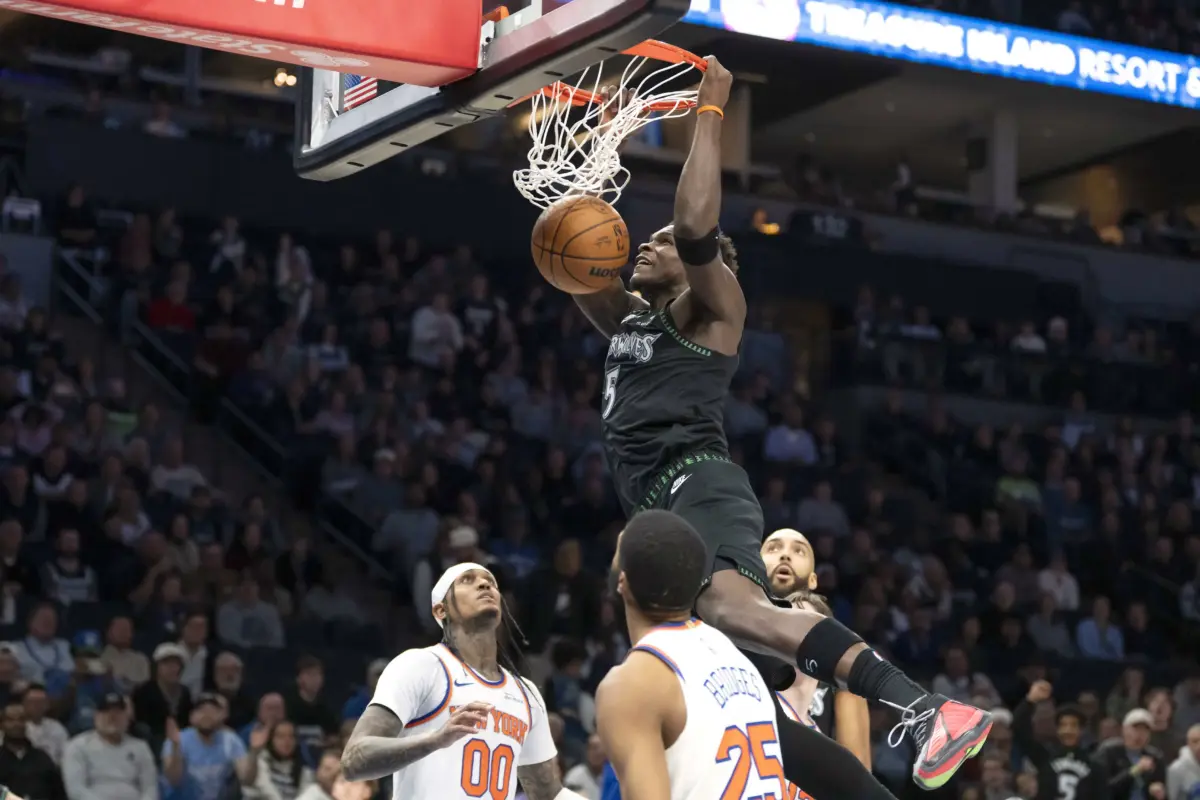
Minnesota is starting from a different place, but the pressure is just as real. Rudy Gobert showed the front office was willing to spend for a higher ceiling. That matters because Edwards is no longer a developmental project. He is the kind of player a franchise builds around before the window narrows, especially as the Wolves enter their most critical offseason.
The problem is that the Wolves have also learned how fragile balance can be. Jaden McDaniels helps because he fits into almost any lineup. Donte DiVincenzo helped for the same reason before the injury changed the backcourt picture. That loss mattered because it exposed how much creation the roster was still asking Edwards to cover.
That is why the Wolves cannot keep treating internal growth like a cleanup crew. A star of Edwards’ level creates urgency, whether the front office wants it or not. His recent frustration shows that waiting carries its own risks. Every month spent waiting for the perfect answer is another month the rest of the West gets stronger and more expensive to beat.
Fit Is the Real Currency
The New York Knicks offer a masterclass in roster construction, proving that organizational dysfunction isn’t a viable blueprint for success. However, when front-office ambition is paired with careful strategic planning, the resulting chemistry becomes the league’s most valuable asset. Ultimately, a bold acquisition only elevates a franchise if it provides a direct, practical solution to a glaring on-court need.
Minnesota should think in those terms. A useful trade would not just add name value. It would steady possessions, loosen defensive attention on Edwards, and reduce the number of possessions where the Wolves need him to create everything from nothing. More importantly, it would help the franchise choose its identity. That kind of change alters a playoff series in quiet ways first.
A strong roster move can also protect McDaniels from being pushed into a role that asks for too much creation. It can keep Gobert in his best lane instead of forcing him to cover for a missing guard. Those small adjustments matter because they keep the team from leaking value in the margins.
The Wrong Swing Is Still a Swing
The danger, of course, is confusing aggression with clarity. Minnesota does not need to chase the loudest available name just because the market is moving. The right move has to address spacing, ball-handling, and late-game organization simultaneously, or the cost starts eating into the benefit.
That is where the Knicks’ model deserves respect. New York did not succeed by collecting random upgrades. It succeeded because each addition strengthened the next one. Once the roster had the right balance, the stars could carry the right kind of burden rather than every burden.
Minnesota should copy that part and ignore the temptation to overreach for its own sake. A second-apron team can lock itself into a bad structure faster than most fans realize. The wrong trade does not just miss the moment. It can shorten the next two or three opportunities, too.
The Timberwolves’ Real Choice
So yes, the Timberwolves should use the Knicks as a guide, but only in the broadest sense. They should value trades and free agency as real tools, not backup plans. They should also remember that the Knicks’ success came from adding players who clarified the team’s identity instead of clouding it.
That is the standard Minnesota has to meet. Edwards already gives the franchise its star power. The front office now has to provide the structure around him, and it has to do so without pretending that patience alone will deliver a title. If the Wolves get that part right, the Knicks’ formula becomes a blueprint instead of a copy.
© Jesse Johnson-Imagn Images