
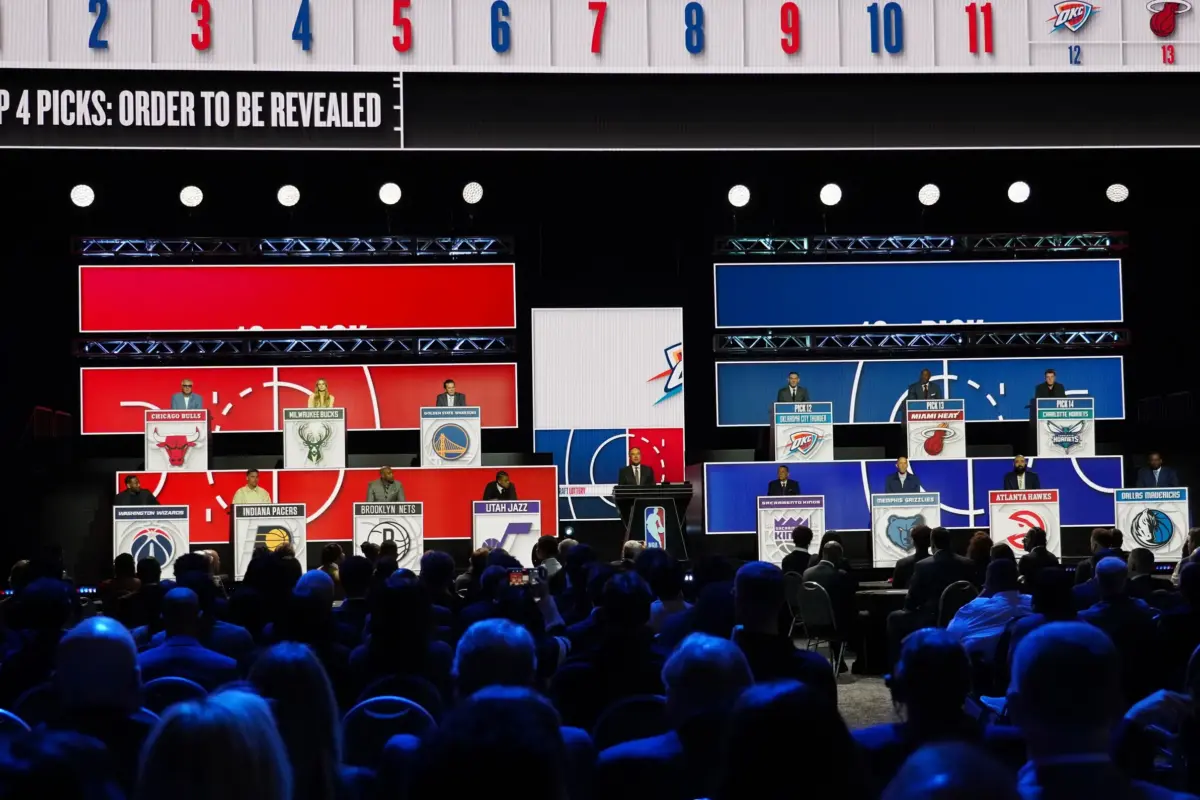

The Charlotte Hornets should trade picks 14 and 18 for a frontcourt reinforcement this summer, and the numbers make the case better than any argument could.
Charlotte enters the 2026 NBA Draft holding two first-round picks, and while the temptation to develop two young prospects is real, the history of those exact positions tells a sobering story. This is not a team in rebuild mode. This is a team that surged from an 11-22 record at the turn of the New Year to a play-in appearance, and the window is open right now. The question is whether GM Jeff Peterson uses these picks to gamble on the future or cashes them in for the present.
Hornets Should Trade Picks 14 and 18 for a Frontcourt Starter
Charlotte has been transparent about the need. Multiple league insiders have reported the franchise is monitoring trade-up scenarios, with NBA insider Evan Sidery noting the front office is actively exploring options to package picks 14 and 18 to land a high-impact interior presence. The conversation inside league circles centers on accelerating the rebuild, not extending it.
What the History of Picks 14 and 18 Actually Shows
Let’s start with the facts. Looking back at the last 15 years of picks 14 and 18, the pattern is clear and uncomfortable. Pick 14 has produced one All-Star — Bam Adebayo in 2017. Three starters. Seven rotation players. Three busts. That is a 20% chance of landing a legitimate starter and a 7% chance of finding an All-Star. The rest of the time, you get a player who fills minutes without filling needs.
| Recent History of the 14th Pick | Recent History of the 18th Pick | ||||
|---|---|---|---|---|---|
| 2025 | Carter Bryant | TBD | 2025 | Walter Clayton Jr | TBD |
| 2024 | Bub Carrington | Rotation | 2024 | Tristan Da Silva | Rotation |
| 2023 | Jordan Hawkins | Rotation | 2023 | Jaime Jaquez | Rotation |
| 2022 | Ochai Agbaji | Rotation | 2022 | Dalen Terry | Bust |
| 2021 | Moses Moody | Rotation | 2021 | Tre Mann | Rotation |
| 2020 | Aaron Nesmith | Starter | 2020 | Josh Green | Rotation |
| 2019 | Romeo Langford | Bust | 2019 | Goga Bitadze | Rotation |
| 2018 | Michael Porter Jr | Starter | 2018 | Lonnie Walker | Rotation |
| 2017 | Bam Adebayo | All-Star | 2017 | TJ Leaf | Bust |
| 2016 | Denzel Valentine | Bust | 2016 | Henry Ellenson | Bust |
| 2015 | Cam Payne | Rotation | 2015 | Sam Dekker | Bust |
| 2014 | TJ Warren | Starter | 2014 | Tyler Ennis | Bust |
| 2013 | Shabazz Muhammad | Bust | 2013 | Shane Larkin | Rotation |
| 2012 | John Henson | Rotation | 2012 | Terrance Jones | Bust |
| 2011 | Marcus Morris Sr | Rotation | 2011 | Chris Singleton | Bust |
| 14th Pick Outcomes | |||||
| Bust | Rotation | Starter | All-Star | ||
| 3 | 7 | 3 | 1 | ||
| 18th Pick Outcomes | |||||
| Bust | Rotation | Starter | All-Star | ||
| 7 | 7 | 0 | 0 | ||
Pick 18 is even starker. Zero All-Stars in the last 15 years. Zero starters. Seven rotation players. Seven busts. That is a 50% chance of the pick amounting to nothing meaningful and a 0% historical chance of landing a franchise-altering player. The best outcomes from pick 18 in recent years include Jaime Jaquez Jr., Josh Green and Goga Bitadze. They’re all solid rotation contributors, but none of them are frontcourt difference-makers who change a team’s identity.
The Hornets are not picking in these positions to find a rotation player. The roster already has LaMelo Ball, Kon Knueppel, Brandon Miller and Moussa Diabate — all of them 24 or younger and already meaningful contributors. The window for this team is not in three years. It is now. And picking 14th and 18th in a draft hoping to find the next Adebayo is a gamble the history of those positions says is unlikely to pay off.
The Frontcourt Problem is Urgent, Not Developmental
Every honest analysis of the Hornets this season arrives at the same conclusion: the frontcourt is the ceiling.
Diabate is an outstanding athlete and a Hustle Award winner, but at 210 pounds, he has been outmuscled in big moments all season. Ryan Kalkbrenner provides size and shot-blocking but is still developing. The result was a team that gave up too many easy interior baskets against physical opponents — a weakness that was fully exposed in the play-in exit against Orlando Magic.
This is not a problem a developmental pick at 14 solves in year one. Even the best-case scenario, landing a high-upside big like Morez Johnson Jr or Aday Mara, means waiting one to two seasons for that player to be ready for the physical demands of playoff basketball. The Hornets do not have that kind of time. Ball is 24, Knueppel is 20, and Miller is 23. Their championship window is opening, and waiting for a draft pick to grow into a frontcourt anchor is the kind of patience that costs teams their best years.
Why Trading Both Picks Makes Strategic Sense
Packaging picks 14 and 18 gives Peterson genuine leverage in trade conversations. Two mid-first-round picks in a loaded draft class are a valuable commodity, exactly the kind of asset that teams like the Milwaukee Bucks — who have the No. 10 pick — would seriously consider acquiring. Moving up to the top 10 in exchange for both picks could land Charlotte a player like Mara, a 7-foot-2 center from Michigan who averaged 12.1 points, 6.8 rebounds and 2.6 blocks on 66.8% shooting this season and has the size, passing ability and rim protection that Charlotte has been searching for.
Alternatively, both picks can be packaged in a trade for an established frontcourt starter. A veteran center who can contribute from day one is worth far more to Charlotte right now than two prospects at positions 14 and 18 who, historically speaking, are more likely to become rotation players than genuine starters.
The 2022 draft offers a cautionary tale. The Hornets held picks 13 and 15 that year, an even stronger position than they are in now. They selected Jalen Duren 13th and immediately traded him to Detroit, then took Mark Williams at 15. Williams never really developed into the answer they hoped for and was eventually moved. Two high picks, no lasting frontcourt solution. The lesson was never learned, and now Charlotte faces the same dilemma with the same temptation.
The Counter Argument and Why It Falls Short
The case for keeping the picks is not without merit. Peterson has said publicly he does not want to skip steps, and this draft class is genuinely deep enough that picks 14 and 18 could land two quality contributors. There is also a real argument that trading both picks leaves the bench dangerously thin. Charlotte already lacks depth, and stripping the roster of two incoming players without replacing that depth is a risk.
But here is the problem with that argument: depth is built through free agency and smart veteran deals, not through mid-first-round picks at positions that historically produce rotation players half the time and busts the other half. If Charlotte re-signs White, adds a frontcourt free agent, and uses the draft picks to trade up or out for a starter, they address every problem simultaneously.
The Case for Trading Both Picks
The numbers are clear. The argument for trading both picks is not about abandoning the future, it is about respecting the present.
Ball, Knueppel and Miller form one of the most exciting young cores in the Eastern Conference, and they deserve a frontcourt partner who can compete at the highest level today, not in 2028 or 2029.
Pick 18 has never produced an All-Star in the last 15 years. Pick 14 has done it once. Charlotte needs certainty, not probability. Trading both picks for a proven physical frontcourt starter — or packaging them to jump into the top 10 for a high-impact big — is the smartest move Peterson can make this summer.
The history of picks 14 and 18 makes the case. Charlotte’s play-in exit makes the case. The frontcourt weakness that has haunted this team all season makes the case. The only question left is whether Peterson is bold enough to act on what everyone can already see.
© David Banks-Imagn Images