
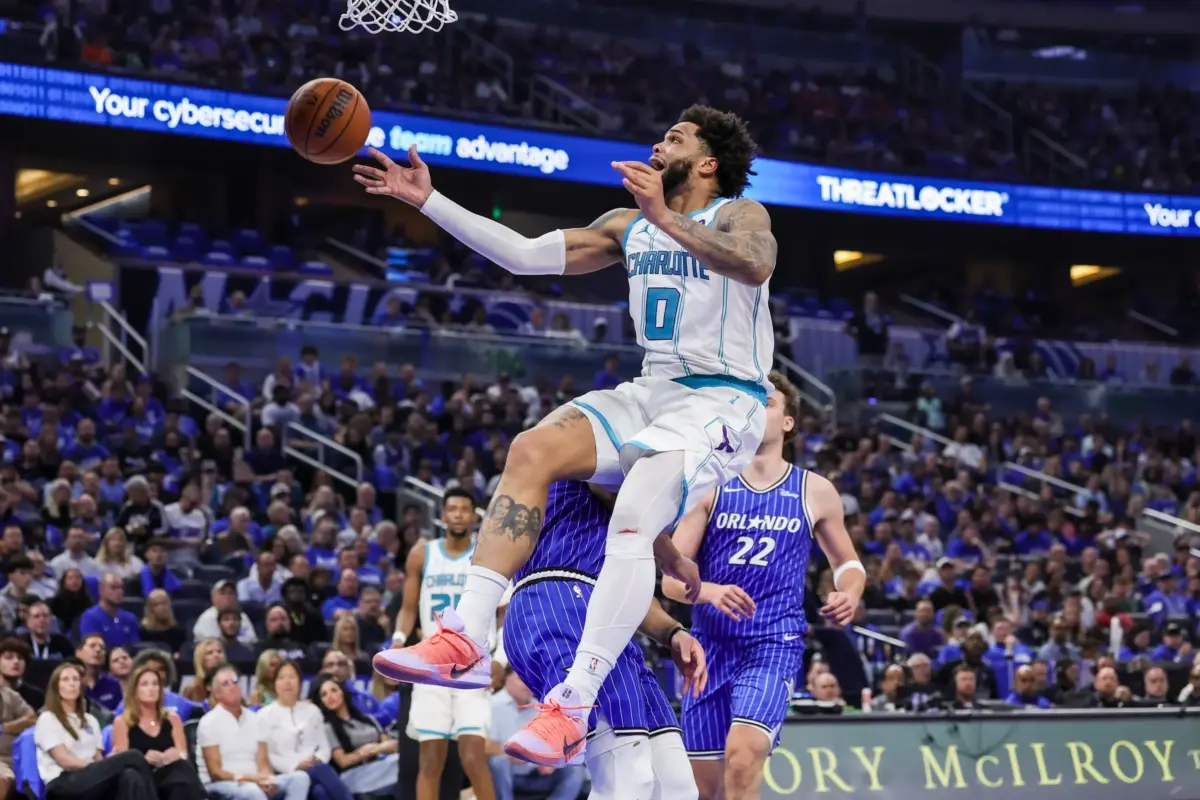

Should the Hornets trade Miles Bridges? It is one of the most debated questions heading into what could be Charlotte’s most consequential offseason in years.
Bridges has been a significant contributor to the Hornets’ remarkable turnaround — averaging 17.1 points, 5.8 rebounds and 3.2 assists this season. However, he is also the one Hornets starter that multiple teams are interested in acquiring.
Should the Hornets Trade Miles Bridges This Offseason?
With Charlotte’s offseason priorities already mapped out, the question of what to do with Bridges could shape everything else that follows.
Bridges is entering the final year of his three-year, $75 million deal, earning $22.8 million in 2026-27. He is 28 years old, still productive, and according to The Athletic’s Sam Amick, drew significant trade interest from the Bucks, Warriors and Suns at the February deadline. Charlotte held firm then, asking for one or two first-round picks. The question is whether they should retain that price or settle for a lower return.
What Bridges Brings and Why Teams Want Him
The appeal around Bridges is easy to understand. He is a strong, physical wing who can defend multiple positions, attack mismatches in the mid-range, and hit big shots when the game demands it. His performance in the Play-In Tournament against Miami showed the best version of what he offers.
At $22.8 million next season, he is attractively priced relative to his production. When you look at the Hornets’ starters, he is the only tradable starter on the roster and his salary makes him a useful piece in virtually any significant trade. If Charlotte wants to make a big move for a star player this offseason, Bridges is almost certainly the key piece that makes the money work.
The Case for Trading Bridges
The most compelling argument for moving Bridges is opportunity cost. Charlotte already has Kon Knueppel and Brandon Miller as established starters — both younger, cheaper, and on a higher ceiling trajectory. Bridges averaged 31 minutes per game this season in a firmly established starting role. However, if Charlotte acquires a more physical two-way forward who also solves their frontcourt issues, Bridges suddenly becomes expendable. His value is at its peak right now. Waiting risks the market softening as he enters his final contract year.
Charlotte’s asking price of one or two first-round picks is reasonable for a player of Bridges’ quality on an expiring contract. Those picks, combined with their existing draft capital, could be packaged for a frontcourt upgrade that addresses their most pressing roster weakness. Trading a good player to fix a great team’s biggest problem is smart asset management, not desperation.
The Case for Keeping Bridges
The counterargument starts with this: why fix what is not broken? Charlotte went from 11-22 at the turn of the New Year to a play-in appearance, and Bridges was part of that turnaround. Removing him from a team that is still building chemistry and continuity carries real risk, particularly if the return does not immediately fill the gap he leaves.
There is also the depth argument. Charlotte’s bench was relatively thin this season. Bridges provided starter-level production that gave the coaching staff genuine flexibility in lineups and matchups. He was also one of the few forwards on the roster capable of creating his own shot late in possessions when Charlotte’s offense stalled, particularly against physical defenses.
Without him, head coach Charles Lee has fewer options, and that matters in a long, physical NBA season. Unless the trade brings back a player of similar or greater impact, the Hornets could find themselves weaker overall despite improving in one specific area.
Furthermore, Bridges is in the final year of his deal, which actually means Charlotte can let it play out without any long-term commitment. If they run it back next season and the team takes another step forward with him in the lineup, his trade value in January 2027 could be just as high, and Charlotte would have another year of evidence before making such a significant decision.
What Could Charlotte Realistically Get?
The February interest from Milwaukee, Golden State and Phoenix gives Charlotte a clear sense of the market. The Bucks were the most active suitor, but the sticking point was Charlotte’s reluctance to take Kyle Kuzma’s $22.5 million salary. Golden State’s interest reportedly centered around Jonathan Kuminga, whose $22.5 million salary closely matches Bridges’ cap hit. A deal centered on Bridges plus draft compensation for a proven frontcourt upgrade remains the most logical path if GM Jeff Peterson decides to move him.
The realistic return is a young rotation player along with the desired draft compensation. That is a meaningful haul and one that gives Peterson additional help to address the interior defense problem that held Charlotte back this season. Whether that is worth disrupting a team that just had a breakthrough season is the question only Peterson can fully answer.
The Last Word
The honest answer depends entirely on the return. At the right price — a first-round pick and a player who directly addresses Charlotte’s frontcourt weakness — a trade makes sense. Bridges is a good player on a team that is becoming great, and his value will never be higher than it is right now. Once he plays out this final contract year, Charlotte loses all of its leverage.
But if the return is a pick and an expiring contract that does nothing to solve the interior problem, Charlotte should stand pat, let Bridges play out his final year, and make the decision at the 2027 trade deadline with a full season of context.
Should the Hornets trade Miles Bridges? Yes, but only if the price is right. And Jeff Peterson has shown he is patient enough to wait for exactly that. The Giannis Antetokounmpo situation and the broader offseason picture will ultimately determine whether Bridges becomes the key piece in Charlotte’s next big move or the veteran anchor of a team making another run at the top six.
© Mike Watters-Imagn Images