

Every year, the NCAA men’s college basketball tournament produces at least one geographical storyline worth talking about. A team placed far from home. A travel schedule that creates an uneven playing field. A program slotted into a region raises questions about competitive balance. The selection committee follows a defined process. However, the results do not always appear straightforward. This year, one of the more notable bracket quirks has nothing to do with talent or seedings. Instead, it has everything to do with location.
Miami Hurricanes Lose NCAA Tournament Home Court Advantage to the Mizzou Tigers
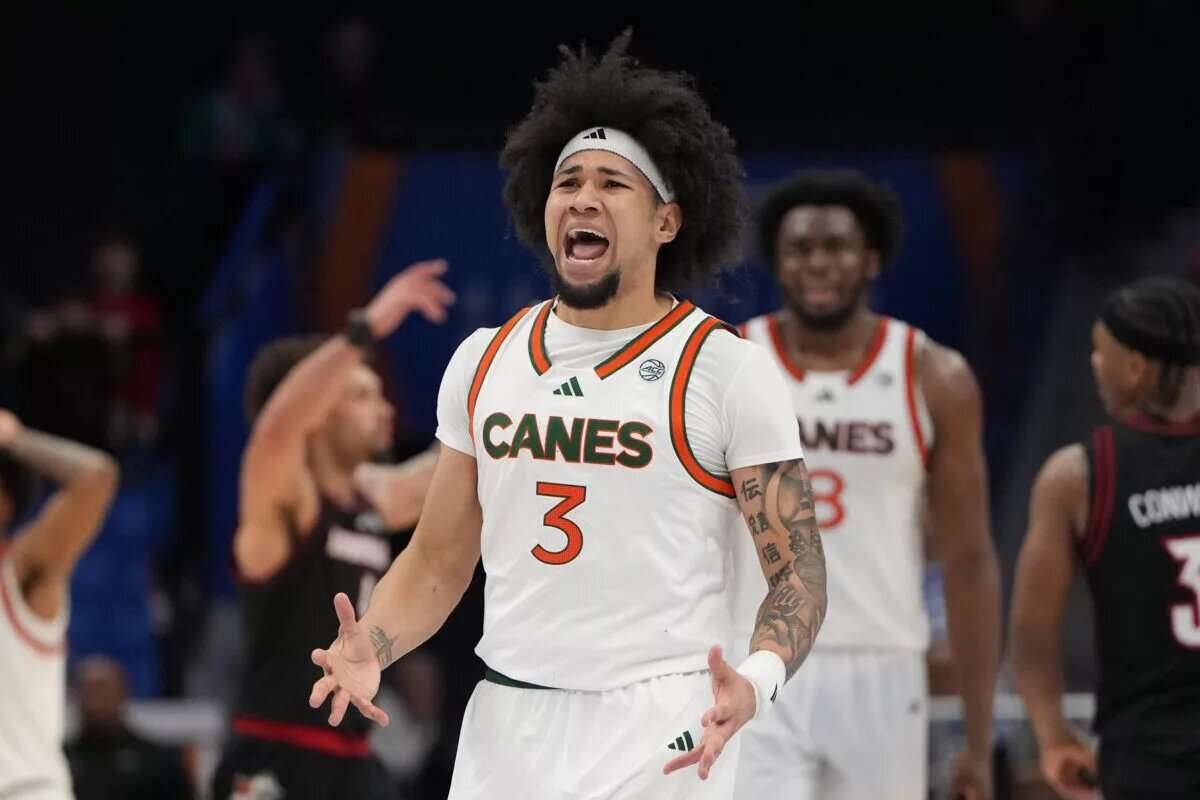
St. Louis will host the No. 10-seeded Missouri Tigers (20-12) on Friday for their first-round March Madness matchup. Their Columbia, Mo. campus sits just roughly 100 miles down the road. Their opponent, the No. 7-seeded Miami Hurricanes (25-8), faces a very different trip. To be specific, they will travel more than 1,200 miles north from South Florida. As a result, the building figures to be filled with Missouri fans.
The higher seed faces the longer trip. Meanwhile, the lower seed plays close to home. Geography has created an uneven dynamic.
Moreover, the bracket does not reflect this on paper. The NCAA Tournament home court designation may not officially exist. Nevertheless, the distance between each team and St. Louis tells a story the seedings do not. Consequently, Friday night’s atmosphere inside the Enterprise Center will make that reality impossible to ignore.
The Higher Seed, The Longer Trip: Miami Earned More Than This
Miami earned a No. 7 seed through a legitimate body of work. Hurricanes head coach Jai Lucas has built something real in his first season. His team is balanced, well-coached, and capable of making a deep tournament run. On a genuinely neutral floor, the Hurricanes would be rightful favorites to advance. Instead, the bracket handed them a first-round environment that is anything but fair.
Missouri will walk into the Enterprise Center to something resembling a home atmosphere. Fans can easily make a casual day trip out of a first-round NCAA Tournament game. Therefore, the Tigers will bring their crowd with them. The building will be loud, gold and black, and firmly against the Hurricanes from tip-off.
This is not a knock on Missouri. The Tigers earned their spot in the tournament as well. They also earned their placement in St. Louis. Context matters, though. Miami holds the better seed and the stronger body of work. Furthermore, the Hurricanes find themselves facing the most difficult possible version of a game that the NCAA Tournament bracket already favors them to win.
Missouri’s NCAA Tournament Home Court Advantage
Favorable circumstances have completely aligned for Missouri. This happened not because of anything they did, but simply because of geography.
As the No. 10 seed, the tournament identifies Missouri as the weaker team. They did not earn a more favorable bracket position. They did not post a better record. Additionally, they did not carry a stronger body of work into Friday night. Yet, they get to play in front of thousands of their own fans who’ll make a short drive down the interstate to pack the building.
For Miami, the contrast is striking. By every measurable standard, the Hurricanes outperformed Missouri this season. After earning the better seed, they now face something genuinely difficult. Essentially, they must go on the road against a team the bracket itself identifies as inferior. The NCAA Tournament labels the Enterprise Center a neutral site. In practice, however, it functions as anything but.
The Invisible Disadvantage Miami Has to Overcome
None of this is insurmountable for Miami. The gap between a No. 7 and a No. 10 seed is real. Regardless of the crowd, the Hurricanes have the talent and coaching to compete. Moreover, Lucas’s team does not fold under pressure.
Hostile environments, however, present unique challenges. As players know, a building rooting against you makes every possession heavier. That pressure is difficult to simulate in practice. The tournament already delivers the loudest atmosphere most of these athletes have ever experienced, especially for the ones who have never stood on an NCAA Tournament floor.
Why Crowd Energy Changes Everything
Crowd energy is not a minor variable in close college basketball games. It affects officiating rhythm. It also rattles opposing shooters at the free-throw line. It can turn a four-point Missouri run into an eight-point momentum swing. The building amplifies every mistake and magnifies every mistake.
Tigers head coach Dennis Gates knows exactly how to channel that energy. He coaches with intensity and recruits players wired for big moments. He has also consistently extracted maximum effort from his roster under pressure. Therefore, giving him a near-home crowd in the first round hands him one of the most potent advantages in the sport. Notably, no amount of film study can prepare a team for that reality.
The Margin for Error Is Razor Thin
Miami must be locked in from the opening tip. There is no easing into this one. There is also no settling in after a slow start. With the crowd roaring, every possession will feel heavy from the very first minute.
A slow start gives the building life. Moreover, an early Missouri run does more than put points on the board. It galvanizes an already motivated crowd. It also puts the Hurricanes in a hole they cannot afford. Climbing out with an entire arena working against you is far harder than doing it in a quiet gym; the noise compounds the deficit significantly.
Miami has the talent to win. Their coaching staff has also prepared them well. However, preparation and execution under live fire are two very different things. Ultimately, the Hurricanes must be sharp enough to avoid finding out just how thin that margin really is.
The Bracket’s Unspoken Truth
The gap between what the bracket says and what Friday night delivers is worth examining. On paper, Miami is the clear favorite. They have the better record and the stronger body of work. In reality, however, they must win what amounts to a road game. Notably, the tournament officially refuses to call it one.
The NCAA Tournament always uses the language of neutral sites. Technically, the rulebook supports that framing. However, college basketball does not exist in a vacuum. Location shapes outcomes. Similarly, crowds shape momentum. A No. 10 seed playing close to home in front of thousands of their own fans is simply not on a neutral floor in any meaningful sense.
The Hurricanes have the roster, the coaching and the body of work to reach the second round. Nevertheless, one obstacle stands between them and that outcome. Though objectively unfair, their first game will be played on someone else’s court, and it’ll take an extraordinary effort to win there.
© Bob Donnan-Imagn Images