
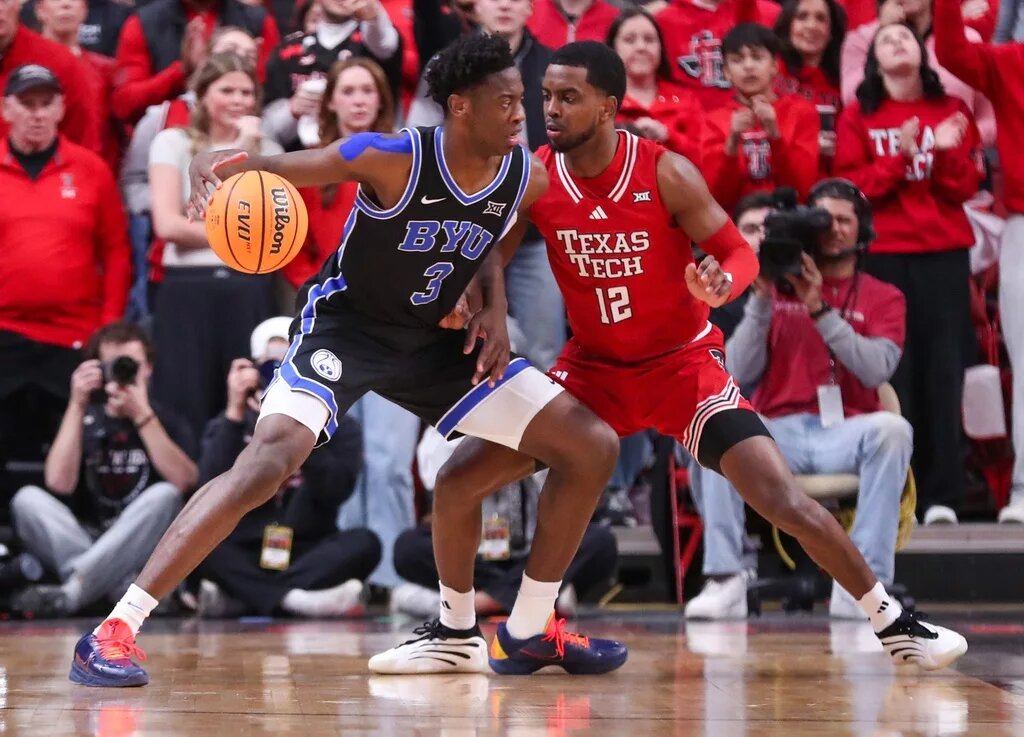

Saturday evening on the college hardwood and we have a Big 12 contest loaded up and ready to roll. The Texas Tech Red Raiders will travel to Provo, Utah, to battle it out with the BYU Cougars. The Red Raiders are currently in third place in the Big 12 conference with a 12-5 mark, while going 22-8 overall. The BYU Cougars have struggled of late, and are now just 8-10 in league play, but they are 20-10 overall. Continue reading to see my Texas Tech vs BYU prediction.
Texas Tech vs BYU: Prediction, Preview, Odds
Odds: BYU -1.5; Over/Under 159.5
Texas Tech Red Raiders
Texas Tech enters this matchup at 22-8 overall and 12-5 in Big 12 play, pushing for strong postseason positioning. The Red Raiders average 79.7 points in conference play and shoot 47.2%, ranking among the league’s most efficient offenses. Their perimeter shooting is elite, hitting 40.9% from three and making 12.1 threes per game, both first in the Big 12. With JT Toppin out, the scoring load shifts to Christian Anderson, who averages 19.1 points and 7.7 assists. Donovan Atwell adds 13.3 points and reliable perimeter shooting, while LeJuan Watts provides physicality and interior scoring. Tech’s ball movement remains strong, with 16.5 assists per game, and their spacing forces defenses into difficult rotations.
Defensively, Texas Tech has been one of the most disciplined teams in the conference. They allow only 71.5 points in Big 12 play and hold opponents to 42.7% shooting, ranking near the top of the league. Opponents hit just 31.1% from three, showing Tech’s strong closeouts and perimeter discipline. Watts anchors the paint with physicality, while Anderson and Jaylen Petty pressure the ball and disrupt rhythm. Luke Bamgboye adds length and rim protection off the bench. Tech also limits second‑chance points by controlling the defensive glass and forcing opponents into long possessions. Their ability to defend without fouling and stay connected on switches makes them difficult to attack.
For Texas Tech to win, they must lean on their elite shooting and disciplined defensive structure. Anderson must control tempo and generate clean looks early, especially with Toppin unavailable. Atwell needs to hit perimeter shots to stretch BYU’s defense. Watts must win the rebounding battle and protect the rim. Tech must also limit BYU’s interior scoring and keep the Cougars off the offensive glass. Their spacing can challenge BYU’s rotations, especially if the shooters find rhythm from deep. Ball security is critical, as BYU thrives on transition scoring. If Tech maintains defensive intensity, avoids foul trouble, and forces BYU into a half‑court game, they can dictate pace and take control late.
BYU Cougars
BYU enters this matchup at 20-10 overall and 8-9 in Big 12 play, fighting to strengthen their postseason résumé. The Cougars average 82.1 points in conference games and shoot 46%, with strong interior efficiency at 54.1% on twos. AJ Dybantsa leads the team with 24.8 points, 6.7 rebounds, and elite shot‑creation ability. Robert Wright adds 18.4 points and 4.7 assists, giving BYU a dynamic backcourt presence. Richie Saunders provides 18.0 points and strong rebounding from the wing. BYU hits 8.4 threes per game, and their spacing allows them to attack mismatches. They also get to the line consistently, averaging 16.2 free‑throw makes per game. Their offensive versatility makes them dangerous in long stretches.
Defensively, BYU has been inconsistent throughout Big 12 play. They allow 82.8 points and give up 47.1% shooting, which puts pressure on their offense to stay efficient. Opponents hit 37.2% from three, so BYU must tighten its perimeter defense against Texas Tech’s elite shooters. Keba Keita must protect the paint and rebound at a high level, while Wright and Saunders must stay disciplined on closeouts. Kennard Davis adds length and defensive versatility on the perimeter. BYU rebounds well at 34.3 boards, but they must finish possessions cleanly to avoid Tech’s kick‑out threes. Their defensive communication and rotations must improve to slow Tech’s spacing and ball movement.
For BYU to win, they must control tempo and avoid turning this into a pure shooting contest. Dybantsa must establish himself early and create pressure at the rim. Wright needs to push pace selectively and generate efficient looks early in possessions. Saunders’ scoring is critical, especially if Tech’s defense forces BYU into late‑clock situations. BYU must rebound well and limit Tech’s second‑chance threes. Ball security is essential, as the Red Raiders thrive on turnovers and transition scoring. If BYU defends the arc, attacks the paint, and keeps the game physical, they can stay competitive deep into the second half and give themselves a chance late.
Prediction
BYU enters this matchup with the stronger late‑season momentum and the more reliable top‑end scoring options, which gives them an edge at home. Dybantsa and Wright form one of the most explosive duos in the Big 12, and their ability to create efficient shots in the half court should matter in a game with slower stretches. Texas Tech will compete, but the loss of Toppin removes their best interior scorer and rebounder, forcing Anderson and Atwell to shoulder more of the offensive load. BYU’s length on the perimeter and improved defensive rotations at home should help them limit Tech’s three‑point volume. With both teams playing meaningful basketball in March, possessions should slow, and each side will value shot quality. That style favors BYU’s creators and supports a lower‑scoring game.
Texas Tech’s offense has been efficient in conference play, but their rhythm depends heavily on spacing and perimeter accuracy. Without Toppin, they lose a key interior threat who forces defensive help, and that makes their shooters easier to track. BYU’s defense has been inconsistent, but they match up well here because they can switch more actions and stay attached to shooters. Dybantsa’s length and Saunders’ physicality should help BYU contest Tech’s wings and limit clean catch‑and‑shoot looks. On the other end, Wright’s ability to control tempo reduces the risk of a fast, high‑possession game. BYU’s offense will still produce, but Tech’s defense is strong enough to prevent extended scoring runs. The matchup leans toward a controlled pace, especially in the final eight minutes.
The most likely script features BYU winning a tight, possession‑heavy game where both defenses dictate stretches. BYU should generate enough half‑court scoring through Dybantsa’s isolation ability and Wright’s playmaking to stay in front, while Tech’s offense may struggle to maintain efficiency without Toppin’s interior presence. Expect long possessions, deliberate sets, and fewer transition chances than usual. Both teams defend the arc well, and neither side profiles as a group that will push tempo for 40 minutes. BYU’s late‑game execution and home‑court edge make BYU -1.5 the stronger side, while the defensive matchups and pace expectations support Under 159.5. This projects as a competitive Big 12 game that stays inside the half‑court and finishes below the posted total.
BYU -1.5 & Under 159.5
© Nathan Giese/Avalanche-Journal / USA TODAY NETWORK via Imagn Images