
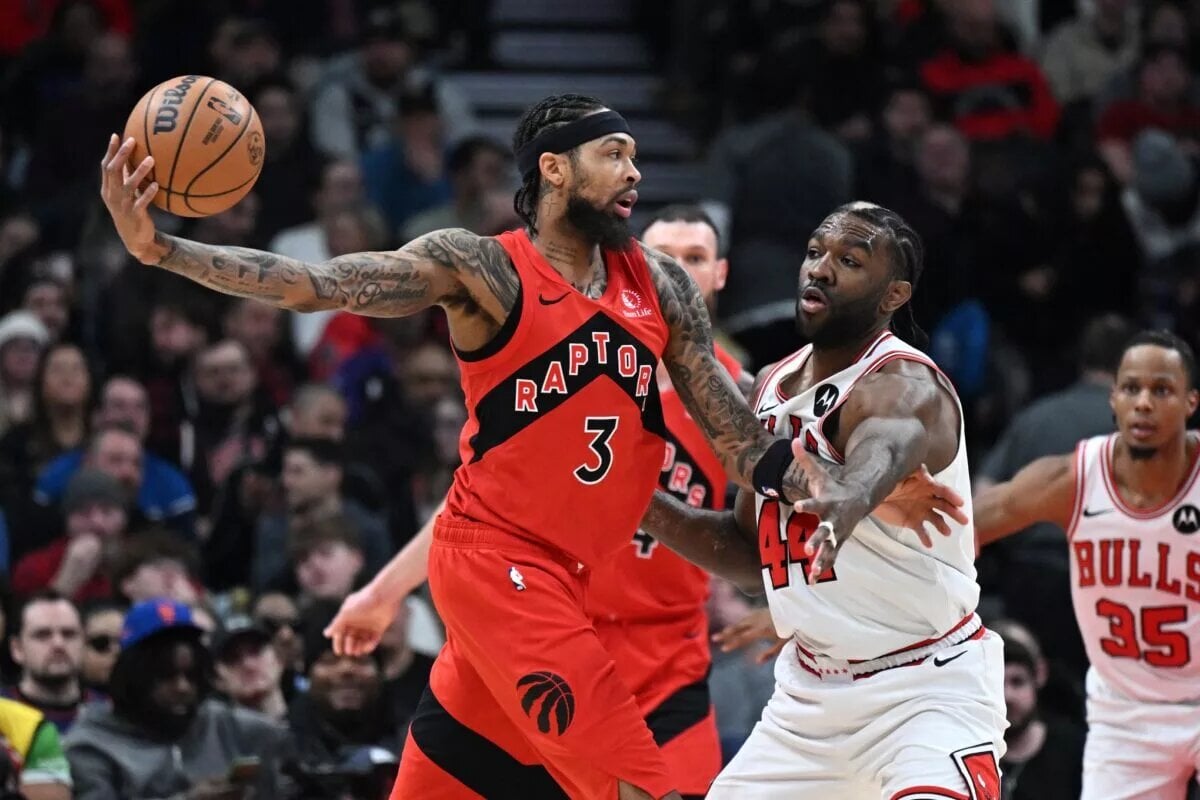

The Toronto Raptors entered the season as one of the most intriguing teams in the league. Following a major roster reshaping at last year’s trade deadline, expectations were centered on how the newly assembled core would perform once fully healthy and integrated.
One of the biggest storylines was the acquisition of Brandon Ingram, who was unable to log minutes with the team after the trade. Heading into this season, there was significant curiosity surrounding how Ingram would fit alongside Scottie Barnes and how the offense would evolve with another high-level scorer in the lineup.
Over the past few seasons, the Raptors have fully committed to a rebuilding phase after dismantling the remnants of the championship core. The front office shifted its focus towards younger talent, bringing in players such as Immanuel Quickley and RJ Barrett while clearly positioning Barnes as the franchise centerpiece. As the All-Star break approaches, the first half of the season has begun to reveal what this new version of the Raptors truly looks like and what questions still remain unanswered.
What We’ve Learned From the Raptors Before the All-Star Break
Scottie Barnes’ Growth as a Franchise Cornerstone
One of the clearest takeaways from the first half of the season has been Scottie Barnes’ continued evolution. Barnes embraced a larger offensive role while remaining impactful defensively. His ability to create for others, attack mismatches, and lead emotionally has solidified his status as the franchise cornerstone.
The Raptors’ best performances have almost always coincided with Barnes controlling the flow of the game. His growth has also been reflected in his improved decision-making under pressure, particularly in late-game situations. When Barnes is off the floor, the Raptors have often struggled to maintain the same level of offensive organization.
Barnes’ defensive versatility has also remained a defining trait of his game. He continues to guard multiple positions while anchoring the Raptors’ defensive schemes. That flexibility allows Toronto to experiment with different lineups without sacrificing defensive stability.
Brandon Ingram’s Offensive Impact
Another major storyline heading into the season was Brandon Ingram’s long-awaited debut with the Raptors. After being acquired at last year’s trade deadline but never seeing the floor, Ingram’s integration into the offense has been closely monitored.
His ability to create his own shot and provide consistent half-court scoring has added a new dimension to Toronto’s offense. Ingram’s presence has helped relieve offensive pressure, allowing the Raptors to diversify their offensive approach rather than relying on a single offensive creator in Barnes. Additionally, the defensive attention Ingram commands has opened cleaner looks for teammates, improving overall shot quality.
While the team continues to refine its offensive production, Ingram’s role has quickly become a central piece in shaping Toronto’s offensive identity.
RJ Barrett’s Importance to the Raptors’ Offense
RJ Barrett’s impact has also been evident when he has been unavailable due to injuries. During those stretches, the Raptors have noticeably struggled to generate consistent offense, particularly in transition and on the wing. Barrett’s ability to attack downhill, apply rim pressure, and play through contact provides a different offensive dynamic that the roster lacks when he is sidelined.
Without him, Toronto has often relied more heavily on half-court creation, exposing limitations in spacing and shot creation. His absence has highlighted not only his importance as a scorer, but also his role in maintaining offensive balance and physicality on the perimeter.
The Role of the Bench
An additional key area to examine before the All-Star break has been the impact of the Raptors’ bench. Players such as Jamal Shead and Ja‘Kobe Walter have played important roles with the second unit, providing energy, on-ball pressure, and a more aggressive defensive presence. Walter, in particular, has shown flashes as a capable perimeter defender, while Shead’s ability to push the pace and disrupt opposing ball handlers has helped stabilize bench lineups.
Gradey Dick has also remained part of the rotation, though his offensive production has come with noticeable struggles, especially in terms of consistency. Rookie Collin Murray-Boyles has added physicality off the bench, contributing on the glass and with interior defense. Overall, while scoring has been uneven, the bench’s effort and versatility have been key factors in keeping the Raptors competitive.
Consistency has been one of the main themes throughout the first half of the season. Strong performances have often been followed by uneven stretches. That pattern reflects a roster still learning how to close games and sustain execution across four quarters.
Defensive effort has remained a consistent priority for the Raptors. The team continues to rely on collective activity rather than individual rim protection. That approach reflects both roster limitations and a developing defensive identity.
Coaching decisions have also shaped the Raptors’ identity. The staff has emphasized ball movement and defensive effort. Players have responded with strong energy in competitive stretches. Execution, however, still fluctuates from game to game.
The Raptors rely heavily on pace to generate offense. Guards push the ball quickly after stops. Wings attack early mismatches. The offense flows best in transition. Half-court execution still requires growth. Defensive effort sets the tone most nights.
Looking Ahead After the All-Star Break
Lineup experimentation has also played a role in the team’s uneven results. Injuries and rotation changes have forced frequent adjustments. Those shifts have tested chemistry and on-court continuity.
As the All-Star break arrives, the Raptors have gained valuable clarity about both their strengths and limitations. With Scottie Barnes firmly established as the franchise centerpiece and Brandon Ingram providing much-needed offensive stability, the foundation of the roster is becoming more defined. At the same time, questions regarding roster balance, frontcourt depth, and long-term development remain.
The second half of the season will be focused on evaluating trade adjustments, player growth, and sustainability. How effectively the Raptors address those areas will ultimately determine the direction of the franchise moving forward.
© Dan Hamilton-Imagn Images