
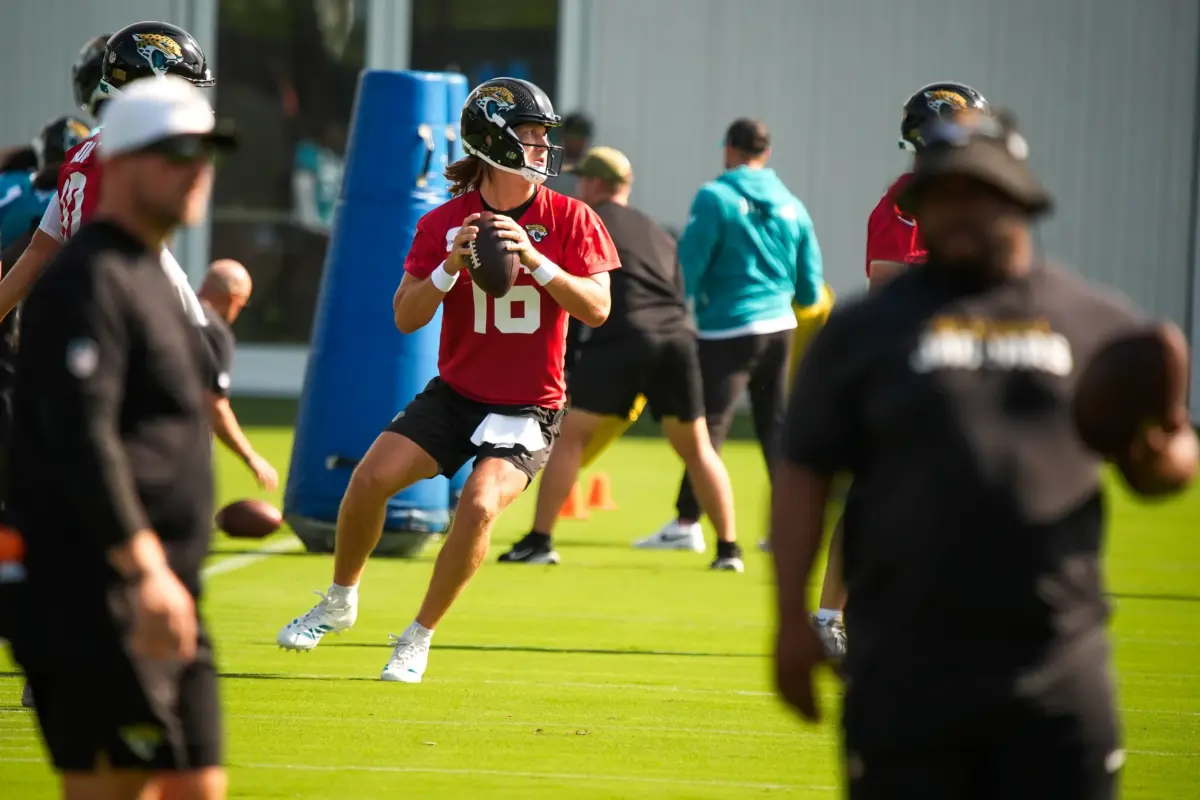

Trevor Lawrence has reached the point in his career where potential is no longer the first thing people mention.
There has always been a reasonable explanation for the uneven play. He entered the league following arguably the messiest rookie year any top draft pick has had. He weathered coaching changes, picked up several different offenses, and navigated injuries. Each year has offered another reason to think the true Lawrence was right around the bend.
Now, it is not as easy to have so many justifications for the inconsistency.
Lawrence’s Big Contract Demands Results
The Jaguars have already made their decision. In June of 2024, Lawrence signed a five-year, $275 million extension that includes $200 million in guarantees and keeps him under contract through the 2030 season. Teams don’t commit that kind of money because they hope a quarterback eventually becomes elite. They do it because they believe he already is, or soon will be.
That’s what makes 2026 such an important season.
Lawrence has produced enough to remind everyone why he was considered a generational prospect. Through five NFL seasons, he has thrown for 17,822 yards and 98 touchdowns while earning a Pro Bowl selection. At times, he’s looked every bit like the quarterback Jacksonville envisioned when it selected him first overall in 2021.
The problem is not that he has shown greatness in flashes.
It’s that they still come in flashes.
One month, Lawrence looks capable of carrying the offense by himself. Then, the Jaguars’ offense never really gets into gear, and the questions start. People aren’t asking after five years whether he can be an electrifying player. They’re wondering why the spectacular hasn’t become routine.
Lawrence’s Playoff History is Better Than Many Young Quarterbacks
His playoff résumé tells a similar story.
Lawrence authored one of the greatest comebacks in postseason history when Jacksonville erased a 27-point deficit against the Chargers after he threw four first-half interceptions. It remains one of the defining moments of his career. Outside of that game, however, postseason success has been harder to find. In three playoff appearances, Lawrence has completed just over 60 percent of his passes for 712 yards with eight touchdowns, seven interceptions, and a 75.8 passer rating.
None of that means the Jaguars should be thinking about another quarterback. Quite the opposite. Financially, that conversation isn’t realistic.
Lawrence’s extension makes moving on after one disappointing season almost impossible. His contract was designed around Jacksonville building with him, not searching for his replacement. The organization has too much invested, both financially and organizationally, to panic after 2026.
But that doesn’t mean nothing changes if he struggles. If Lawrence doesn’t take the step everyone expects, the pressure simply moves elsewhere. Questions about the coaching staff will be more frequent. Roster construction comes under the microscope. The front office starts looking for different ways to maximize a quarterback it has already committed to.
Eventually, though, those conversations circle back to Lawrence.
How Quarterbacks Are Judged in the NFL
Quarterbacks drafted first overall don’t get judged forever on traits or upside. At some point, they get judged against the league’s best. That’s the company Lawrence entered when Jacksonville made him one of the NFL’s highest-paid players.
Fair or unfair, the expectations changed the day he signed that extension.
That’s why 2026 feels like more than just another season.
If Lawrence puts together the kind of year many people have been waiting for, this entire discussion disappears. His contract becomes a bargain for a franchise quarterback entering his prime, and Jacksonville can focus on chasing championships instead of answering questions.
If he doesn’t, the Jaguars probably won’t move on. They almost certainly can’t.
What they will do is enter another offseason asking the same question they’ve been trying to answer for several years now: when does potential finally become production? By the end of 2026, Jacksonville needs that answer to be “right now.” Otherwise, a conversation that once seemed impossible will only become harder to avoid.