
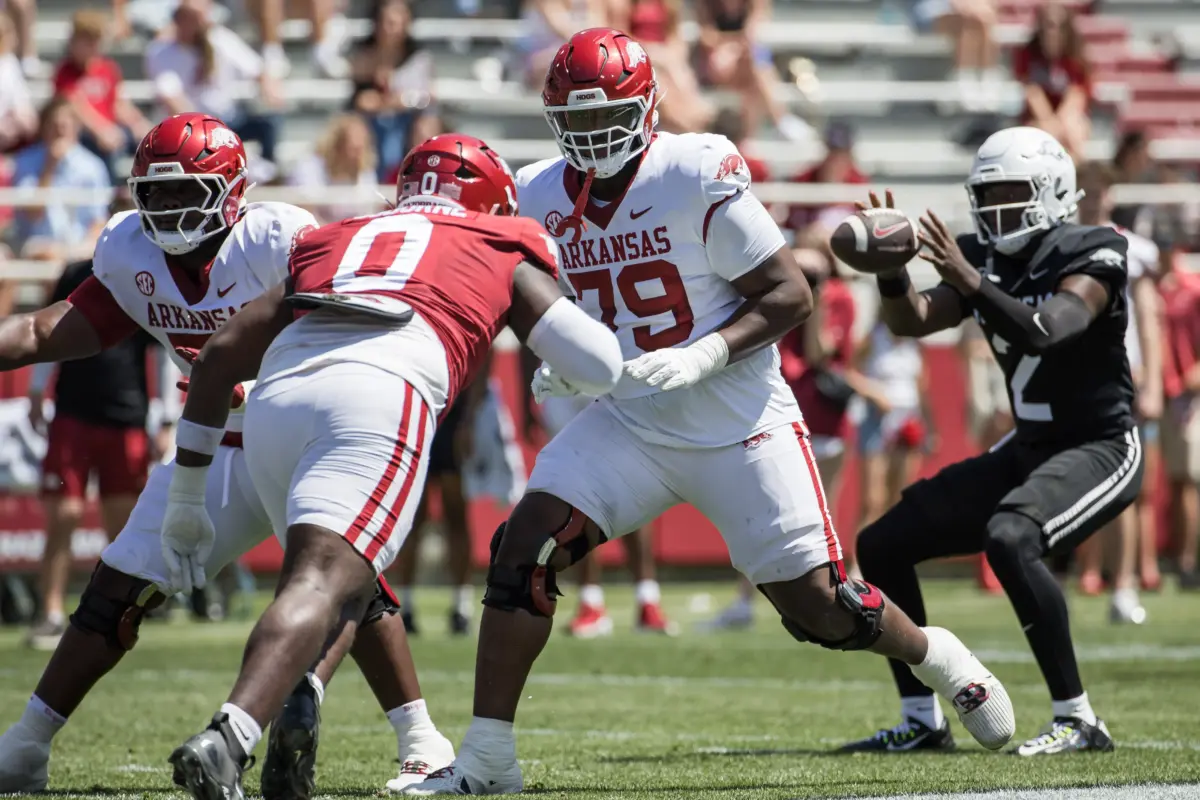

In the American Conference, Tim Cramsey’s offense was a problem for opposing defenses. Memphis was fast, flexible, and dangerous under his direction, able to score in bunches and adjust to whatever personnel it had at quarterback and running back. Now Cramsey is bringing that system to Arkansas, where the stakes are higher, the defensive fronts are nastier, and the margin for error is much smaller. The bet is simple: that his scheme can protect the Razorbacks’ quarterbacks and give a still-developing roster a fighting chance every Saturday.
Tim Cramsey vs. the SEC
Can Arkansas’ New Offense Protect Its Quarterbacks?
With Ryan Silverfield, while at Memphis, Cramsey leaned into tempo, spread formations, and a mix of RPOs and play-action to put stress on defenses. His units were rarely predictable, and they often found ways to get the ball to playmakers in space without needing dominant offensive line play on every snap. That is exactly the kind of approach Arkansas needs right now. This is not a team that can line up and bully the entire SEC. It needs an offense that helps manufacture easier throws, lighter boxes, and manageable third downs.
Fitting the Scheme to the 2026 Personnel
The first question for Arkansas fans is how Cramsey’s philosophy fits the 2026 roster. At quarterback, there is a clear focal point in KJ Jackson, a big-bodied passer with arm strength and some mobility, backed by options like AJ Hill, Braeden Fuller, Cade Trotter, and Hank Hendrix. Jackson does not have to be a superstar, but he has to function inside a structure that asks him to make the right read quickly and avoid the kinds of negative plays that killed drives last season.
Cramsey’s history suggests he can build that structure. Expect plenty of quick-game throws, defined reads off RPO looks, and movement in the pocket to keep defenses from teeing off. This is where the offensive line’s limitations can be mitigated. If the ball is out faster, if the defense has to respect the run game and horizontal stretches, it becomes harder for those SEC edge rushers to ruin the night.
In the backfield, the combination of Braylen Russell and TJ Hodges gives Cramsey two different styles to work with—power and burst. The run game does not need to be dominant, but it does need to be respected. A steady diet of efficient runs and safe throws can keep Arkansas out of third-and-long, which is where this offense would be most vulnerable.
On the perimeter, receivers like CJ Brown, Courtney Crutchfield, and Antonio Jordan offer a mix of experience, athletic upside, and size. Cramsey’s job is to turn that group into a set of defined roles: a chain mover, a vertical threat, a red-zone mismatch. If he can do that, the quarterback’s job gets simpler: find the matchup, trust the read, and let the scheme do some of the heavy lifting.
The Protection Question
All of this comes back to one core issue: protection. The SEC will expose any offense that cannot protect its quarterback, scheme or no scheme. Cramsey can help with design—quick rhythm, screens, RPOs, moving pockets—but there will still be drop-backs where linemen have to win their blocks. The Arkansas offensive line does not need to suddenly be the best in the league, but it does need to be functional enough that Cramsey’s concepts can breathe.
That is part of why this hire is so interesting. Instead of bringing in a coordinator known for slow, methodical power football, Silverfield chose someone who wants to play on the front foot. There is risk in that—aggressive offenses can lead to quick three-and-outs if execution is poor—but there is also clear upside. For a team trying to close a talent gap, being tactically sharp is not a luxury. It is a necessity.
Success for Cramsey in 2026 will not be measured solely in points per game. It will be measured by whether Arkansas looks like an offense with a plan. Are there defined answers against pressure? Are the quarterbacks better protected statistically and physically? Are the Razorbacks more efficient in the red zone and on third down? If the answers are yes, the offense will have done its job—even if the overall record is still a work in progress.
Cramsey has proven his system works at a high level outside the SEC. This season will tell whether it can work against the deepest defensive fronts in college football and whether it can give Arkansas’ quarterbacks a chance to develop instead of just survive.
Main Image: Brett Rojo-Imagn Images