
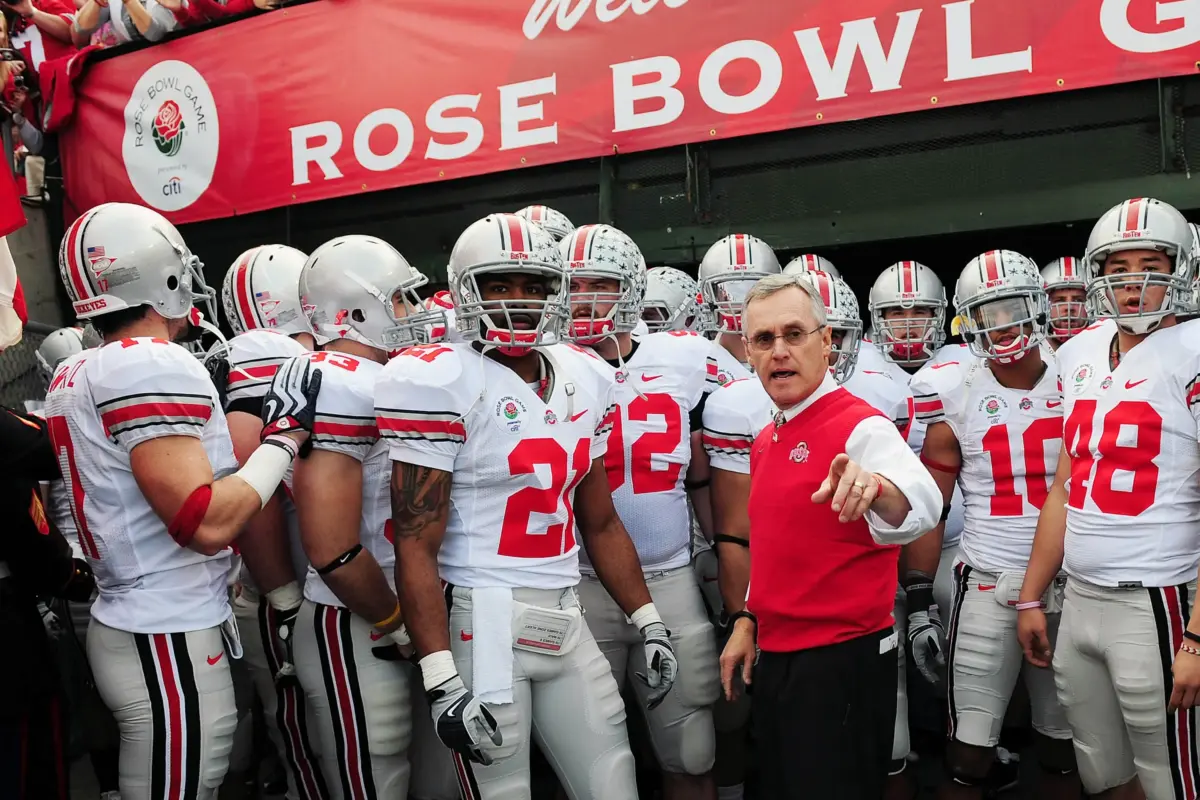

On Tuesday, Ohio State officially announced that, for the first time since 2014, it would be adding a name to the prestigious Ring of Honor at Ohio Stadium. Joining program coaching legends Paul Brown and Woody Hayes, Jim Tressel is to be enshrined on September 5 when the Buckeyes open the season at home against Ball State.
When his name is finally installed, he will join Brown and Hayes as the only coaches. In addition, the program’s six Heisman Trophy winners are honored in Troy Smith, Les Horvath, Eddie George, Vic Janowicz, Howard “Hopalong” Cassady, and Archie Griffin, plus program legends Chic Harley and Bill Willis.
Tressel’s accolades as the head coach of the Buckeyes are well documented, but his impact on the program goes even further.
Jim Tressel’s Legacy at Ohio State is About More Than a Title
The On-The-Field Impact
Let’s get the obvious, tangible results out of the way. After getting through 13 seasons with John Cooper, Ohio State went an unconventional route and hired a 48-year-old coach away from the Youngstown State University Penguins on a $700,000 contract. In 15 seasons with YSU, Tressel went 135-57-2 with 10 Division I-AA playoff appearances and four national championships. From 1991 to 1994, Youngstown State won three titles in four seasons.
Imagine the social media reaction if Ohio State hired an FCS coach today. Sheesh.
Regardless, Tressel took over in January and made his now-famous speech at a basketball game. In that speech, Tressel proclaimed, “I can assure you that you will be proud of your young people in the classroom, in the community, and most especially in 310 days in Ann Arbor, Michigan.” Considering the fact that Ohio State had lost 12 of the last 16 matchups with Michigan to that point, it was a breath of fresh air.
He paid off that speech. While Ohio State finished the year 7-5 after an Outback Bowl loss to South Carolina, it did upset 11th-ranked Michigan in Ann Arbor, 26-20. The following season, he led Ohio State to a 14-0 season and the program’s first national championship in 32 years.
.@LtGovJimTressel taking it all in for the Ohio Stadium Ring of Honor Surprise 🌰 🥹 pic.twitter.com/E6NtE6WnqG
— Ohio State Football (@OhioStateFB) June 23, 2026
In the end, Tressel finished his coaching career 106-22 with (94-21 if you take away the 2010 season), was 9-1 vs Michigan, won six Big Ten titles, and one BCS national championship. He also appeared in two other BCS national championship games and six other BCS bowls (5-1 record).
Ohio State had 26 All-Americans (nine consensus, five unanimous), 67 NFL Draft picks (14 first-round picks, 32 top-100 picks), and one Heisman Trophy winner in his time.
The Program Savior
Now, let’s get into his impact overall.
If you think Ohio State fans are apoplectic with every failed drive or, God forbid, loss to Michigan, imagine what it would have been like during the Cooper years. Cooper was great at beating pretty much anyone not named Michigan or not in a bowl. In total, he went 2-10-1 against Michigan and was 3-8 in bowls (2-1 in what we now consider BCS/NY6 bowls).
Of those 10 losses, Ohio State fell to a lower-ranked Michigan team four times, including back-to-back losses as the number-two team in the country, thus killing any shot of winning a national title. He went into The Game as a top-five team four times over the course of five seasons and lost every time.
In total, he went 111-43-4. For plenty of programs, that’s good enough. When Ohio State went 6-6 in 1999 – its first non-winning season since 1988, Cooper’s first season – Cooper needed to show significant improvement. The Buckeyes went 8-4 in 2000, capped off by back-to-back losses to end the year, and that was enough.
It's not hyperbole to say that Jim Tressel saved the Ohio State football program when he took over. https://t.co/n4xNY1kVt0
— Last Word On Ohio State (@LastWordOSU) June 23, 2026
While Ohio State can pride itself on being the only recession-proof program in the history of college football, the Cooper years could have been considered a light recession.
Tressel took over a program desperate to get back into national prominence. Cooper did a good job for a few years, but he could not be counted on to beat Michigan. The difference was that Tressel prioritized the Michigan game. He understood what The Game meant to the program and the fanbase.
Tressel was born in the Cleveland area. His neighbor was Lou Groza. His father, Lee Tressel, born in Ada, Ohio, coached high school football in Ohio at Ada, Massillon, Washington, and Mentor. Lee was slated to play for the Buckeyes starting in 1943, but he enlisted in the Navy for World War II and never got the opportunity.
The Tressel name is about as Ohioan as any. He is a pure-blood Buckeye and saved Ohio State from falling into irrelevance.
The “Scandal”
The end of the Tressel era is about as infamous as any. Following the 2010 season, the greatest scandal to ever rock college football struck the Ohio State program: players sold and traded personal property for cash and tattoos. The horror. The scandal. As a result, five Buckeyes (Terrelle Pryor, Devier Posey, Mike Adams, Solomon Thomas, and Boom Herron) were suspended for the first five games of the 2011 season.
Tressel was made aware of the egregious and disgusting affairs, but was advised by a local lawyer not to say anything, as the information is part of a larger FBI investigation into the tattoo parlor.
Is the sarcasm thick enough?
Either way, Tressel was not fired; he chose to step down in May. Pryor entered the NFL Supplemental Draft and was picked with a third-round bid by the Raiders.
Ohio State self-vacated its 2010 season and elected to self-impose a bowl ban for the 2012 season. Luke Fickell had to step in to mitigate the situation and finished with the first losing season since Cooper’s first season. Then, Urban Meyer came in and didn’t have the opportunity to play for a national title despite a 12-0 season in 2012.
Compared to some of the recent scandals to rock college football, this looks like small potatoes. It was back when the NCAA was perceived to have a little power. Now, not so much.
The best way to honor Tressel on September 5, in addition to the Ring of Honor, would be to restore the 2010 season. If Penn State can restore Joe Paterno’s 111 vacated wins despite knowing everything Jerry Sandusky was doing, if Auburn can just claim four more titles, if Michigan can just not cooperate with an NCAA investigation and literally destroy evidence, if Texas Tech can just get a local judge to allow their quarterback to play despite betting on his own team (which, is a moot point now, but still), Ohio State can restore 12 wins that were taken because a few players traded personal property for a little ink.
What’s the NCAA going to do? What can they even do?
Who is Next?
Considering Tressel’s inclusion is the first induction since 2014, it’s obvious that Ohio State doesn’t just put anyone up on the façade of the C-Deck. When he is officially inducted, the Buckeyes will have honored each of the program’s Heisman Trophy-winning players and each of the first three coaches to win titles. So, the question remains, who is next up?
There is an obvious answer: Urban Meyer.
Meyer took over a program fresh off a losing season and promptly went unbeaten. He finished his tenure with the Buckeyes with an 83-9 overall record, a perfect 7-0 mark against Michigan, three Big Ten titles, and the first College Football Playoff national championship.
Tressel saved the program, and Meyer revolutionized it. He brought the SEC mindset to Columbus. If it weren’t for him, Ryan Day wouldn’t be where he is today, one way or another.
Regardless, that’s likely years down the road. On September 5, it’ll be Tressel’s day. And it’s a well-deserved honor.
Main Image: Gary A. Vasquez-USA TODAY Sports