
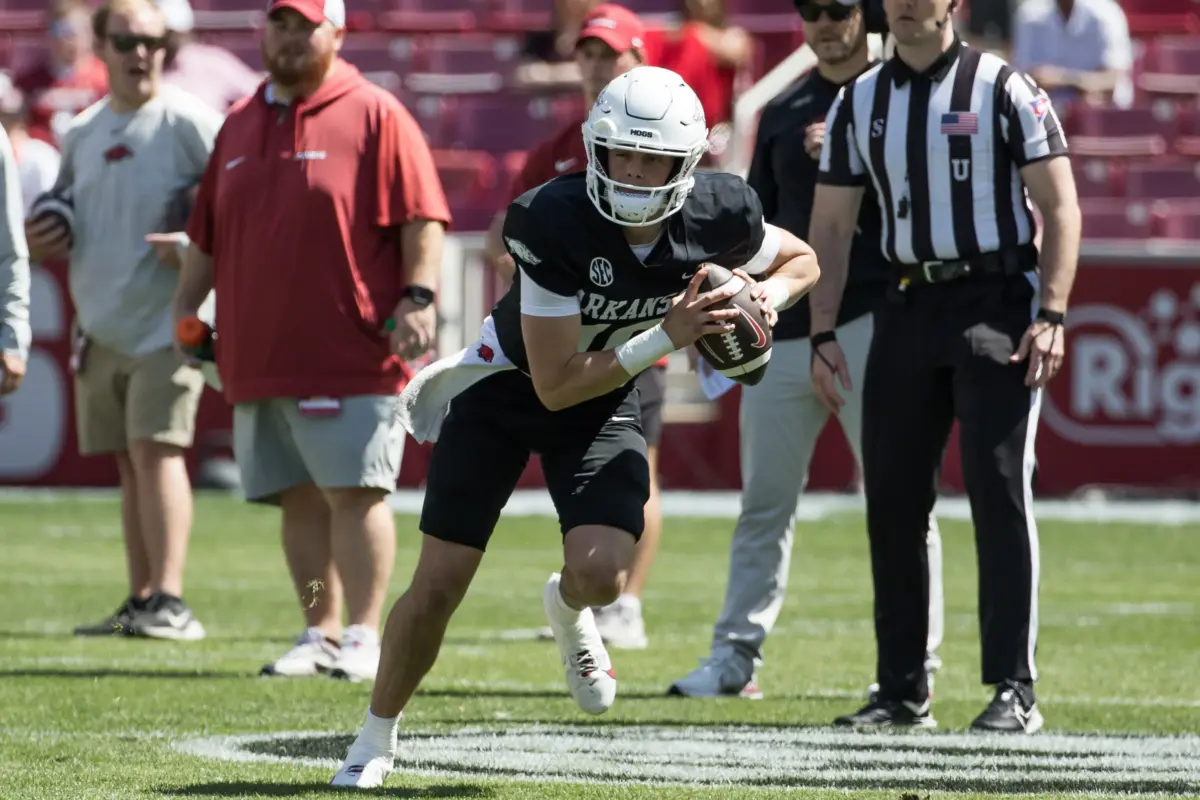

Arkansas can say all the right things about fresh energy, new faces, and a higher standard under Ryan Silverfield. None of it will truly land until the Razorbacks win another SEC game. The losing streak in league play is not just a depressing line buried inside a game note; it is the symbol of everything that has gone wrong, the running joke outsiders fire off on social media, and the weight Arkansas fans carry into every Saturday.
When Does Arkansas Finally Beat an SEC Team Again?
The first real proof that 2026 is different will not be a blowout of North Alabama or a fun September upset watch. It will be the day Arkansas finally walks off the field having beaten an SEC opponent again, with the streak dead on the turf behind it. We at Last Word ask the question, When does Arkansas finally beat an SEC team again?
The Streak That Defines the Era
Until that moment arrives, the streak overshadows everything. New staff, new schemes, portal additions, recruiting wins—none of those positives fully rewrite the feeling of watching Arkansas go week after week without a conference victory. Fans do not measure progress by how the Razorbacks handle an FCS opener or a non-conference road trip. They measure it by whether this team can line up against a league opponent, take the hits, answer back, and be the group closing out the fourth quarter instead of hoping the clock runs out quickly.
That is why 2026 carries such emotional weight. It is not just Year One for a new coach. It is the first time Arkansas will test whether all the talk about competition, toughness, and accountability actually translates when the helmets across from them carry that same SEC logo. The streak becomes the scoreboard for that test. Every time Arkansas lines up for a conference game, the question lingering in the back of everyone’s mind is not simply “Can they win?” It is “Is this finally the one that breaks it?”
Three Saturdays That Can Change Everything
Scan the 2026 schedule, and there are a few dates you can circle as the most realistic windows to end the skid. The heavyweights, Georgia, Texas A&M, Texas, and LSU, serve more as measuring sticks than as target dates. Competing there matters, but expecting the streak to fall in those spots is asking a lot. The more honest question is which of the middle-tier and must-win opponents Arkansas can beat first.
Tennessee at home is the earliest and loudest opportunity. That game offers a chance to punch up, stun the league, and flip the conversation overnight. A win there would not just break the streak; it would detonate it. Suddenly, the narrative would shift from Arkansas being stuck in the basement to questions about how quickly Silverfield’s team closed the gap on a program with top-15 expectations. The stadium would feel it. The locker room would feel it. Even a competitive loss that drags deep into the second half would be a positive sign, but if you are circling games that could end the streak with style, Tennessee is near the top of the list.
Then there is Vanderbilt on the road, the game almost everyone will quietly label as non-negotiable. Neutral observers might see it as just another date on the calendar, but Arkansas fans know better. If the Razorbacks reach Nashville with the streak still alive, the pressure on that Saturday becomes enormous. It is the SEC opponent that, on paper, feels closest to a “should win,” even outside Fayetteville. Drop that one, and the skid takes on a darker tone. It stops feeling like bad luck and starts feeling like the new normal.
Finally, Missouri at home after the bye might be the most emotionally loaded of them all. Recent history in that matchup has tilted in the wrong direction. Arkansas fans have had to swallow too many losses in a series they believe should be at least even. Add in an extra week to prepare, the frustration that has built up over the years, and the psychological need to flip something about that relationship, and you get the classic “enough is enough” spot. If the losing streak somehow survives Tennessee and Vanderbilt, Missouri becomes the circle-in-red game where the new staff can send a loud message that they are finished being pushed around by a program that used to be an afterthought in their eyes.
Of course, football is notoriously stubborn about following any script. Arkansas might end the streak earlier with a surprise at Texas A&M or catch fire late and topple someone nobody picked them to beat. Ball bounces, injuries, and random breaks will all factor in. But if you are picking the likeliest doors for the Razorbacks to walk through into a new reality, Tennessee, Vanderbilt, and Missouri remain the most logical hinges.
What Success Looks Like Once the Streak Is Dead
Ending the SEC losing streak is the first step. It cannot be the only one. If Arkansas finally gets a conference win and then immediately disappears back into the loss column for the rest of the year, the story does not really change. It becomes a blip, not a turning point. A successful 2026 season has to build on that breakthrough, not treat it as a one-night-only event.
Real success looks like this: the streak ends, and it stays buried. The Razorbacks stack at least one more SEC win on top of the first, ideally against a peer program they have struggled with. The blowouts against the league’s giants get a little less ugly, and fourth quarters stop feeling like foregone conclusions by halftime. The final record might still land around 5–7 or 6–6, but inside those numbers, fans can see a team that is tougher to push around, harder to dismiss, and finally starting to resemble a real SEC outfit again.
That is the difference between a feel-good Saturday and a foundation. The day Arkansas finally beats an SEC team again will be the first clear sign that the Silverfield era is more than branding and buzz. It will be the night the losing streak becomes something people talk about in the past tense. What happens after that will determine how big that moment really was, but in a season packed with storylines, the most important one stays simple: when and how the Razorbacks finally make the rest of the SEC stop taking them for granted.
Main Image: Brett Rojo-Imagn Images