
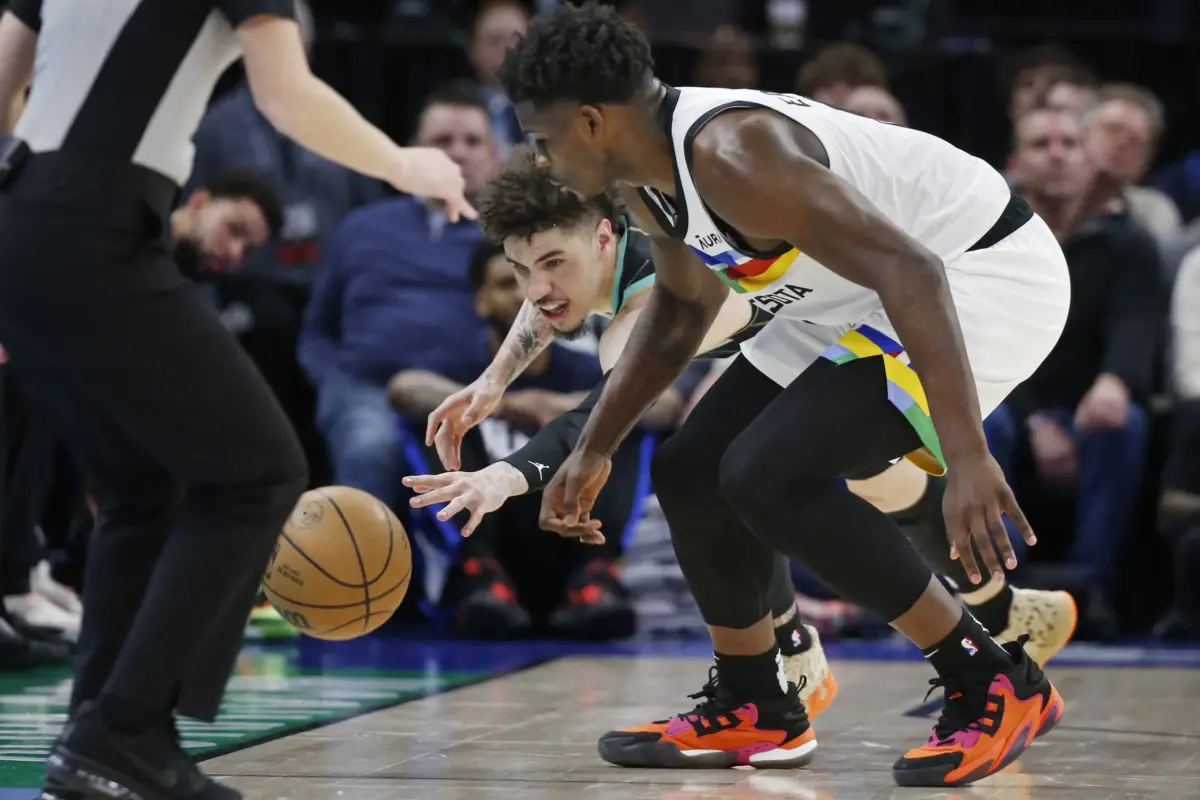

Guard pairings built around two high-usage players have a mixed record in the NBA. Allen Iverson and Chauncey Billups lasted one season in Detroit. Luka Doncic and Kyrie Irving combined for 55.9 points per game in Dallas, but the pair struggled with shot distribution. When two ball-dominant guards share a backcourt, one has to accept less.
Anthony Edwards and LaMelo Ball Bring One Challenge Chris Finch Must Solve
Minnesota will now test that situation with a backcourt built from the 2020 draft class, and the usage numbers involved make the fit difficult.
Anthony Edwards Runs Minnesota’s Offense
Anthony Edwards has spent his entire NBA career as the primary scoring option in Minnesota. His offensive game centers on driving to the basket, pulling up from mid-range, and attacking closeouts from beyond the arc. That workload has also created the biggest problem the organization continues trying to solve.
The Timberwolves ran their offense through him at high rates in pick-and-roll sets and isolation plays this past season. He shot 48.9% from the field and 39.9% from three, numbers that also reflect Minnesota’s incomplete offense.
Edwards averaged 3.7 assists per game, which indicates he can find open teammates. His passing works best as a supplement to his scoring rather than his main function.
LaMelo Ball Pushes the Pace
LaMelo Ball brings a different approach to the backcourt. His strongest skill is pushing the ball in transition and generating early offense before defenses set up. In Charlotte, he built a reputation for advancing the ball quickly off rebounds and finding shooters and cutters on the move. His 7.4 assists per game last season ranked among the league leaders.
His vision in the open floor separates him from most guards at his position. Defenses have to account for his outside shooting as well, which prevents them from sagging into the paint.
Chris Finch Must Split Duties
The coaching task for Finch comes down to half-court offensive structure. Ball can run pick-and-roll possessions while Edwards operates off the ball, using screens and cuts to find scoring chances. Edwards can score off the move, and his 39.9% from three forces defenders to stay close on the perimeter.
The alternative would be keeping Edwards as the primary handler and asking Ball to score more off the ball. That setup would reduce the playmaking Ball brings to the offense, and it would not use his transition skills as often.
James Harden Faced This Before
James Harden and Russell Westbrook paired up in Houston for the 2019-20 season. Both carried usage rates above 30%. Both had spent years as the lone offensive engine on their respective teams. The fit was awkward from the start.
Houston traded Westbrook after one season. Harden requested a move not long after. The pairing produced strong individual statistics but did not survive a second year, in part because neither player accepted a reduced offensive role on a full-time basis.
Edwards and Ball enter their partnership with the same basic tension, though their skill sets may complement each other better than the Houston experiment did. The pairing also addresses the bigger Timberwolves problem that surfaced throughout last season.
Edwards has never shared primary ball-handling duties with a guard who commands a similar workload. Ball arrives in Minnesota after five seasons as the main decision-maker in Charlotte.
The Timberwolves are betting that off-ball scoring from Edwards and transition playmaking from Ball can work in the same lineup. The 2020 draft class will now provide a direct answer on whether two top-five picks from the same year can share a backcourt.
Bruce Kluckhohn, USA TODAY Sports via Reuters Connect