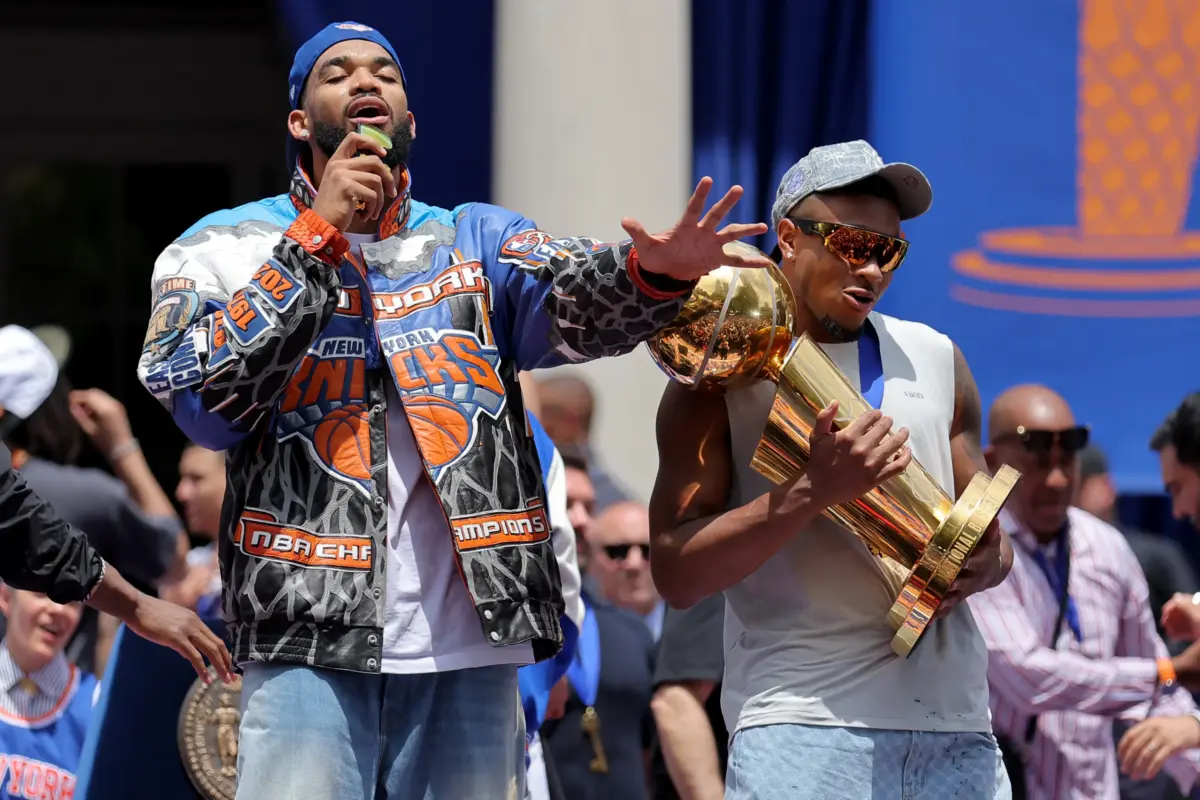

When the history books revisit the New York Knicks’ 2026 NBA Championship, a great deal of effort will flow towards the success of the team’s backcourt. Jalen Brunson’s and OG Anunoby’s heroics rightfully command a lot of the spotlight.
Karl-Anthony Towns and the Anatomy of a Championship Big Man
Without Anunoby’s increased effectiveness in the playoffs or Brunson’s clutch gene, the Knicks likely would not be champions. However, if we truly want to understand the anatomy of this championship-winning team, we have to look toward the paint.
For years, the critique of Karl-Anthony Towns remained the same. Branded as a phenomenal individual talent, he faced questions about whether his impact translated into the hard-nosed, selfless basketball required to win deep into the playoffs.
The numbers from the 2026 postseason tell a very different story. They demonstrate Towns’s evolution into the best version of himself. Sacrificing his own usage, he became a reliable facilitator, a relentless rebounder, and the ultimate anchor under coach Mike Brown.
Unlocking the Playmaking
The most striking aspect of Towns’s game to positively transform was his facilitation. During the regular season, Towns traditionally served as a finisher on offensive possessions. Players delivered the ball to him to score. In the postseason, that changed.
When defenses collapsed on him or he commanded double-teams, Towns no longer settled for contested jumpers. Instead, he picked them apart with his passing. During the first two rounds against the Atlanta Hawks and Philadelphia 76ers, Towns posted three double-digit assist games within two weeks, dishing out 10 assists in all three contests.
By continuing to process the play and find cutters, Towns completely blew up defensive schemes, keeping the ball moving and allowing his teammates to find their rhythm.
Controlling the Glass
When the lights got the brightest and the pressure turned up, Towns no longer worried about his shot volume and focused on the grittier parts of the game by controlling the paint.
Across his 19 playoff games, Towns dominated the boards, posting double-digit rebounds in 14 contests. Understanding the importance of extra possessions and second-chance points, he leaned into his value close to the basket, retrieving as many boards as possible. In Game 2 against Atlanta, Towns recorded 20 rebounds. However, his consistency on the glass truly blossomed in the Eastern Conference Finals.
Against the Cleveland Cavaliers, Towns secured 13, 13, 8, and 14 rebounds over four consecutive games. Anchoring a defense that smothered the Cavaliers, he assisted in holding Cleveland to 93, 93, 108, and 104 points. Not always pretty, Towns displayed the foundational interior work that consistently leads to playoff series wins.
The Efficiency Leap
Looking at Towns’s usage rate and field goal attempts during the regular season, it was not uncommon for him to record substantial shot volumes. In November, against the Miami Heat, he recorded 39 points on 26 shots. Against the Minnesota Timberwolves in December, he scored 40 on 24 shots. To feel engaged, Towns needed to produce a bounty of shots.
During the playoffs, Towns demonstrated uncharacteristic discipline. He picked his spots with precision, rarely taking more than 12 shots in important games. By switching his approach, he maximized his Points per Shot Attempt, improving his shot efficiency. In a Round 2 game against Philadelphia, he scored 20 points, going 6-of-8 from the field, and posted a 166.7 PSA. In the Eastern Conference Finals against Cleveland, he left one game with 19 points, going 8-of-11, and a 172.7 PSA. Finally, in Game 2 against the San Antonio Spurs, Towns accrued 21 points, shooting 8-0f-12, and registered a 161.5 PSA.
As the games became more crucial, Towns forced his offense less. Letting the game come to him, he took only high-value shots and generally recorded a PSA between 150 and 170. Never stalling New York’s momentum, Towns provided the Knicks with efficient and reliable offense.
The Last Word
No, Towns did not win the NBA Finals MVP. However, he secured something far more important: establishing a championship legacy. By sacrificing his touches, elevating his passing, crashing the boards, and playing the exact role his team needed, Towns escaped the criticism that followed him for a large part of a decade. By taking what already made him a great player and infusing it with a team-first approach, he became a winning basketball player.
All Advanced Stats Courtesy of Cleaning the Glass.
Brad Penner, Imagn Images via Reuters Connect