
Sports. Honestly. Since 2011

NBA coaching changes have reached historic levels across the league, but the Miami Heat remain the exception with head coach Erik Spoelstra’s unmatched tenure.

NBA Coaching Changes: The Miami Heat Are the Outlier

NBA coaching changes are the hallmark of the modern league, with teams cycling through multiple head coaches in just a few years. The head coach role is the most pressured position, with average tenure sitting around two to three seasons. Firings in the NBA often come after slumps, playoff exits, or even recent extensions, as the pace of change has become more administrative than strategic — driven by performance pressure, short championship windows, and front-office urgency rather than long-term planning.

Winning no longer guarantees job security. Head coaches operate as middle managers between ownership, analytics-driven front offices, and star players, often without full control over long-term roster direction. As a result, losing streaks quickly turn into indictments, and coaching changes are often seen as the fastest fix.

While teams may believe a new coach can shift direction, it can just as easily disrupt systems and progression. Terms like alignment and fit often mask impatience, while media pressure accelerates the cycle.

Against this backdrop, the Miami Heat stand out as one of the few organizations that maintain continuity while teams across both conferences continue to rotate through coaches. In an association defined by perpetual change and rising coaching turnover, stability itself has become the real outlier.

NBA Coaching Changes: The Miami Heat Are the Outlier

Stability is becoming the exception rather than the rule, as NBA coaching changes continue at a rapid pace across the league.  Head coaches are fired more frequently than in any other major North American sport, with the NBA among the top leagues when it comes to coaching turnover.

In a win-now environment, patience is increasingly rare, and even coaches with playoff success, awards, or recent contract extensions are not safe once expectations shift. NBA coaching changes are widely viewed as the fastest path to immediate improvement.

Key indicators of NBA coaching changes include:

  • Average tenure: 2.4 seasons across the NBA
  • Annual coaching turnover: 30-40% of head coaches replaced each year
  • Multi-change franchises: Several teams cycling through head coaches in recent years
  • Short evaluation windows: Coaches often judged within 1-2 seasons
  • High volatility: Firings after slumps, playoff exits, and sometimes contract extensions

These figures highlight how quickly leadership changes occur across the league and how little long-term patience exists in today’s NBA.

Several franchises have driven these NBA coaching changes in the last decade:

  • Phoenix Suns: 7 head coaching changes
  • Brooklyn Nets: 7 head coaching changes
  • New York Knicks: 6 head coaching changes
  • Sacramento Kings: 5 head coaching changes
  • Cleveland Cavaliers: 5 head coaching changes
  • Milwaukee Bucks: 5 head coaching changes

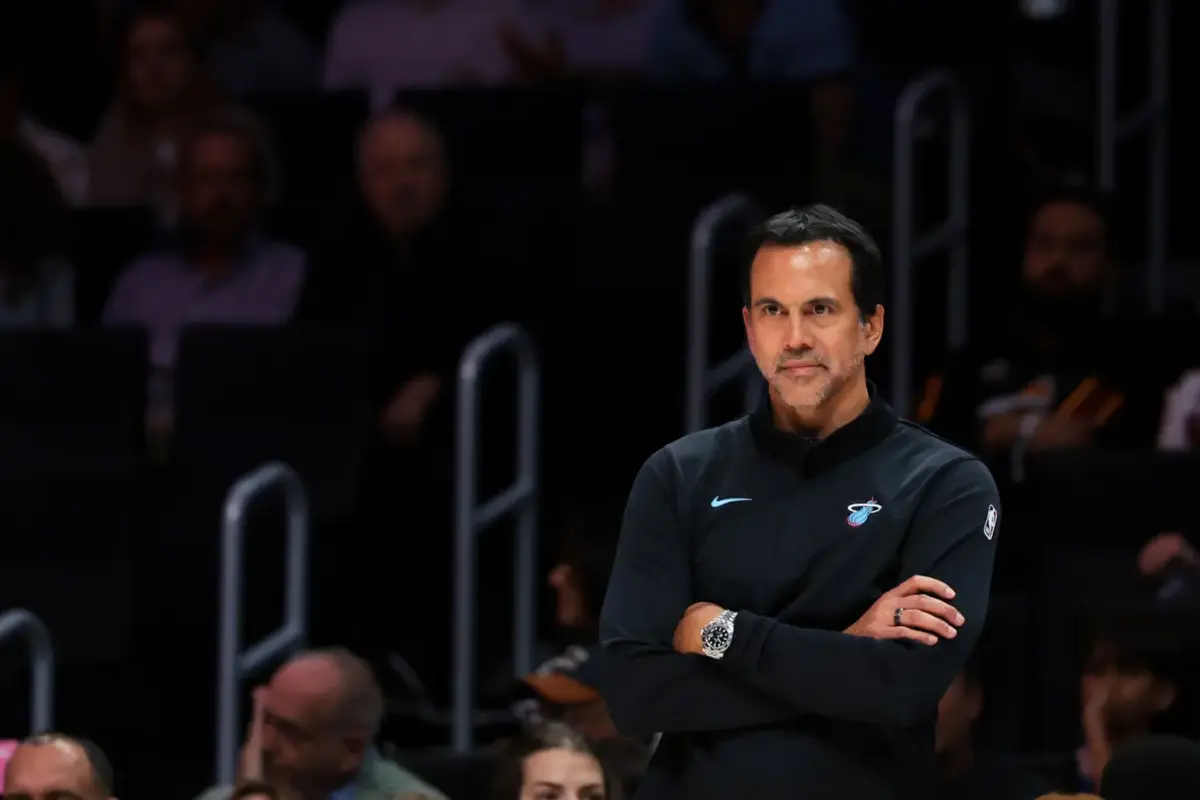
Yet amid this volatility, one franchise stands apart. Following Gregg Popovich’s retirement from the San Antonio Spurs, Heat head coach Erik Spoelstra now holds the longest active tenure in the NBA, making Miami a rare symbol of stability in a league defined by constant change.

Spoelstra and Miami’s Model of Organizational Stability

In contrast to league-wide volatility, the Heat represent continuity at the highest level. Erik Spoelstra is the NBA’s longest-tenured active head coach, and his rise within the organization is one of the league’s most notable success stories. He began in 1995 as a video coordinator, working in the film room, breaking down game tape. In 1997, he was promoted to assistant coach with scouting responsibilities, and by 2001 he was assistant coach and Director of Scouting before being named head coach in 2008.

That progression reflects a rare internal development model built on trust, organizational knowledge, and long-term vision, culminating in multiple championships and sustained postseason success. Spoelstra has endured 18 seasons of roster overhauls, superstar transitions, and shifting eras of NBA basketball, while Miami has remained committed to leadership continuity.

Rather than treating the head coach as a replaceable role, the Heat operate with a long-term organizational approach built around stability and internal development. This continuity supports consistent team building, player development, and playoff contention.

Instead of drastic changes, Miami evolves within its system rather than rebuilding from scratch, reinforcing a long-term identity even without immediate success.

The 2025-26 NBA Coaching Changes Carousel

    The 2026 offseason has accelerated NBA coaching changes, triggering a full-scale coaching carousel across the league, with several franchises already reshaping leadership:

    • Milwaukee Bucks: Doc Rivers exited after the regular season; Taylor Jenkins hired as replacement
    • New Orleans Pelicans: Willie Green dismissed; Jamahl Mosley hired after interim period
    • Orlando Magic: Mosley dismissed; Sean Sweeney to become head coach after Spurs’ Finals run
    • Dallas Mavericks: Parted ways with Jason Kidd; search ongoing
    • Chicago Bulls: Billy Donovan stepped down amid roster reset
    • Portland Trail Blazers: Tiago Splitter remains interim head coach amid uncertainty

    This level of coaching turnover reflects a league where job security is fragile, and change is constant. In many cases, volatility has become strategy, though repeated coaching changes can still disrupt continuity and long-term development.

    Meanwhile, the Heat have largely avoided this cycle under Spoelstra, prioritizing stability while much of the league continues to seek solutions through coaching changes. NBA.com has established a Coaching Tracker to keep up with those offseason moves.

    Coaching Stability Has Become the Exception

    NBA coaching changes have become routine. A losing streak, playoff exit, or slow start can quickly put a coach’s future in question. Franchises like the Suns and Nets have cycled through roughly seven head coaches over the past decade, while the Knicks have had six.

    As a result, coaching is no longer viewed as a long-term investment in culture and development. It has become an adjustable roster component and one of the fastest variables teams change under pressure.

    The NBA’s “Win Now” Problem

    Today’s NBA is defined by urgency. Championship expectations, superstar movement, and front-office pressure have created an environment in which patience is often viewed as a weakness. With players more influential than ever and teams operating on analytics-driven timelines, ownership expects immediate results and often turns to coaching changes when they don’t arrive.

    Coaches are increasingly asked to juggle developing young talent, managing superstar relationships, implementing organizational systems, and winning games. Few roles carry so much responsibility with so little security.

    As a result, the head coach is often the first adjustment when progress stalls, regardless of whether issues stem from roster construction, injuries, or broader organizational decisions.

    An NBA coach is less an architect and more an intermediary between ownership, front offices, and players, responsible for:

    • Managing superstar relationships
    • Implementing front-office vision
    • Developing young talent
    • Producing immediate wins

    But they rarely control the roster long enough to build continuity, which explains the fragile nature of job security across the league. Not every organization treats the position this way, however, and few examples illustrate that better than Miami.

    The Heat Are Not Resisting Change, But Staying Consistent in How They Operate

    NBA coaching has become one of the most unstable roles in professional sports. As average coaching tenures continue to shrink, what was once a long-term position is now often temporary.

    The Heat stand as the exception, with Spoelstra and president Pat Riley representing one of the clearest examples of sustained organizational stability. In a league defined by rare pockets of longevity, Miami’s model is not about resisting change, but about evolving without abandoning its foundation.

    © Sam Navarro-Imagn Images

    About Stephanie Meadows

    Stephanie Meadows is excited to join LWOS Basketball as a contributing writer, where she provides comprehensive coverage of the NBA, delivering timely team news, in-depth game analysis, roster breakdowns, trade and free agency insight, player development features, and thoughtful commentary on league trends. Her work highlights not only what happens on the court, but also the strategy, storylines, and culture shaping today’s game. Previously, she served as a contributing writer for FanSided with All U Can Heat. An accomplished, published writer whose work has appeared both in print and online, Stephanie draws inspiration from sports, art, and music, blending culture, emotion, and insight into everything she creates. A graduate of the University of Miami with degrees in Journalism and Sports Administration, she is driven by a passion for meaningful storytelling and continuous growth. “You're only given a little spark of madness. You mustn't lose it.” – Robin Williams

    Stay in the Game

    Get the latest sports news and analysis delivered to your inbox.

    Share This Article