
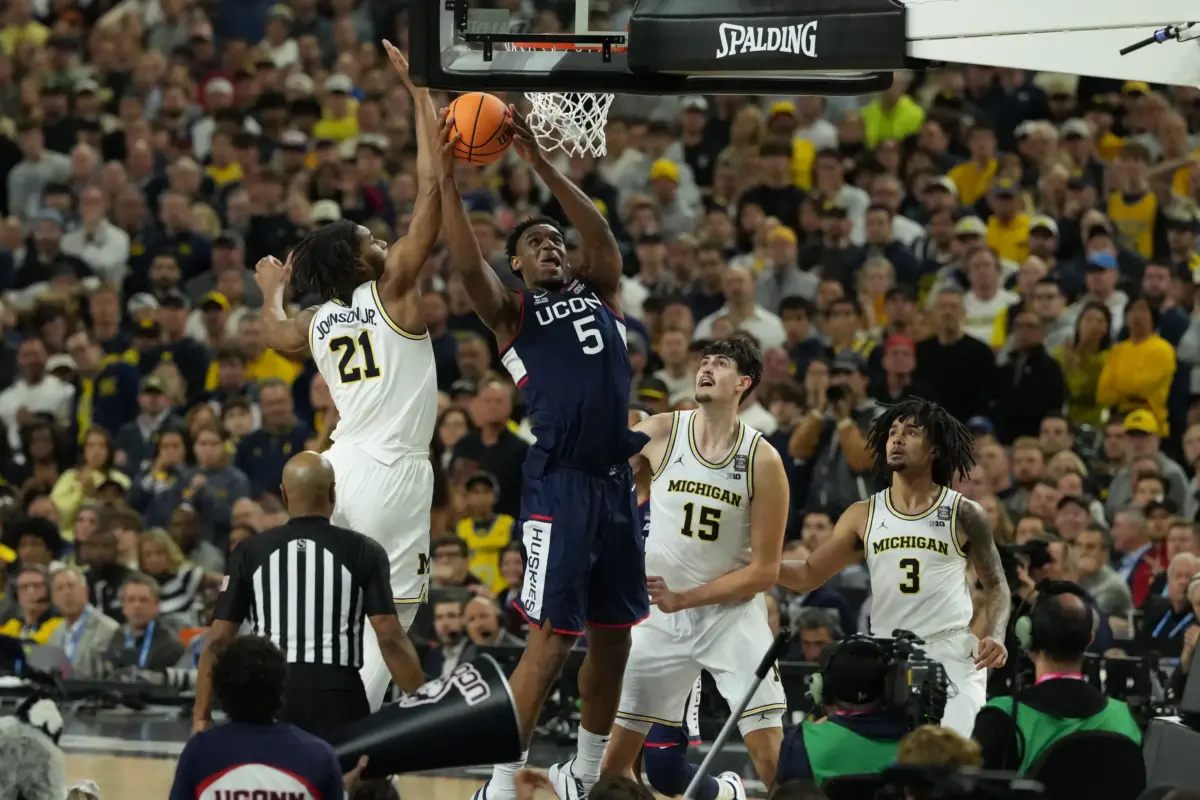
UConn Huskies big man Tarris Reed Jr. can be counted among the better centers in the 2026 NBA Draft. While he may not be as popular as other center prospects like Aday Mara and Henri Veesaar, Reed has demonstrated that he has the talent and skill to stick in the league that both Mara and Veesaar possess. Let’s dive into an evaluation of Reed in this 2026 NBA Draft profile.
Tarris Reed Jr. 2026 NBA Draft Profile
College Career
Reed played for two teams in his collegiate career, the Michigan Wolverines and the UConn Huskies. He played his first two seasons with the Wolverines, where he played a limited role off the bench for his freshman year. For his sophomore season, Reed became the full-time starter for Michigan, having seen a general increase in his production.
After his second collegiate season, Reed decided to transfer to UConn to play under head coach Dan Hurley, who had just won back-to-back national titles. Reed saw another increase in his production despite playing a bench role behind starting big man Samson Johnson. His contributions helped UConn make the NCAA Tournament, where they made it as far as the second round. His level of play also helped Reed win the 2024-2025 Big East Sixth Man of the Year award.
As for this past season, Reed became UConn’s full-time starting center, and he increased his level of production even further. Reed demonstrated his talents as a skilled post scorer and excellent rebounder, utilizing his size and strength to bully opposing players. As one of the most important players on the roster and UConn’s leading scorer, Reed helped lead the Huskies to the NCAA Tournament as a second seed. They got past multiple tough opponents like the Michigan State Spartans and Duke Blue Devils to make it to the National Championship game, eventually losing to his former team, the Michigan Wolverines.
Reed averaged 14.7 points, 9.0 rebounds, 2.3 assists, and 2.0 blocks in 27.3 minutes per game this season. He shot 60.7% from the field and 61.7% from the free-throw line. For his efforts on the season, Reed made the All-Big East first team, received an All-Big East Tournament nod, was selected for the NCAA All-Tournament award, and was honored with an NCAA Tournament All-Region selection.
Strengths
Offense
Reed has demonstrated impressive abilities in several areas on the offensive end. One positive for Reed is his strong interior scoring, using his strength and footwork to break down the opposition in the paint. Reed has shown that he is slightly quicker than opposing bigs, allowing him to burst by them to score. He also uses that strength and size well to be a terrific screener in the pick-and-roll, allowing his teammates to gain significant space to operate with.
Another aspect of his offensive game that has shone is his passing upside. Reed has demonstrated extremely positive signs as a passer, such as having a 17.8% assist rate, which is at an amazing 95th percentile among bigs. He also possesses a great 1.2 assist-to-turnover ratio, which is at the 88th percentile. Reed uses his gravity as a post scorer to force defenses to collapse on him, where he can spray the ball out to open teammates. As a passer, Reed is great at finding cutters and has shown the potential to make cross-court passes.
Reed’s offensive rebounding is another excellent ability in his skill set. He is great at fighting on the glass and keeping possession alive, having averaged 3.2 offensive rebounds. He has a 14.2% offensive rebounding rate, which is good for the 82nd percentile. His size, length, and physicality serve him well as he can outmuscle opposing players for second-chance opportunities.
Defense
While Reed isn’t the quickest or most explosive defender at the center position, he does have multiple aspects that make him impactful defensively. Something that is in Reed’s favor as a defender is his sturdy frame and overall strength. He has the physicality to contend with other big men in the post. Reed uses his length well to bother or alter shots. He combines his length with solid positioning and awareness to be an active defender. He has a 2.0% steal rate, which sits at the 78th percentile among centers.
One of his best aspects as a defender is his rebounding, utilizing his length and physicality to battle on the boards. He averaged an impressive 9.0 rebounds for UConn this past season, and Reed’s defensive rebounding rate stands at an equally-impressive 24.5%, which is at the 82nd percentile.
Weaknesses
Offense
Something that is clear about Reed’s offensive game is that he is strictly limited to scoring in the paint. He hasn’t demonstrated any ability to stretch the floor and is not someone who can create their own shot besides through post-ups. Reed will most likely be limited to rim-running and screen setting in terms of the offensive end. Additionally, Reed isn’t someone who can consistently knock down his free throws, shooting only 61.7% on 4.4 attempts per game. Not only does that make him less reliable in late-game situations, but it is also a negative indicator of potential shooting upside. Also, Reed isn’t the quickest or most explosive player, which may hinder his ability to be a lob threat.
Defense
The 2026 NBA Draft prospect is a strong interior defender, but he does have areas of concern on defense. Specifically, his lack of quickness will make it difficult for him to stay in front of NBA-level guards. He will find it difficult to defend against ball-screens, where he is being switched defensively onto perimeter players.
It should also be noted that Reed’s lack of vertical athleticism will be a detriment to his overall rim protection abilities, as he isn’t the best shot-blocker, and the level of athleticism at the NBA level is significantly higher. In fact, Reed’s block rate is only 8.4%, which sits at just the 65th percentile among big men. Reed is also a bit undersized as a center at six-foot-ten, though he does have a seven-foot-four wingspan.
NBA Comparison
In terms of an NBA comparison for Reed, one player that he shares similarities with is current Brooklyn Nets big man Day’Ron Sharpe. They are both undersized centers who possess great length and a sturdy frame. While neither is a standout rim protector, both use their strength and positioning to bother opposing players in the paint. Furthermore, they actively use their length to bother passing lanes. They also utilize that strength on the offense and when rebounding the ball. Reed and Sharpe both have good touch around the rim, and they also have solid vision for big men.
2026 NBA Draft Projection
Late first to early second round pick.
Featured Image: Robert Deutsch-Imagn Images