
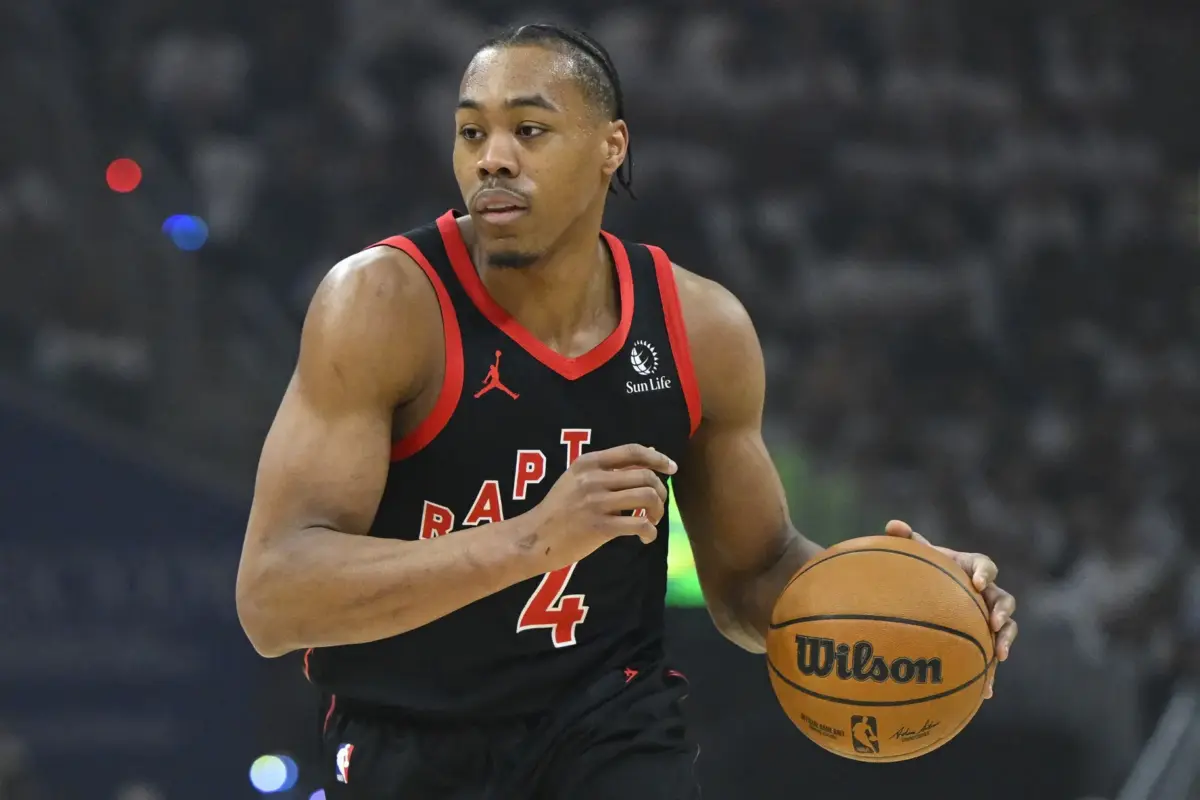

The Toronto Raptors exceeded expectations this season, even though they fell to the Cleveland Cavaliers in Game 7. If anything, their postseason run should highlight just how far they have come.
Coming into the 2025–26 season, expectations around the league were modest. Many projections placed Toronto around the play-in range, with some estimates hovering near 37–44 wins and a fight just to reach the postseason.
Instead, the Raptors finished with a 46–36 record and the 5th seed in the Eastern Conference, securing a playoff spot outright and returning to the postseason for the first time since 2022. That alone represents a clear step forward.
However, the real story goes beyond the record.
The Toronto Raptors Exceeded Expectations Despite Game 7 Loss
A Season Defined By Growth
Toronto’s season was not built on a single star or one breakthrough moment. It was built on development, adaptability, and depth.
This was a team that improved significantly from the previous year and, more importantly, established a clearer identity on both ends of the floor. Instead of relying on isolated performances, Toronto consistently found ways to generate contributions across the roster.
Even in the playoffs, the Raptors pushed a strong Cleveland Cavaliers team to seven games despite missing key players at times. That is not underperformance.
That is progress.
Collin Murray-Boyles Looks Like A Draft Hit
One of the biggest positives from the season was the emergence of Collin Murray-Boyles.
Selected with the 9th overall pick in the 2025 NBA Draft, Murray-Boyles quickly proved he belongs at the NBA level. His impact was not just statistical — it was structural. He consistently influenced possessions with his defensive instincts, physical presence, and ability to make smart reads within the flow of the game.
As the season progressed, his role expanded naturally. Rather than forcing production, he fit into what the team needed, which made his development even more valuable.
For a team building around Scottie Barnes, finding a player who can contribute without disrupting the system is a major win.
Young Guards Took Real Steps
Another major takeaway from the season was the development of Toronto’s young guards.
Ja’Kobe Walter showed growth as a scorer and spacer, gaining confidence as the season progressed and delivering key performances late in the year. His presence helped stretch defenses and opened space for the offense to operate more effectively.
Meanwhile, Jamal Shead proved he could handle NBA-level responsibility. His playmaking and energy gave Toronto valuable minutes, especially in situations where composure and control were needed.
These are not finished products, but they are real building blocks for what comes next.
A Clear Identity Around Scottie Barnes
At the center of everything is Barnes. He continued to evolve into a true franchise player, earning All-Star recognition and leading the team on both ends of the floor. More importantly, the Raptors began to build a clear identity around him — one that emphasizes versatility, playmaking, and defensive impact.
That identity was not always consistent in previous seasons. This year, it started to take shape in a more sustainable way.
Depth And Resilience Defined The Playoff Run
The Raptors’ playoff run may have ended in Game 7, but it reinforced one key idea: this team is ahead of schedule.
They competed despite missing key players like Immanuel Quickley and Brandon Ingram, and they consistently found contributions from different parts of the roster. That ability to adapt and stay competitive speaks to the culture the team is building.
Even in difficult moments, Toronto never fully lost control of the series. That level of resilience is something that typically takes years to develop.
What They Did Right
Toronto’s success this season did not come from one single decision. It came from multiple areas aligning at the right time.
They drafted well and trusted their young players. They allowed development to happen naturally instead of forcing results. At the same time, they committed to a defensive identity that gave them a consistent foundation, even when the offense was inconsistent.
Those are not short-term wins. Those are long-term indicators of a team moving in the right direction.
The Bigger Picture
A Game 7 loss can feel like a missed opportunity. However, context matters in this situation. This was a team that was not expected to reach this point. Instead, they surpassed preseason projections, established a young core, and proved they can compete in meaningful games.
The Raptors did not just meet expectations. They moved beyond them.
The Last Word
The Raptors did not win the series. But they won something more important. They proved they are ahead of schedule. They proved their core works. And they proved that this is not the end of something — it is the beginning. If this season showed anything, it is that Toronto is no longer rebuilding.
They are building something real.
Featured Image: David Richard-Imagn Images