
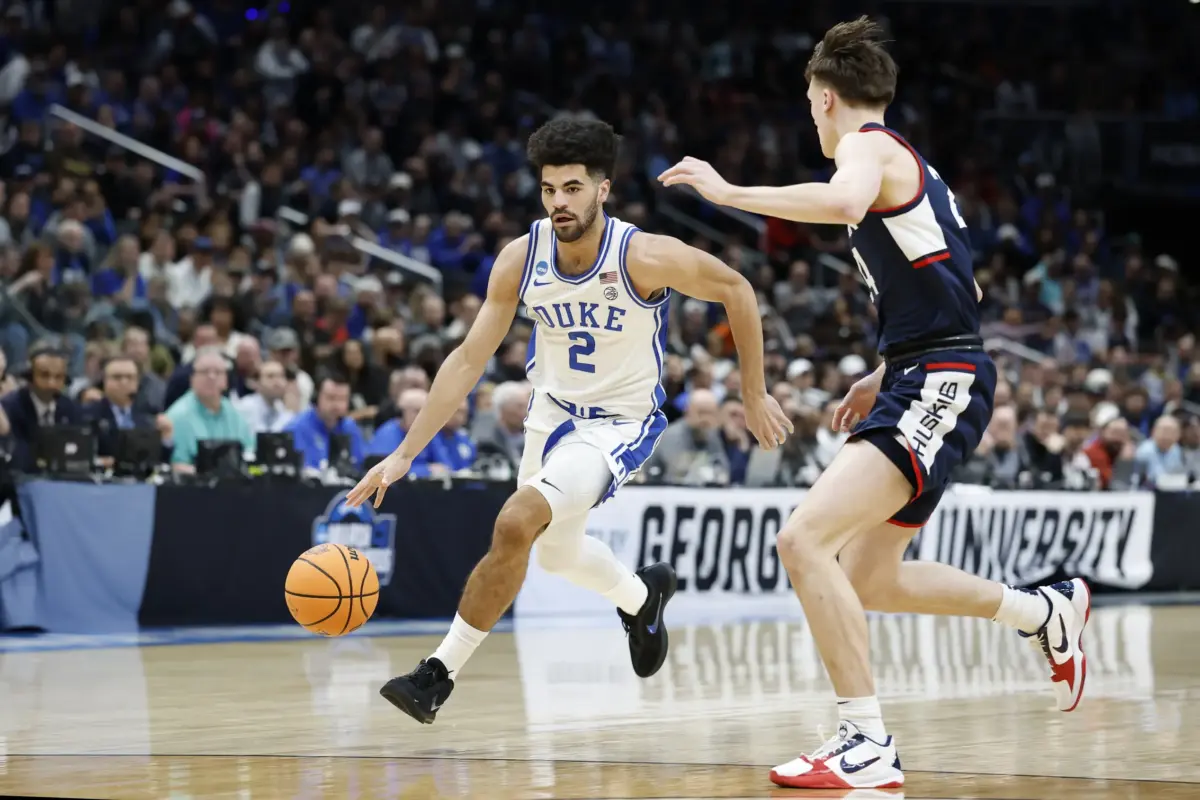
In today’s college basketball, success is dictated by a high-stakes transfer portal and NIL. Constructing a college basketball roster is often a numbers game. Not only do programs need to build the best roster possible within the constraints of a particular budget, but coaches also need to break down playing time to accommodate all their assets. For Duke’s backcourt rotation, the upcoming season presents an interesting puzzle for Jon Scheyer.
Decoding the Duke Backcourt Rotation
With four starting-caliber guards, Duke presents the deepest backcourt in college basketball next season. Each player brings a unique skill set and high-level talent. This group of guards does not lack for skill. With so much ability to account for, Coach Scheyer will have to find a way to successfully split up 80 minutes of playing time between Caleb Foster, John Blackwell, Deron Rippey Jr., and Cayden Boozer.
The Veteran Floor General
Entering his senior season at Duke, Foster represents what it truly means to bleed blue. Foster had a 119.0 offensive rating per 100 possessions this season. The six-foot-five guard brings both size and elite decision-making to the court.
In a crowded room of guards deserving of playing time, Foster’s standout asset certainly comes in the shape of efficiency. During the last six games of Duke’s 2025-26 regular-season campaign, he posted a 12.5 assist-to-turnover ratio. That stat demonstrates his excellence in distributing the ball while committing few turnovers. With a collection of players demanding the rock, Foster can be selective with his shooting, focusing on creating offense for those around him. It will be all about spacing the floor and preventing a half-court offense from growing stagnant.
The Proven Scorer
Blackwell, on the other hand, enters the picture as a proven scorer. A focal point for Wisconsin’s offense last season, he was responsible for finishing over a quarter of the Badgers’ possessions when he was on the court. His 26.7% usage rate and 19.1 points per game represent the Badgers’ willingness to put the ball in Blackwell’s hands and his ability to deliver on that confidence.
It will be interesting to see how his high-usage reputation transfers on a team flush with playmakers. One statistic offers cause for optimism in this regard. Blackwell shot 38.9% on his three-point attempts, with 74% of those shots being assisted. That level of effectiveness means he does not have to dominate the ball to be effective. He will receive his fair share of production opportunities, positioning himself on the perimeter and waiting for defenses to collapse on a drive in the paint.
The Paint-Touch Catalyst
In basketball, a paint-touch guard is a perimeter player who is most valuable when getting the ball into the paint, typically through penetration. Not only do these guards create high-danger scoring opportunities and increase free-throw attempts, but they are also successful at breaking down a defensive structure. For Duke, Boozer became one of the ACC’s best paint-touch guards, shooting an excellent 65.2% at the rim.
Boozer projects to be the primary engine for the Blue Devil offense, especially since Cameron Boozer will be off to the NBA after the upcoming 2026 NBA Draft. Boozer’s success comes from beating defenders off the dribble and forcing rotation. When he drives to the paint, defenders must crash and leave their man, leading to open looks on the perimeter, which leans into the strengths of other contributors, such as Blackwell.
The Freshman Speedster
Opposite to the strength Boozer provides, freshman Rippey Jr. gives Duke a true speedster at the guard position. An asset not consistently present on past Blue Devil rosters, Rippey’s aggressiveness and pace allow the team to dictate the tempo. His two-way capabilities make him effective in the transition game and in applying full-court pressure defensively.
As a freshman, one can expect a growth period for Rippey Jr., likely providing quality minutes off the bench. Still, when the likes of Foster, Blackwell, or Boozer need a rest, he can positively impact the game and develop into a key executioner of the offense in future seasons.
Solving the Puzzle
Scheyer’s greatest challenge, one most teams envy, is providing quality playing time for all four of these players. There should never be a time when two of these guards are on the floor together. However, Scheyer’s best bet may come in the form of a three-guard rotation. Duke can heavily lean on Boozer, Blackwell, and Foster to populate the point and wings. As for Rippey, he can learn the ropes and come off the bench, creating a lethal perimeter rotation. Throw in Dame Sarr, Patrick Ngongba II, Cameron Williams, and Drew Scharnowski, and you have an impressive group of talent to lead Duke to a title. Guys like Sarr, Ngongba, Williams, and Scharnowski are all skilled players who Scheyer can use for winning basketball next season.
Duke’s backcourt conundrum is a great problem to have. Still, for it to work, all four guards will need to sacrifice personal accolades for the betterment of the team. If they can do that, it is time to put the entire college basketball landscape on notice.
Featured Image: Amber Searls-Imagn Images