
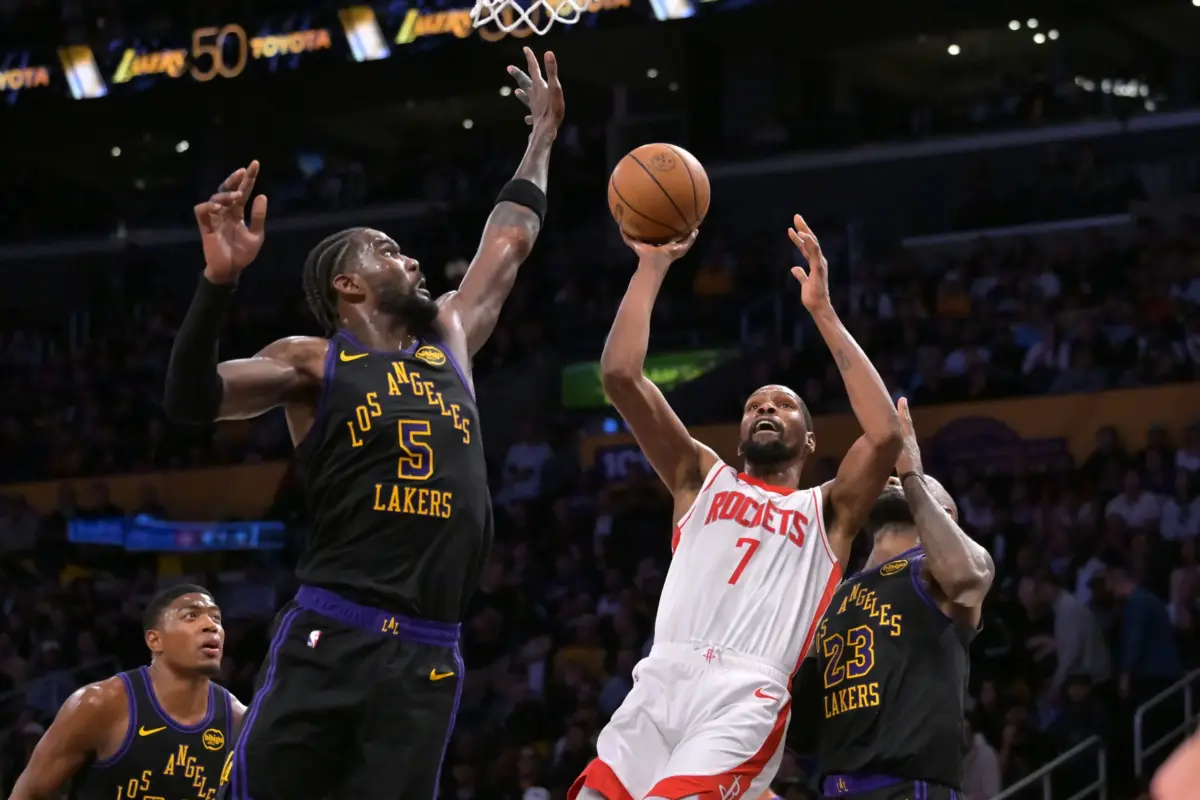

Kevin Durant‘s absence for Game 1 was an unexpected development. Houston Rockets head coach Ime Udoka announced Durant’s knee contusion to the media roughly 90 minutes before tipoff.
En route to a 107-98 loss against the fourth-seeded Los Angeles Lakers, it was clear that Houston had two main glaring issues.
The Rockets struggled defensively, both individually and as a team. Despite being one of the NBA’s premier perimeter defenders, Amen Thompson gave up 27 points to Lakers guard Luke Kennard. Finishing the regular season with the sixth-best defensive rating in the NBA, the Rockets also gave up 29 assists, 13 of which belonged to LeBron James.
The Houston Rockets Need A New Approach For Game 3
Being listed as a game-time decision for Game 2, Durant was able to suit up for Houston. Despite the injury risk, he played 41 minutes and put up a team-high 23 points.
So what did Durant’s comeback spell for the Rockets? And what are some key takeaways ahead of Game 3?
Defensive Downfall
As mentioned before, Houston struggled defensively in Game 1. Unfortunately for the Rockets, the same story unfolded in Game 2.
Starting the game off with a three-pointer from Jabari Smith Jr., Houston was unable to cover the Lakers’ three-point attempts effectively. As a team, the Lakers shot 46.4% from deep. The Rockets’ lackluster coverage allowed Kennard and Marcus Smart to hit comfortable shots in the first quarter, helping them get into a rhythm.
Smart had a great game for the Lakers, finishing with 25 points, seven assists, and five steals. Despite shooting just 32.4% from three for his career, Smart also made five of his seven three-point attempts.
During his postgame press conference, Udoka said the Rockets’ defense on Kennard and Smart was “not good enough.” He also talked about the team not closing out effectively, which led to Smart getting into a rhythm early.
Houston’s lack of defensive communication hurt them throughout the contest. Alperen Sengun, Smith Jr., and Thompson were out of position in several situations. Rather than stunting and recovering, the Rockets often neglected help defense, which resulted in easier routes to the basket on many of the Lakers’ possessions.
For a Game 3 victory, Houston’s players will have to be much more vocal about switching and defending the Lakers. Thompson’s defensive performance over the last two playoff games has been unusually poor for a defender of his caliber. Additionally, the Rockets have to be more effective at collapsing when a player drives, as well as closing the gap on help defense. This prevents the Lakers’ primary scorers, such as Smart, Kennard, and James, from going downhill one-on-one with little resistance from other Rockets players.
Offensive Shortcomings
Many assumed after Game 1 that Durant’s return would improve Houston’s offense. None of the Rockets that played in Game 1 scored 20 points.
However, Durant’s performance in Game 2 was a far cry from what the team wanted out of him. Durant’s 23 points came on 7-12 shooting from the field and 8-9 from the free throw line. However, he was responsible for more than half of Houston’s 15 turnovers, accounting for nine of them.
Durant was fighting through double teams for most of the game. Lakers head coach JJ Reddick’s strategy involved trapping Durant as soon as he crossed half-court. This effectively took Durant out of many of the Rockets’ possessions, where he otherwise would have been able to help his team score.
Reed Sheppard‘s shooting was a key for Houston to take home Game 2. However, the sophomore went scoreless in his 11 minutes Tuesday night.
The rest of the Rockets’ young core had games with room for improvement. Thompson’s efficient 16 points, five rebounds, and nine assists juxtapose sharply with his lack of defensive impact over Houston’s past two games.
Despite previous mentions about Sengun being out of position on defense, his impact there is evident on the scoresheet. The All-Star center posted four steals and two blocks alongside his 11 rebounds and five assists.
And although he recorded a double-double in Game 2, the Turkish center shot the ball with similar efficiency as in Game 1. The same is true for Smith Jr., who also did not shoot the ball well in the Rockets’ past two games.
Sengun and Durant’s efficiency and scoring are significant for Houston to take home Game 3 at the Toyota Center. The Rockets will look to their two All-Stars when the time comes to score the ball.
Durant noted in his postgame interview that there were many times during the game when he could have shot the ball, but chose to pass up the look.
“I just gotta be more aggressive to look to score, no matter where the double team comes from, no matter who is doubling. There was plenty of times where I feel like I could shoot over those guys.”
The Last Word On the Houston Rockets’ Game 3 Approach
It is clear to those watching that Houston has a lot to improve on. Holding top-10 positions in both offensive and defensive rating during the regular season, that is not reflected in how the Rockets have played these past two games.
Sengun will have to be more physical in the paint. Combining it with his elite footwork will be key for the big man to beat Deandre Ayton‘s superior athleticism.
On the other hand, Durant needs to be more aggressive on offense. The Slim Reaper will be the Rockets’ final frontier when all else fails, and his performance in Game 3 will dictate Houston’s chances to win.
Tightening their defensive discipline and communication, as well as better and more efficient offensive production from not just Houston’s All-Stars, but from the team as a whole, will be key for a Game 3 victory.
© Jayne Kamin-Oncea-Imagn Images