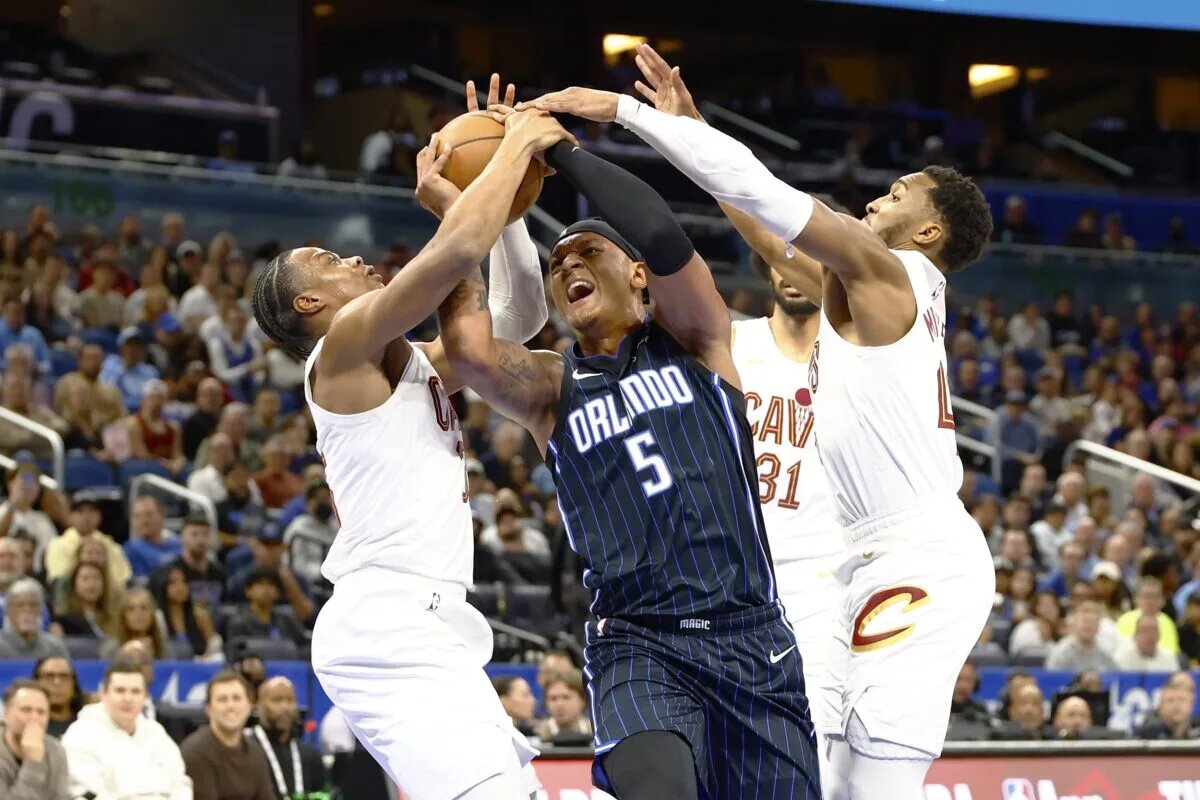

With a league whose fan base who now considers the 3-ball to be the holy grail of basketball, the discourse surrounding Orlando Magic forward Paolo Banchero‘s shot-selection were to be expected. This season, the 22-year-old is averaging a career-high 23.0 points per game. However, he’s converted just 41.9 percent of his field goals and 29.3 percent of his threes.
While most players are zigging, he’s zagged, playing a style more suited for the 1990s and 2000s. That being said, there are some merit to criticisms of his shot diet. However, the problem is less of where he’s taking his attempts than when.
The Magic Solution To Paolo Banchero’s Shot-Selection Problem
Those who simply want Banchero to take more 3-pointers are ignoring the fact that he’s already taking a career-high 29.9 percent of his shots from beyond the arc.
Furthermore, his touch has never been great from long-distance. Despite having the highest career scoring average (21.6 PPG) in his draft class, he’s a career 31.5 percent shooter from deep. In his one-and-done season with the Duke Blue Devils, he made 33.8 percent of his 3s. That’s even with the college 3-point line being three feet closer to the rim.
So, even if the 3-ball was still considered the most efficient shot in basketball, it’s not the most efficient shot for him. Meanwhile, the 2022 No. 1 pick shoots 68.3 percent when 0-3 feet away from the rim; 39.1 percent when 3-10 feet away from the rim; 39.8 percent when 10-16 feet away from the rim; and 38.5 percent when 16 feet away from the rim to the 3-point line. His percentages in every area outside of the restricted area need work but frankly, he’s at his best inside the arc.
With that in mind, the Magic’s primary in-season task should be getting Banchero to make better plays for his teammates, which should ultimately lead to better shots.
Patience & Trust
Like many players given the mantle of face of the franchise, Banchero has a tendency to play hero ball. This has played a part in him taking a high volume of tough jumpers. In fact, 42.1 percent of his field goal attempts have come against tight defense. This includes 38.0 percent of his two-point attempts.
Because it’s in his nature to post-up, that number may always be relatively high. Nonetheless, the Seattle native’s tunnel vision skews that number. Whether it’s because of a lack of trust in the pass, a lack of belief in his comrades, or a lack of court vision, he often chooses to call his own number rather than make a pass to an open teammate.
Why Paolo Banchero’s efficiency plummets:
Mose runs a play to get him a post-up. Paolo denies the ball. The result: wide open Gary 3PT miss. Next play: Horns Chin for Paolo — Gary screens — Paolo gets switched-to blitzed & elects to take a fadeaway instead of passing back to 14 pic.twitter.com/BKgCxvxwJ5
— Fawzan Amer (@FAmer__) February 26, 2025
This selfishness, for lack of a better word, doesn’t just affect Banchero of course. Every possession could be as much as a six-point swing (well, eight points if there were somehow back-to-back and-1 calls on 3-point makes). He also runs the risk of preventing his teammates from getting in rhythm, which could have short- and long-term effects.
Frankly, Banchero’s teammates don’t give him much to be confident in. The only one who’s shooting above league-average from beyond the arc is out for the season. Only Franz Wagner is a reliable scorer on a nightly basis. Nevertheless, because process plays a large part in performance, ball (and player) movement will ultimately get them better shots collectively. With how much attention Banchero can draw with the ball in his hands, that’s particularly true.
To be fair, the young star does average 4.8 assists per game, the second-highest mark on the team. However, that number can and should be higher.
© Russell Lansford-Imagn Images