

Xavier Legette’s development brings up a familiar NFL Draft question: traits or refinement?
It happens every year. A wide receiver runs a blazing 40-yard dash, jumps out of the gym at the combine, and shows a handful of dominant plays on film. Then suddenly, organizations begin talking themselves into what that player could become instead of what he already is. Size, explosiveness, catch radius, and raw athletic upside dominate draft conversations because teams believe those traits are impossible to teach.
And to be fair, they are right.
On this planet, there are only so many people who have a certain look. You cannot teach D.K. Metcalf’s frame. You cannot manufacture Julio Jones’ explosiveness or Calvin Johnson’s physical gifts. Every front office wants to believe they are one coaching staff away from unlocking the next superstar athlete at receiver.
But development is never guaranteed.
Meanwhile, teams will overlook technical refinement when it consistently translates to the NFL faster than teams want to admit.
The Xavier Legette conversation is a good example of that balancing act.
Xavier Legette and the One NFL Draft Mistake Teams Keep Making
Xavier Legette vs. Ladd McConkey: A Question of Timeline
When the Panthers selected Xavier Legette in the first round of the 2024 NFL Draft, the reasoning made sense on paper.
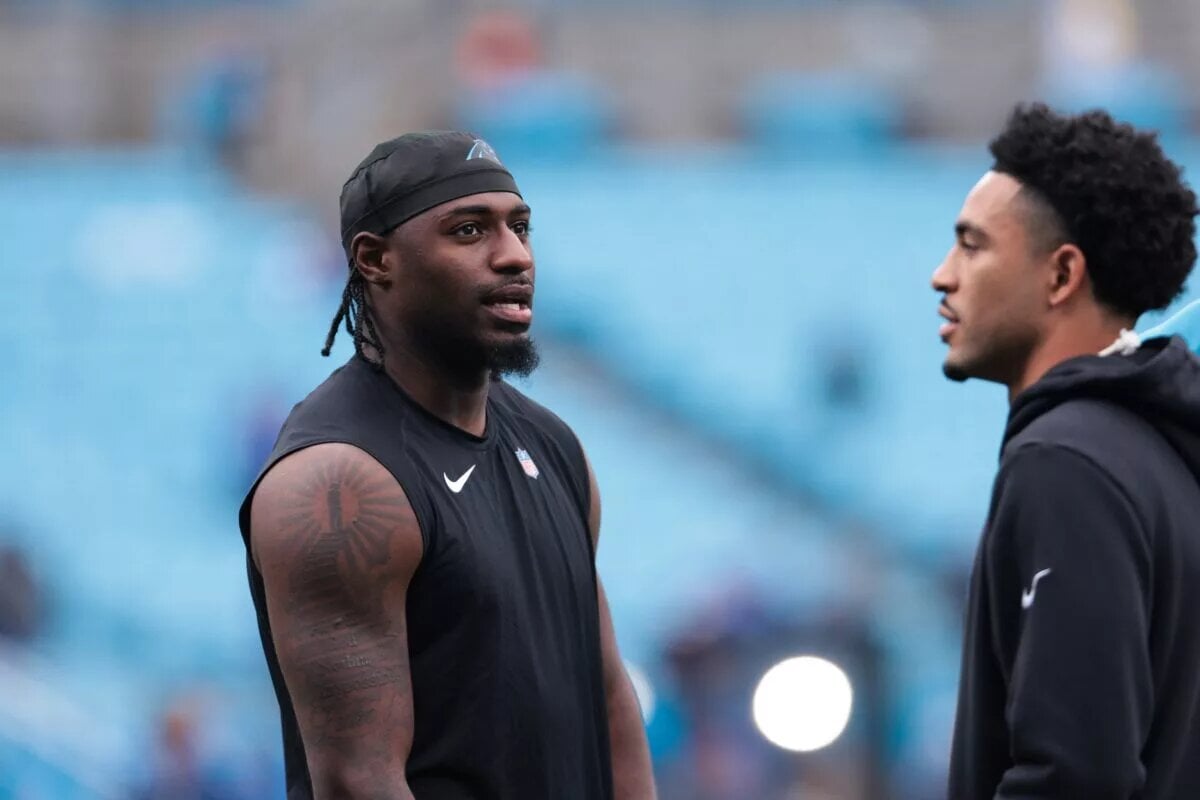
Carolina desperately needed explosiveness around Bryce Young after one of the worst offensive seasons in franchise history. The offense lacked speed, size, explosiveness, and physicality. Legette, the South Carolina prospect, looked like the type of player capable of changing that immediately.
At 6-foot-3 and over 220 pounds, Legette brought rare athletic upside to the position. His breakout season at South Carolina showed flashes of dominance that NFL teams dream of. Projecting forward, many scouts compared his physical profile to D.K. Metcalf, and the Panthers clearly believed they could develop him into a true wide receiver 1 over time.
The issue was never his talent. The issue was the timeline.
Just a few picks later, the Chargers selected Ladd McConkey, a receiver who may have lacked Xavier Legette’s physical ceiling but entered the league far more technically refined. McConkey immediately showed advanced route discipline, leverage awareness, good pacing, and separation ability. He created easy throwing windows and quickly earned Justin Herbert’s trust.
Bryce Young’s game has always depended on timing and anticipation.
His best football at Alabama came with receivers capable of winning through precision rather than pure athleticism. Jameson Williams and John Metchie III were excellent route runners and were able to get drafted in 2022.
McConkey naturally fit that style of play. Legette, meanwhile, needed significant development in the exact areas where Bryce Young needed help.
The Panthers drafted traits when Bryce Young needed reliability.
As of now, that does not mean Xavier Legette cannot still become a productive player. It just shows a larger issue across the league: teams often underestimate how valuable technical readiness already is.
The easy conclusion is that Carolina simply picked the wrong player.
I don’t think that’s entirely fair.
The Legette discussion is less about one receiver and more about a mistake NFL teams make every year. Front offices consistently face the same dilemma: do you draft the player who can help immediately, or do you bet on the athlete with the higher ceiling? Carolina is not the first team to choose traits over refinement, and they certainly will not be the last.
That is what makes the Xavier Legette decision worth examining beyond Charlotte.
Quentin Johnston vs. Zay Flowers and Jordan Addison
The Panthers are far from the only organization guilty of this.
The 2023 NFL Draft gave another example with Quentin Johnston.
Johnston entered the league with elite size, explosiveness, and yards-after-catch potential. On paper, he has the prototype modern NFL receiver build. Meanwhile, players like Zay Flowers and Jordan Addison entered the draft with concerns about size and physical limitations despite being significantly more polished route runners.
Once again, teams chased that higher athletic ceiling.
But once the games started, it was clear that Flowers and Addison immediately looked more prepared for NFL football. Both receivers were immediately taken after Johnston but showed why they were the best players. They entered the league understanding spacing, route tempo, and leverage. How to consistently separate from professional defensive backs.
Those skills translated immediately.
While Johnston’s physical upside has remained intriguing, his game needs much more refinement before becoming the star the Chargers hoped for. It is difficult when organizations draft raw players into offenses that need consistency. Their development becomes even more difficult.
Johnston’s career is a good example of that challenge. The early dropped passes have hurt his confidence and become part of the narrative around him. While he has improved in that area and developed into a legitimate red-zone threat, his consistency remains a work in progress. There are still stretches where his physical tools flash like a comet, but then immediately fade away.
The important thing is that none of these examples proves that betting on traits is wrong.
They simply show that context matters.
A developmental receiver is much easier to justify when the roster around him can absorb the growing pains. Problems arise when organizations ask unfinished players to solve immediate problems.
Ironically, that is why Carolina’s approach with Chris Brazzell feels so different.
Why Chris Brazzell II Feels Different
Carolina’s selection of Chris Brazzell II in the third round adds another layer to this discussion.
At first glance, it almost looks like the Panthers fell back into the same trap again. Size over refinement. Brazzell entered the draft as another traits-heavy receiver prospect: 6-foot-4 with blazing 4.3 speed and that vertical-play ability that catches scouts’ attention.
Unlike the Xavier Legette situation, Carolina’s environment for Brazzell is completely different.
The Panthers are not asking a raw receiver prospect to stabilize this offense for Bryce Young.
Brazzell enters a much healthier developmental situation with far less pressure. With Tetairoa McMillan established as the primary target and Jalen Coker continuing to settle as the number 2 option, Brazzell will likely enter year one as the third or fourth receiver in the rotation. Xavier Legette, Metchie III, and Jimmy Horn Jr. are also still in this rotation, fighting for reps.
It gives Carolina something they failed to give Legette when they drafted him: A developmental runway.
Xavier Legette entered the league with expectations attached to a first-round pick and an offense desperate for answers. Brazzell enters a room where he can spend a year working on his route running, learning the playbook, and earning snaps gradually rather than being asked to become part of Bryce Young’s solution immediately.
And truthfully, Brazzell needs that time coming out of college. Despite his elite physical tools, many evaluators have several concerns about his overall polish as a receiver.
His route tree at Tennessee was viewed as fairly limited due to the type of offense that they run. The receivers are expected to run a lot of choice routes, which are dictated by the placement of the defenders. It doesn’t require technical route-running and an understanding of the playbook needed at the NFL level. Then, off-field concerns also played a role in his draft slide. He was arrested in 2025 for speeding and driving on a suspended license. Some teams questioned his maturity and decision-making process during evaluations. When you combine those two major things, his slide wasn’t surprising.
Context changes significantly when expectations change.
The Panthers are not depending on Brazzell to save the offense. They can allow him to develop slowly, expand his route tree, improve his technical refinement, and learn behind a much more stable receiver room. That is a completely different developmental environment than the one Xavier Legette walked into as a first-round pick expected to immediately elevate Bryce Young’s offense.
Traits become much easier to bet on when patience is built into the plan.
It’s a Question of Timeline
Of course, none of this means teams should stop betting on traits.
If they did, players like D.K. Metcalf would never become stars. Terrell Owens would never have developed into a Hall of Fame receiver after being selected in the third round. Brandon Marshall, a fourth-round pick, may never have become one of the most productive receivers of his era.
All three guys entered the league with physical gifts that their teams believed they could develop. The difference is that development was allowed to happen. Metcalf grew into his game alongside an established quarterback in Russell Wilson. Owens spent time refining his craft, learning from Jerry Rice before becoming one of the NFL’s most dominant receivers. Marshall’s impact wasn’t immediate either in Denver. None of them were finished products when they entered the league.
That is what makes these draft decisions so difficult.
Every front office believes it can find the next Metcalf, Owens, or Marshall. Sometimes they do. More often, they are betting on a development path that may take years to complete.
The challenge is understanding what your offense needs right now.
If a team has patience, stability, and a quarterback capable of carrying the offense while a receiver develops, betting on traits can make sense. But if a young quarterback needs immediate help, there is a strong argument for prioritizing the receiver who already knows how to separate, create throwing windows, and earn trust from day one.
That’s why the Xavier Legette-Ladd McConkey debate remains so fascinating.
It was never really a discussion about talent.
It was a discussion about timing.
Carolina needed a receiver who could accelerate Bryce Young’s development. Instead, they drafted a receiver whose own development needed time.
Two years later, the Panthers appear to understand that distinction far better than they did on draft night.
Main Image: Scott Kinser-Imagn Images