
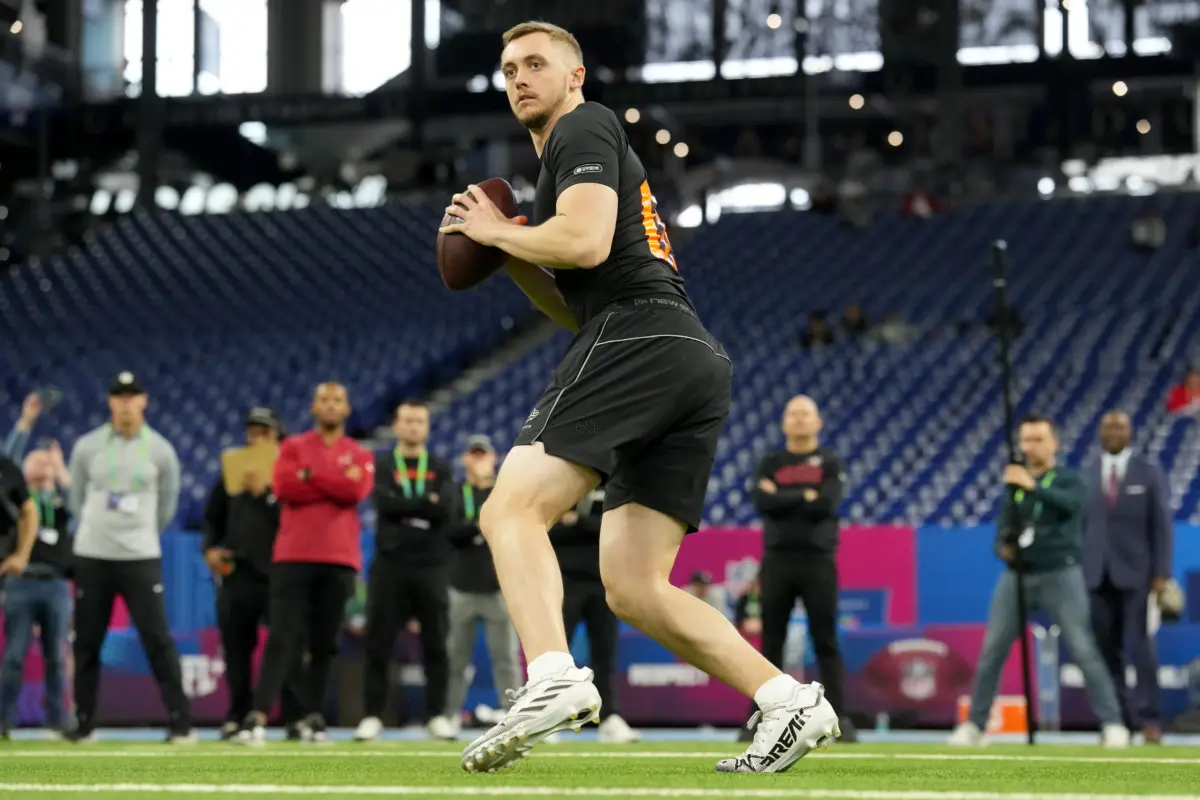

Haynes King enters the 2026 NFL Draft as a late-round quarterback prospect whose value is tied more to traits than polish.
After beginning his career at Texas A&M, King transferred to Georgia Tech and rebuilt his trajectory, turning into one of the most productive dual-threat quarterbacks in college football.
He doesn’t project as a future starter at the NFL level. Instead, his evaluation centers on whether his athleticism, toughness, and growth can translate into a defined role.
This creates a key question for teams late in the draft:
Is Haynes King a quarterback you develop, or an athlete you find ways to use?
Athletic Profile
King’s athletic testing is where the intrigue begins.
- 6’2”, 212 pounds
- 4.46 40-yard dash
- 6.89 3-cone drill (elite)
- 4.17 shuttle (elite)
- 33.5” vertical
He is one of the more athletic quarterbacks in this class, with the ability to:
- Extend plays outside the pocket
- Create as a runner on the designed concepts
- Add value in short-yardage and red-zone situations
This becomes a bigger factor when you consider how teams are increasingly valuing mobility in backup quarterback roles, particularly for game-planning and situational flexibility.
College Career
King’s career is defined by resilience and progression.
At Texas A&M, injuries and inconsistency limited his impact. A season-ending injury in 2021 and struggles in 2022 led to a loss of the starting role.
The transfer to Georgia Tech reset his career.
- 2023: 2,842 passing yards, 27 TDs, 10 rushing TDs
- 2024: 72.9% completion rate, 14 TDs, 2 INTs
- 2025: ACC Offensive Player of the Year, 3,900+ total yards, 15 rushing TDs
He also:
- Set school records in total offense and completions
- Finished with 37 career rushing touchdowns
- Served as a multi-year team captain
This becomes important in evaluation.
King didn’t just produce, he showed year-over-year development, particularly in efficiency and decision-making within structure.
Strengths
Haynes King’s value starts with his toughness, athleticism, and ability to function outside of structure. He’s not a polished passer, but he consistently finds ways to keep plays alive and create opportunities when the initial design breaks down. That trait alone gives him a pathway to sticking on a roster, especially in today’s NFL, where mobility at the quarterback position is increasingly valued, even in backup roles.
As a runner, King is more than just functional; he’s a legitimate weapon. His speed shows up both on designed runs and scrambles, and he has a natural feel for picking up tough yards in key situations. This becomes a bigger factor when you consider how offenses are incorporating quarterback movement into short-yardage and red-zone packages.
What separates King from other late-round quarterbacks, though, is his resilience and leadership. His career didn’t follow a clean trajectory, but he responded to adversity, transferred, and rebuilt his game. At Georgia Tech, he wasn’t just productive; he was trusted. That matters more than it seems, especially for quarterbacks fighting to earn a long-term role in the league.
There’s also clear evidence of growth as a passer. His completion percentage improved significantly over time, and he showed better decision-making within structure, particularly in his final seasons. While the ceiling remains limited, the progression suggests he can operate within a system when asked.
Key Strength Traits:
- Dual-threat ability with legitimate running production
- High-level toughness and leadership presence
- Play extension and off-script creation
- Noticeable improvement in efficiency and decision-making
Weaknesses
The biggest concern with Haynes King is simple: the passing traits don’t consistently meet NFL standards. While his efficiency improved, the underlying issues with accuracy and ball placement still show up on tape. He struggles to consistently hit tight windows, and his placement can limit yards after the catch. At the next level, where timing and precision are critical, that becomes a major limitation.
Pressure only amplifies those concerns. When the pocket collapses, King’s mechanics tend to break down. His footwork becomes inconsistent, his base narrows, and his throws lose both accuracy and velocity. This leads to rushed decisions and turnover-worthy plays, which will make it difficult for coaches to fully trust him in critical situations.
Arm talent is another limiting factor. King doesn’t consistently generate the velocity needed to attack the boundaries or drive the ball into tight coverage. While he can layer throws at the intermediate level, his ability to threaten defenses vertically or outside the numbers is inconsistent.
There are also valid concerns about how his game translates from a scheme perspective. He operated in an offense that leaned into his mobility, simplified reads, and created defined throwing opportunities. This becomes a bigger issue when projecting him into an NFL system that requires full-field reads and consistent pocket execution.
Finally, his frame raises durability questions relative to his play style. At just over 210 pounds, he absorbed a high number of hits as a runner in college. That’s not a sustainable formula at the next level, which limits how much of his rushing ability can be featured.
Key Weakness Concerns:
- Inconsistent accuracy and ball placement
- Mechanics break down under pressure
- Limited arm strength and velocity
- Scheme-dependent production
- Lean frame for physical play style
Last Word on Haynes King
Haynes King is a late-round evaluation that requires discipline.
He doesn’t offer:
- Starting upside
- High-level arm talent
- Immediate impact as a passer
But he does bring:
- Athleticism
- Toughness
- Leadership
- Proven development
This is where teams have to be clear in their approach. King is not a player you draft to build around. He’s a player you draft to develop within a role.
Because at this stage of the draft, success isn’t about finding stars. It’s about finding players who can stick and provide value in specific situations.
Haynes King has just enough of those traits to give himself that opportunity.