
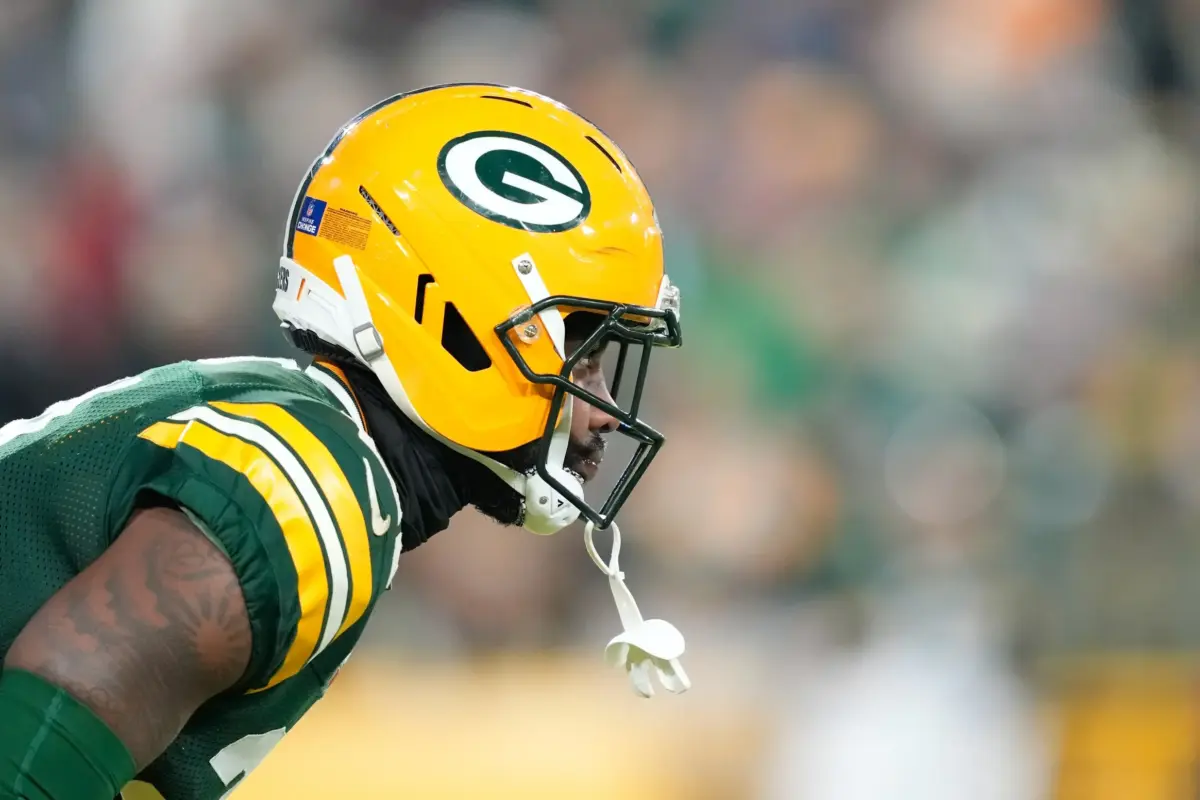

NFL roster building is often thought of as a long-term investment strategy. Some decisions are rewarded over time, while others reveal mistakes along the way. What often sets apart stable organizations is not perfection, but rather the ability to adjust before mistakes become permanent. With that being said, that’s what the Packers did this offseason for their cornerback room.
A deal was made to sign cornerback Benjamin St-Juste to a two-year contract. Shortly after, the Packers decided to release Nate Hobbs, one of the previous offseason’s most notable additions. Together, the deals represented more than just a roster shuffle. It showed that Green Bay is not only reshaping its secondary but also correcting course in real time.
Breaking Down the Packers’ St-Juste Signing and Nate Hobbs Decision
Moving on from Hobbs
The Nate Hobbs signing was never completely in line with Green Bay’s typical free-agent history. A four-year, $48 million contract showed belief in untapped potential, but it also included significant risk given his history of injuries and inconsistent performances on the field. Those concerns came to light in 2025.
Hobbs struggled to stay on the field, missing six games and failing to show defensive consistency. His impact was limited, and the return on investment never met expectations for Green Bay. While the financial consequences of moving on are significant, the Packers avoided worsening their mistakes by offering more money and resources to him.
The Packers could have doubled down and paid the roster bonus. Instead, they shifted and owned up to the mistake. Because in today’s NFL, the worst thing a front office can do is hold on to a miss for too long.
Enter: Benjamin St. Juste
Benjamin St-Juste arrives as a fundamentally different type of acquisition for the Packers. At 6-foot-3, a size that had been largely absent at the position is now present. That alone changes the conversation. Matchups can be approached differently. Certain coverage responsibilities can be distributed with more flexibility.
While his career has been rocky, his most recent performance gives reason for optimism. In 2025, St-Juste allowed only a 50.0 percent completion rate and a maximum passer rating of 64.0. He was also a consistent tackler, missing only one throughout the season.
There are still limits. His ball production has been limited, and penalties have been a problem in previous seasons. However, the structure of his contract reflects those problems. This is not a long-term financial deal; instead, it is a low-risk opportunity to get value from a player with established physical tools. In that sense, the move matches Green Bay’s overall recruiting style.
The Room as a Whole
These moves are best understood within the broader context of the secondary, and specifically, last year. The Packers’ secondary struggled with consistency throughout last season. Recurring injuries disrupted stability, and coverage performance was inconsistent, particularly on the perimeter. When the pass rush failed, these issues became even more apparent.
Keisean Nixon and Carrington Valentine both had periods of strong play, but neither appears to be a long-term solution. Depth was frequently tested, and the unit lacked both versatility and size.
St. Juste addresses a part of that problem. His presence brings an extra layer to the room, giving the coaching staff more options for how to deploy personnel. However, it is only one step in an ongoing process.
Looking Ahead
The truth is that the Packers’ work in the secondary is not complete. While St-Juste does provide size and experience, the secondary unit still requires more talent and a long-term answer for the corner. With the 2026 NFL Draft approaching, cornerback remains a position to monitor closely.
For now, however, the organization has taken an important step. It identified a weakness, adjusted accordingly to it, and avoided the temptation to wait for improvement that may never come.