
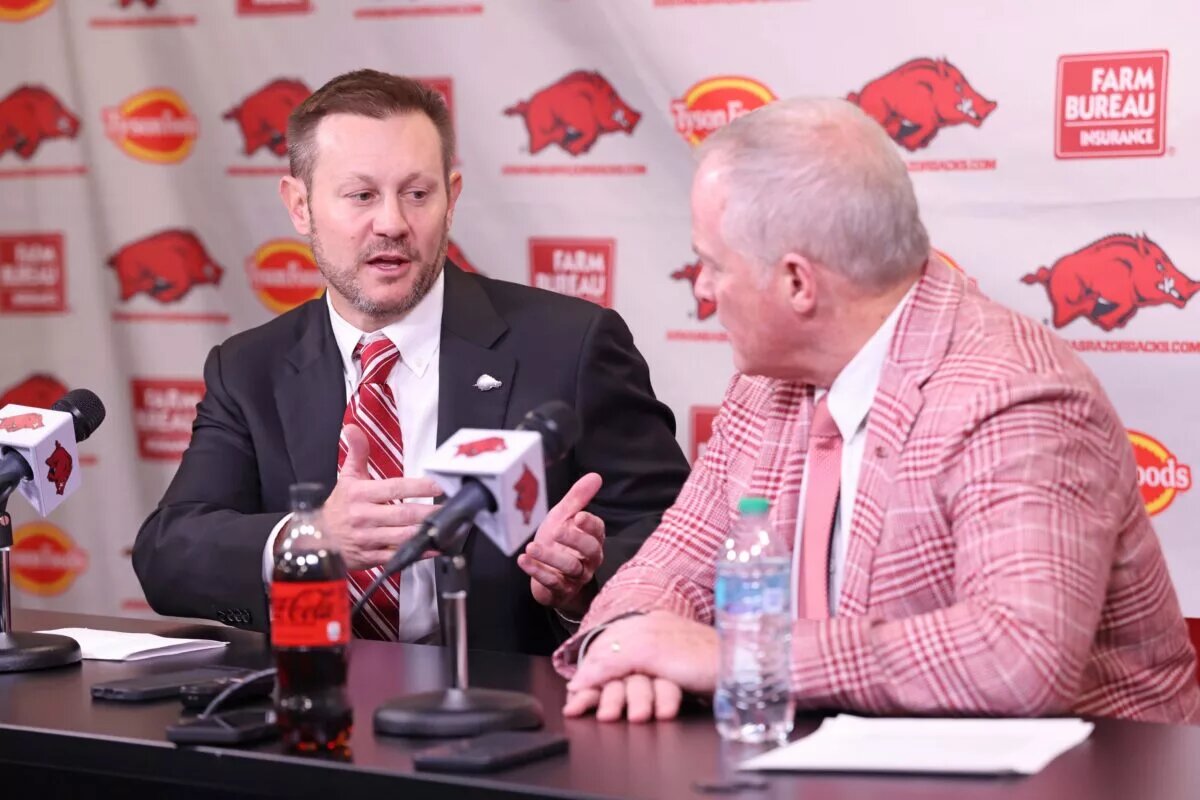
The phrase “sleeping giant” has floated around Arkansas football for years, usually paired with a hopeful shrug and a reference to facilities, fan base, or “potential.” It popped up again when word leaked about Hunter Yurachek’s handshake with Ryan Silverfield and the line that came with it: “Let’s go win a damn national championship.” On its face, it sounds like the AD is finally speaking the language fans want to hear. Lay it next to the last decade of football, though, and the gap is hard to ignore.
Arkansas Football: Sleeping Giant Or Middle‑Class Program?
“Realistic Expectations” Has Become A Crutch
Any time Arkansas bottoms out, the chorus starts. Toughest schedule in the country. Brutal league. No easy outs. None of that is wrong. It’s just incomplete. Those factors are baked into the job. They’ve also become the first refuge when another season falls into the same 5–7, 4–8 neighborhood.
If you strip away the excuses, the résumé is plain enough. Arkansas has been stuck in a cycle of brief spikes, painful valleys, and coaching changes. For every season that flirts with relevance, there’s another that ends with a buyout. A “giant” doesn’t stay asleep that long. A middle‑class program does.
Silverfield walks into that history with a reputation built at Memphis. He won there. He adapted schemes to his talent. He kept the Tigers in the mix every season. That’s impressive work, but it’s not proof that he can navigate the SEC meat grinder. The week‑to‑week reality is different. Depth is different. Margin for error is almost non‑existent. What works on Friday nights in the AAC doesn’t always translate to Saturday afternoons in Baton Rouge or Athens.
Onward and Upwards
If Arkansas really wants to change tiers, the bar has to move. Bowl eligibility can’t be treated like a parade‑worthy achievement. Eight and nine‑win seasons should be part of the regular diet, not a once‑in‑a‑decade sugar high. The occasional ten‑win run should exist as something more than a hazy memory from another era. Those are the signposts of a program that has outgrown its excuses.
That’s where the handshake language collides with reality. “Let’s go win a damn national championship” doesn’t line up with a school that spends most of its time trying to claw its way to 6–6. You can’t aim for the biggest stage in the sport and then ask everyone to grade on a curve when the record comes in under .500.
The Handshake Fans Will Bring Back Later
The national title line at the contract table did more than pump up a room. It gave the fan base a clear, unmistakable measuring stick. For years, Arkansas leadership could dance around what “success” really meant: competing hard, improving facilities, and keeping the program “respectable.” That sentence blew up the wiggle room.
At some point down the line, probably sooner than anyone in the building would like, the results will have to be held against that standard. If year three rolls around and Arkansas is 5–7 with a couple of encouraging losses, the handshake will come back up. If another staff change happens and the new direction sounds suspiciously like the old one, the handshake will come back up. That’s how this works once you put the biggest dream on the table.
The roster, the recruiting profile, and the financial landscape don’t currently match that dream. They might get closer. Silverfield might prove he was more than a “safe” hire. He might build a team that really does feel like a throwback to the bruising, no‑nonsense version of Arkansas fans still romanticize. None of that can be assumed. It has to be earned.
The Sleeping Giant
The “sleeping giant” line, for now, feels like a story people tell themselves to soften the blows. Giants don’t need reminders about their potential. They show it. The reality is harsher: Arkansas has behaved like a middle‑of‑the‑pack program in the toughest league in the country. Until the record changes, that’s what it is.
Silverfield didn’t choose the weight of that handshake phrase, but he accepted it. Yurachek didn’t have to say the quiet part out loud, but he did. Those decisions raise the stakes on everything that happens from here. If this staff turns Arkansas into a consistent problem, the story of that contract‑room moment becomes part of program lore. If not, it becomes another line everyone throws back at the people who said it.
Either way, the days of hiding behind vague talk about “building it the right way” are over. Arkansas put championships in the job description. Nobody outside the building is obligated to pretend that makes sense until the wins catch up.
Main Photo: Nelson Chenault-Imagn Images