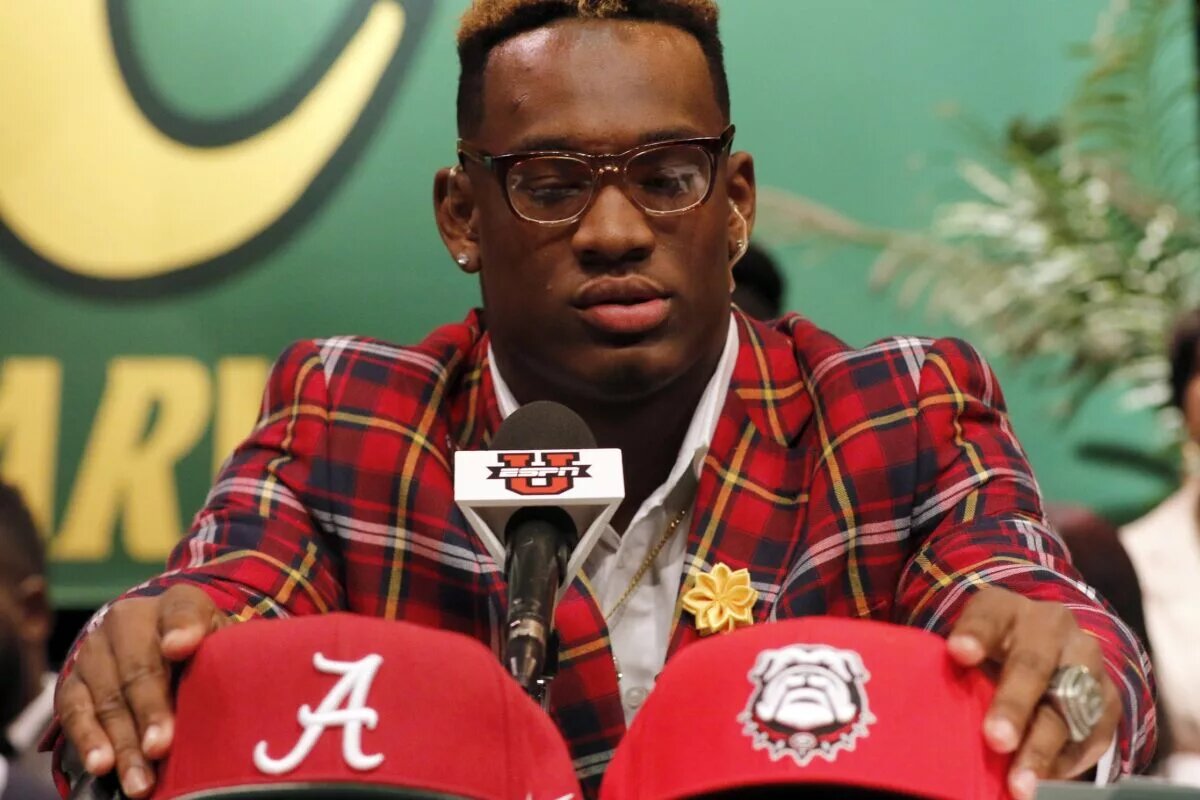
Did you participate in the 2016 trend on Instagram? We did. The dark circles and wrinkles were nonexistent. If you have no clue what we are talking about, here is the short answer. The 2016 trend on Instagram is a nostalgia-driven movement in which users, celebrities, and brands share unfiltered, lower-quality photos from 2016 to embrace a “simpler,” more authentic, and less curated era. With National Signing Day technically on Wednesday, we thought it was a good chance to take a look at how much it has changed in the last 10 years.
National Signing Day: 2016 to 2026
Which Hat Will He Pick?
Technically, National Signing Day has come and gone. In 2016, all eyes were locked on the February date. All eyes were on whether the five-star quarterback would select my team’s hat, or if that hat and my team’s dreams would be discarded like Lane Kiffin on the tarmac at LAX. During the 2017-2018 school year, the NCAA allowed for an “early signing period.” The ruling has flipped the high school recruiting calendar on its head. Most of your recruits, especially the ones most coveted, used to wait until February to announce their commitments. Ten years later, that model has turned on its head. In December, almost 90% of the Class of 2026 signed. We will have a handful of “announcements” this week, but the hay is in the barn for the players and teams for this year’s class.
Who Are The Top Teams?
Let’s take a look at who was in the Top 10 in 2016 and who rounds out the list in 2026. We’ll use the data from 247Sports to make the comparison. Let’s face it, Shannon Terry didn’t even know what On3 was 10 years ago.
| 2016 | 2026 |
| Alabama | USC |
| LSU | Alabama |
| Florida State | Oregon |
| Ohio State | Ohio State |
| Ole Miss | Notre Dame |
| Georgia | Georgia |
| Texas | Texas |
| Michigan | Tennessee |
| Auburn | Miami |
| USC | Texas A&M |
- Who’s still here? Maybe the sky isn’t falling in Tuscaloosa (until they lose or miss the playoffs again). The Buckeyes remain a constant at the top. Georgia and Texas have remained constant at 6/7 (insert annoying joke here), but those are disappointing numbers in 2026.
- Who are the new guys? “The U” is back. Sorry, we know that was played out with their national championship appearance in 2025. Miami and Texas A&M have leveraged their NIL dollars to get into the Top 10 club. Marcus Freeman continues to show that maybe (definitely) Brian Kelly was wrong not being able to build an elite roster in South Bend.
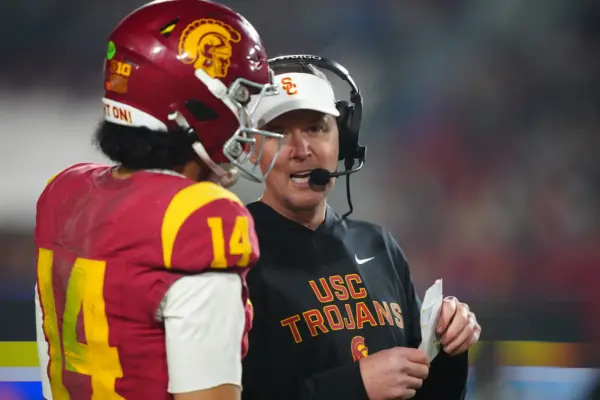
- Fight on? USC has the number one class in 2026. They have a lot of players and some great talent, but let’s just say we had to Google this a few times to make sure we were right. Lincoln Riley hasn’t gotten much right in L.A, but a fancy recruiting class and hiring GP as his new defensive coordinator is a good start.
- Who are we missing? Ole Miss, Auburn, and Michigan were missing from our list. Michigan had its own challenges this offseason and should be back near the Top 10 next season. We all know how Brother Hugh got Ole Miss into the Top 10. While the Rebs aren’t in the Top 10, Pete has used the Portal to build the roster. Auburn is still searching… for what? We hope Alex Golesh knows.
Who are the top conferences?
So long, Pac 12, we miss you. Well, we miss Pac12AfterDark. Conference realignment put an end to the “Conference of Champions.” The big two and the “other two” have greatly benefited. Here is a look at how the conferences have evolved over the last ten years.
| 2016 | 2026 | |
| ACC | 3 | 4 |
| B1G | 4 | 6 |
| Big 12 | 4 | 3 |
| SEC | 9 | 11 |
| Pac 12 | 4 | N/A |
| G6 | 0 | 0 |
| Indepenent | 1 | 1 |
- It Still Just Means More: The SEC may be in year three of a national championship drought, but there is something to be said for the conference’s depth. 70% of the conference’s teams are ranked in the Top 25 in the Class of 2026.
- B1G additions: The Pac-12’s loss is the B1G’s gain. USC, Oregon, and Washington all find themselves in the Top 25 and are helping the B1G try to match the depth of the SEC.
- Big 12’s Number Three: The ACC and Big 12 are in a cage match to stay relevant in a world where the SEC and B1G take up most of College football’s oxygen. The Big 12 has done a better job of creating a scrappy conference. Deep pockets in Lubbock, Stillwater, Provo, and Houston are going to help the Big 12 distance itself from the ACC.
Where are the stars going?
What about the high-end recruits? The numbers look relatively close, but a closer look reveals key differences over the last five years.
| 2016 | 2026 | |
| Five Stars | 18 teams | 18 teams |
| Four Stars | 57 teams | 68 teams |
- Stacks of talent: In 2016, five-star talent was slightly more evenly distributed across the top 10–15 programs. While Alabama led the way then (3), many top-10 teams, such as Ohio State, Florida State, and Michigan, had only one five-star each. In 2026, the elite recruits are starting to stack. Alabama, Oregon, and Notre Dame have landed five-star recruits.
- Go West Young Man: In 2016, the five-star recruits were predominantly in the ACC, SEC, and Columbus (SEC North). Take a look at 2026, Oregon and USC have compiled the most five-star talent. Contrast that with Georgia that has just one five-star.
- Spread the wealth: In 2016, it was extremely rare to see a 5-star commit to a program outside the traditional top 25. Ed Oliver was the exception when he decided to stay in Houston. 2026: Hold my beer. Vanderbilt (#33) and Maryland (#45) have both secured 5-star commitments in 2026.
- Four is greater than three: In 2016, a “loaded” class consisted of 12 to 17 four-star recruits. Back then, many top-10 programs still filled a significant portion of their rosters with 3-star “developmental” players. Now, the number of Four-star players at the top has exploded. Programs like USC (19), Notre Dame (20), Georgia (22), and Miami (22) are now signing classes in which almost the entire group is composed of 4-star talent or higher.
Does National Signing Day still matter?
National Signing Day does not carry the buzz that it did ten years ago. That is the impact of NIL and the Transfer Portal. Teams are now bringing in 20-40 new players each year from the Transfer Portal. Sure, they may still bring in high school recruits, but for the most part, that is now how teams are built in 2026. National Signing Day is still a lot of fun, especially for the recruits. It gives them one more opportunity to shine as high school athletes as they enter the now semi-professional world of college athletics.
Main Photo: Butch Dill-USA TODAY Sports