
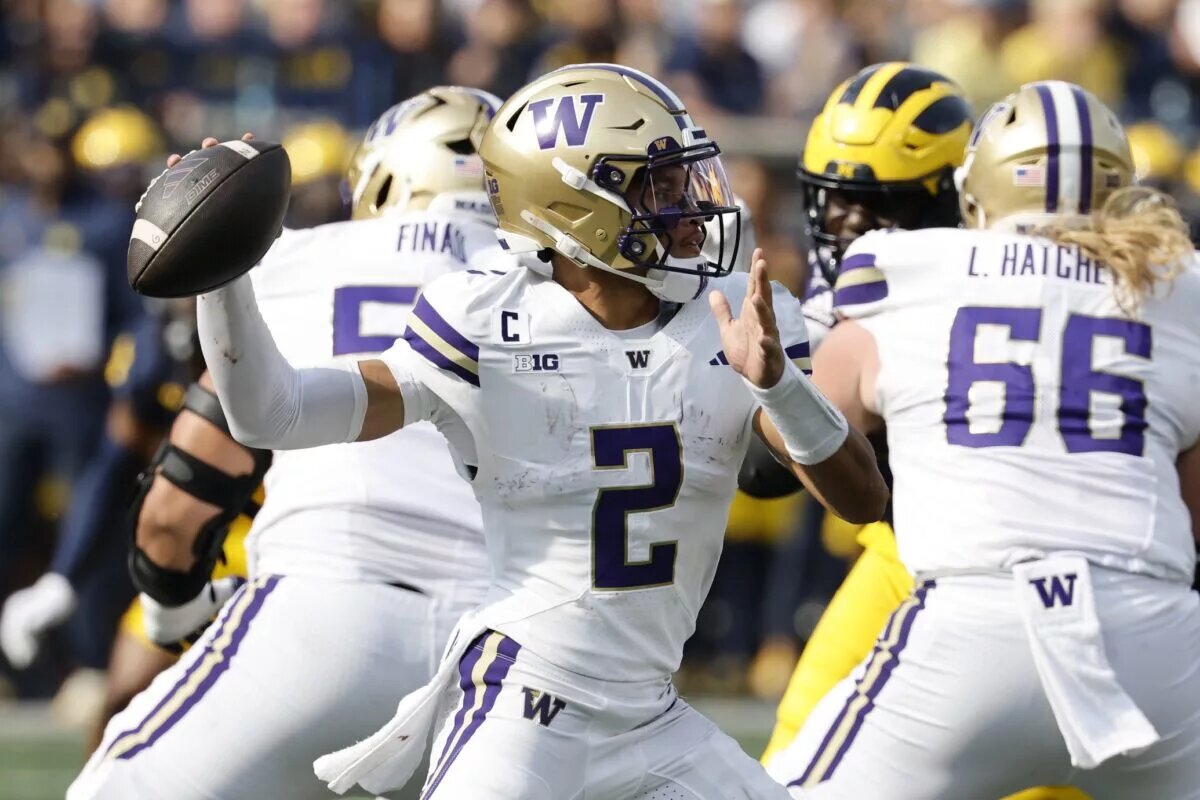
Washington will enter Camp Randall Stadium on Saturday afternoon for the first time since 1968. The 2-6 Wisconsin Badgers have yet to win a conference game this season. The Badger offense has struggled with injuries at quarterback and along its offensive line. Wisconsin’s 12.5 points per game ranks 134th nationally as drive sustainability continues to be the biggest hurdle for Luke Fickell’s group. Meantime, Washington’s efficiency on offense continues to turn heads. Among the entire nation, it ranks second in third-down conversion percentage and 12th in available yards percentage while averaging 6.8 yards per play.
Previewing Washington vs. Wisconsin
Offensive Inconsistency
In the last four games, Wisconsin has played two different quarterbacks. Senior Hunter Simmons has taken the vast majority of the snaps, with redshirt freshman Danny O’Neil having taken a few against Ohio State. Since starter Billy Edwards Jr. was injured in week one and re-injured in week four, he’s been sidelined with no timetable for return. Fickell was unclear about who will start for the Badgers against Washington this weekend. He even said that former four-star true freshman Carter Smith is in the mix this week. Smith has yet to take a snap in 2025, but could theoretically play the rest of the season and still maintain his redshirt.
Wisconsin has thrown at least one interception in every game this season and has thrown 10 total. The offense is gaining just 35% of its available yards (124th nationally), and is converting third downs just 34% of the time (117th nationally). Drive sustainability has been an issue for the Badgers this year. In their last four games, the Badger offense has averaged just 19 yards gained per possession. Just two of its 41 possessions during those four games spanned 70-plus yards. In addition to the inconsistency at quarterback, the offensive line has tried seven different combinations in eight games thus far.
Rush Defense Strength
Wisconsin has struggled this season in a lot of areas. It’s been shut out twice in conference play (against Iowa and Ohio State), and remains winless in the Big Ten. But defensively, the Badgers’ run defense is the team’s strength. The group allows just 110 rushing yards per game on average, which ranks inside the top 25 nationally. Wisconsin’s run defense gets its strength in two different ways.
One of those ways is in its personnel. “They’re very big, they’re fast, they’re physical,” Jedd Fisch said this week. “They’ve got two outstanding pass rushers that we have to be able to handle.” One of those pass rushers is outside linebacker/EDGE Mason Reiger. He’s a prototypical Wisconsin defensive end who plays with twitch and physicality. His violent style allows him to shed blocks in the pass rush and fight his way into rushing lanes against the run. Reiger has generated a team-high 26 quarterback pressures this season and made 16 stops according to Pro Football Focus.
The other pass rusher to make note of is Darryl Peterson, who’s recorded four tackles for loss in the last four games. Peterson is second on the team with 15 quarterback pressures and has logged 12 stops. He and Reiger have the highest pass-rushing grades on the defense, according to Pro Football Focus.
Defensive Schematics
The other way Wisconsin finds success in run defense is with its scheme. The secondary plays conservatively, with the goal to keep everything in front of it while maintaining eyes in the backfield. Safeties and cornerbacks are heavily involved in run defense, playing a leverage game rather than a tight-man-to-man to man coverage game. This type of coverage defense allows the Badgers to create solid run protection to the edge, not allowing big gains on outside runs.
Wisconsin’s Ben Barten (6’-5” and 330 pounds) and Parker Peterson (6’-4” and 315 pounds) are a significant physical presence on the interior of the Badger defensive line. The two don’t fill up the stats column, but they excel in stuffing run lanes and directing running backs towards tackling defenders on the outside. This is where the EDGE and secondary defenders get involved in the run game.
“Their safeties play extremely hard downhill,” Fisch said this week. “They’re a team that has always been known to be hard-hitting, physical, tough, defense to go against.” Two of the Badgers’ top three tacklers are safeties in Matthew Jung and Austin Brown. “Coach Fickell has always done a good job with his defenses, going back to when he was at Ohio State in 2011. I coached against him when I was at Miami. So, certainly have a lot of respect for him and the program.”
Misdirection & Motion
Because of the nature of the Wisconsin defense, much of its tendency is reliant upon the first step of the offense. With eyes in the backfield, the second level can tend to be reactionary to offensive movement. This is where Washington can implement misdirection and reverse action into its run game. In the Badgers’ game against Iowa, it was forced to defend the speed of Kaden Wetjen out of the backfield. The Hawkeyes frequently motioned him and other receivers pre-snap to get the defense on its heels. This helped open up big gains in the run game up the middle. Iowa had five runs of 10-plus yards in that game through the middle of the formation alone.
A similar approach for Washington this weekend can be impactful. Fisch has used Dezmen Roebuck and Raiden Vines-Bright in a similar way in motion before the snap, getting the football to them with jet sweep action and pop-passes. If Washington can set up this kind of lateral run game early in the game, it will open up the run game for Jonah Coleman through the middle.
Washingston vs. Wisconsin Prediction
Wisconsin’s run defense is its best opportunity to force Washington into a single dimension. But even in that event, the Badger pass defense has struggled this season. It allowed just shy of 10 yards per attempt against Michigan and Ohio State. The Badgers are allowing successful passes on 45% of their plays, which ranks outside the top 100 nationally.
This opens up a window of opportunity for Demond Williams to establish rhythm in the passing game on Saturday. Cornerback Ricardo Hallman has been stingy in coverage, allowing just 48 yards after the catch out of 305 total yards allowed. But on the other side, Geimere Lattimer II has given up 201 yards after the catch on 331 yards allowed. That’s an average of 9.5 yards after the catch per reception given up. If Washington can execute the run game with misdirection and motion, it will create opportunities in the passing game over top of a Badger defense playing on its heels.
Washington – 37
Wisconsin – 10
How To Watch Washington vs. Wisconsin
Date/Time: Saturday, November 8th; 4:30 pm Eastern
Location: Camp Randall Stadium (Madison, WI)
TV: BTN
Main Image: Rick Osentoski-Imagn Images