
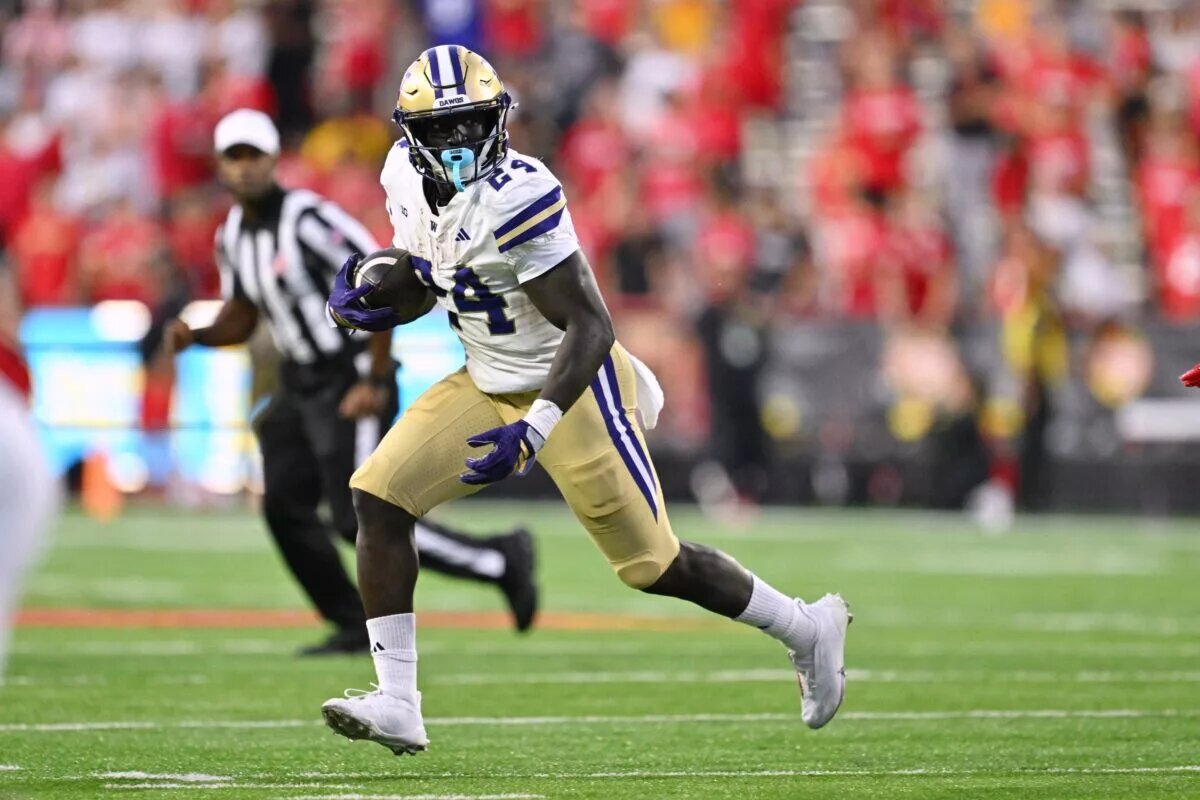
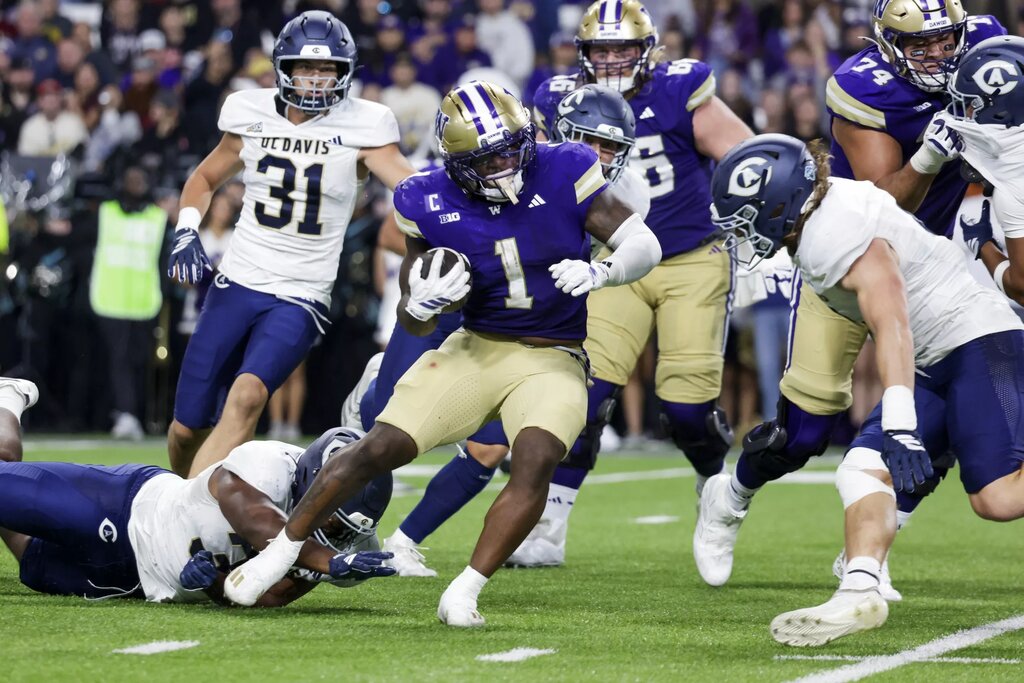
It’s been since the UC Davis game that the Washington running backs have accounted for more than 100 rushing yards in a single game. Jonah Coleman has not rushed for more than 70 yards since his 111-yard, five-touchdown performance in week two. However, as a team, Washington logged 173 rushing yards against Washington State, 115 yards at Maryland, and 177 against Rutgers. Quarterback Demond Williams provided the boost in those games, rushing for 88, 57, and 136, respectively.
Jedd Fisch still aims to prioritize the running game. He views the Husky running back struggles as more of a result of the circumstances of weeks past. But the two losses this year can’t just be attributed to a struggling run game. Against Michigan and Ohio State, the Husky offense ran significantly fewer plays than Fisch believes to be ideal. Making matters worse in those games, Washington failed to take advantage of its available yards like it has done in its five wins this year.
Washington Run Game Imbalance
How Teams Defend The Run
“You lose your starting left tackle, you lose your starting left guard, you lose your starting Y-tight end. Then you lose your backup left tackle,” Fisch said in his Monday press conference. “There are some challenges in running the football.” At Michigan, the offense totaled just 40 rushing yards. That was Washington’s lowest output of the Fisch tenure, and lowest since playing Oregon last year (43). “We will continue to make running the football a priority,” Fisch continued. “I think the healthier we get back up front, maybe the more running lanes will open.” The Husky head coach announced on Monday that he’s hopeful that the line will have both Carver Willis and John Mills back against Illinois. But he did not provide a hard timeline for their return.
The struggles in the run game also have to do with how teams have prepared to defend the offense. “We ran for 200 yards [against Rutgers],” Fisch said. “It just happened to be the way they wanted to defend Jonah; they gave us the opportunity to run the ball with Demond.” Washington rushed for a sack-adjusted 184 yards against the Scarlet Knights, but Fisch’s point is true. Defensively, Rutgers generated 11 stops against 31 run attempts (35%), and created six havoc plays against the run. With respect to the run game, a havoc play represents a tackle for loss or a forced fumble. That opened up a lot of room for Williams and he took advantage.
Not a Lack of Trying
“This past week, there just really wasn’t much space to run the football,” Fisch continued. Washington averaged a sack-adjusted 2.8 yards per rush on 21 attempts at Michigan. The Wolverine defense generated stops (gains of less than two yards) on nine of those runs (43%). Stopped runs have been an issue in the last four games against Michigan, Maryland, and Ohio State. Washington was stopped on 42% of its runs at Maryland and 46% of its runs against Ohio State. “We gotta keep getting our run game going,” Fisch said. “It’s not from a lack of trying.” The Huskies have run the ball on about 45.5% of their plays in Big Ten games thus far. But the running backs alone have averaged just 64.5 rush yards per game in those games.
“Each week we’re going to figure out how does a team try to take one guy away,” Fisch said. “If they take one guy away, what does that mean for the others? I think we saw that against Rutgers with Demond.”
Evaluating Play Count
Fisch also pointed to the number of plays being a factor in the production of the run game. “You don’t have a lot of plays,” he said. “All of us that have coached for a bunch of years in the past at programs that have played out here [on the West Coast], you’re used to about 76 plays a game. We’re now looking at 60 plays a game. That’s 16 less opportunities to rotate in a running back.” Thus far, only Coleman and Adam Mohammed have had meaningful touches in the run game. Jordan Washington has not taken a handoff in Big Ten play.
“You’d love to have, I think, a 68, 70 play game,” Fisch said, when discussing his ideal play count. “And that usually would come with a couple takeaways, or a couple more conversions.” Fisch said that increasing the play count would not necessarily be the result of going no-huddle or working with tempo. Quickly going three-and-out is a negative side effect of a tempo offense, and that can further reduce your play count in a game. “We need to take the ball away to get a few more possessions,” Fisch said. “You’d love to have about 10 possessions in a game, not eight.”
Washington had just eight possessions against Ohio State. However, against Maryland and Rutgers, it did have 10 possessions, excluding the kneel-down possessions at the end of each game. And on the road at Michigan, Washington had the ball 10 times. But four of them were drives that lasted three plays or less. Each ended because of an interception or a three-and-out. But if you look at play count, Washington has only exceeded 60 plays per game once in Big Ten competition. It was against Maryland when the Huskies ran 76 plays. Otherwise, against Ohio State, Rutgers, and Michigan, Washington ran 53, 59, and 55 plays, respectively.
Drive Sustainability
This indicates that the Huskies are struggling to sustain drives in these games. The offense reached the number of drives that Fisch believes is ideal. But their play count was low. In Washington’s two losses against Ohio State and at Michigan, it averaged just 29 and 23 yards per drive, respectively. Washington ranks 11th in available yards percentage (61.3%) this year. But in its two losses, it gained just 46% of its possible yards (Ohio State) and 38% (Michigan).
It makes sense that Washington’s run game is at its best when the offense is in rhythm, gaining the majority of its available yards. Washington has gained 170-plus rushing yards in four games this year. In all four games, the offense gained at least 70% of its available yards. It goes without saying that more yards gained generally means more offensive plays. That’s clearly something that Fisch is looking to produce. A healthy offensive line will help balance the run game between the quarterback and running back.
Main Photo: Jamie Sabau-Imagn Images