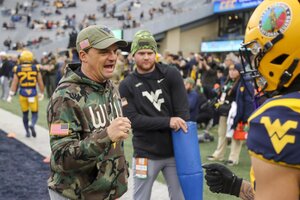

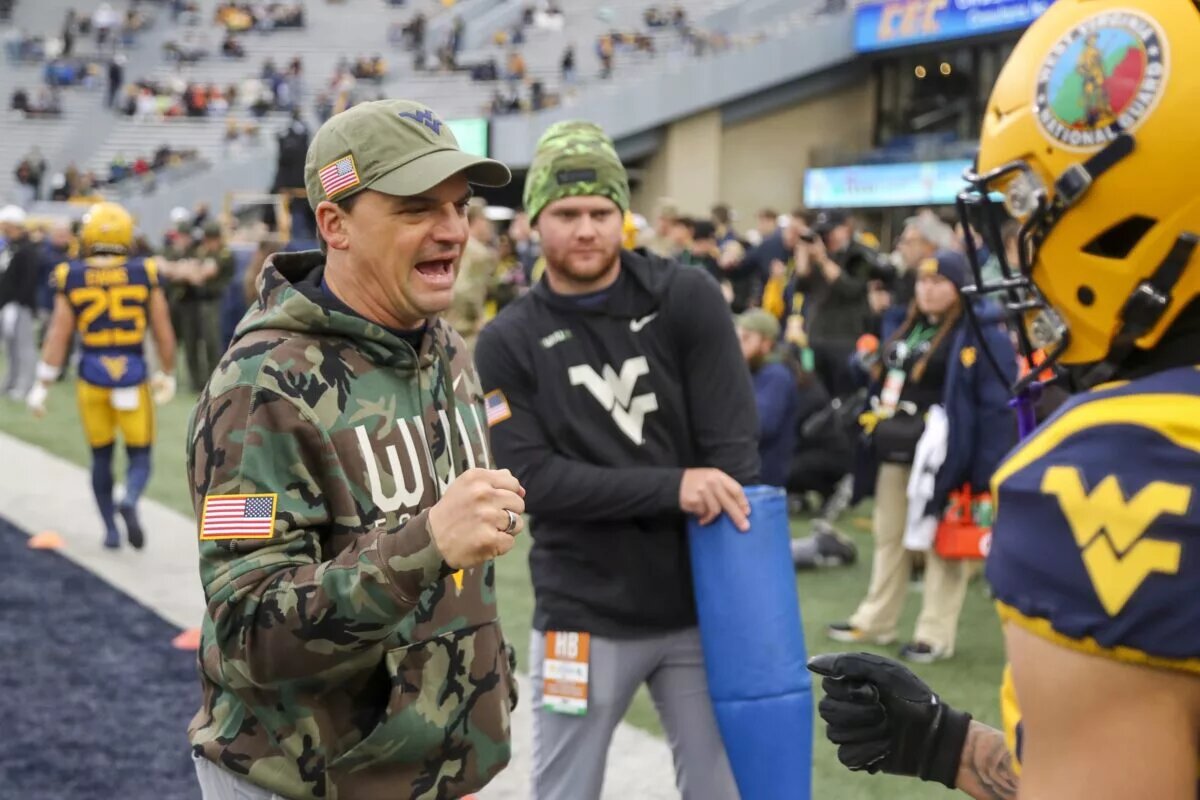
Over the past couple of weeks, rumors spread that the West Virginia Mountaineers would part ways with Head Coach Neal Brown after the 2024 season. In the hours since losing in lop-sided fashion to Texas Tech, those rumors heated up. Based on various reports, it is official: the Mountaineers fire Neal Brown.
Mountaineers Fire Neal Brown
In the past month, Mountaineer Athletic Director Wren Baker openly addressed the financial situation facing WVU athletics. With the House v. NCAA settlement approved, schools must start budgeting for revenue sharing with their student-athletes. They must also pay out their share of the substantial settlement for “back pay” owed for prior athletic seasons. The numbers going into that tally will not be small.
Collectives and NIL deals with student-athletes, will undergo greater scrutiny, and most believe the collectives will give way to the revenue sharing, which will be capped at approximately $20.5 million for the first year with expectations that this figure will grow to $32.5 million by year ten of the settlement term. Each Power Conference school must also contribute approximately $1.1 million to the settlement figure being paid out for prior athletic seasons. For the next ten years, then, each school must prepare to pay about $25 million of their revenue directly to players or former players (the latter in the form of the settlement fund).
The Financial Implications
As a result, Baker has addressed fans by noting that the athletic department would have to find money in the budget not only to overcome this shortfall but to pay a buyout owed to Brown and hire staff should the school choose to fire him. With Baker recently saying that he would want to set up any new hire with the resources necessary to succeed, some interpreted this as Baker warning fans that he may not have the finances needed to fire Brown.
That said, fan apathy continues to grow and the difference in fan attendance per game between a winning Mountaineer team and a losing Mountaineer team is about 7,000. That amounts to over $3 million in ticket and concessions revenue a year using the most conservative estimates.
The contract “fixed” the cost to fire Brown at 75% of the remaining amounts due under his contract. After this season, the Mountaineers owe $12.7 million to Brown for the next three seasons. They only owe one month of his 2024 salary (or $1 million) as of December 1. The contract does not require West Virginia to pay the full sum on termination, however. Instead, the amount can be paid over the term of his contract. Alternatively, the parties can negotiate a reduced buyout for a fixed lump sum. Even more, we use the word “fixed” in quotes because the buyout would be reduced by any salary Brown earns for football activities elsewhere.
What Does Brown Do Next?
As soon as rumors started flying that WVU would move on from Brown, associated rumors started coming in that other schools were reaching out to Brown’s agent. We even heard some rumblings that these discussions received WVU’s unofficial blessing. If true, that means the chances Brown finds a different head coaching job soon after being fired increased. Various sources tie Brown to job openings at places like UMass. That job would put roughly a $1 million dent in the buyout owed by West Virginia per season.
A comparable move would reduce the buyout owed to Brown over the next three seasons to about $8 million. Again, the parties could negotiate that figure into a lump sum with a further discount. Averaged over three seasons, West Virginia may gain money by reducing the chance of a continued decline in attendance numbers.
Regardless, we never interpreted Baker’s comments as warming fans up to the idea that they might retain Brown. Instead, Baker was likely trying to prepare fans for the reality that replacing their head coach might require greater asks of donors and higher prices for the gamey experience. Baker has at least answered the first part of the equation as the Mountaineers fire Neal Brown.
Looking Back at Brown’s Tenure
Since his arrival, it seems the dark side of Murphy’s Law caught up with Brown. He took over a team that lost over 80% of its offensive production heading into 2019. Then, he dealt with the short- and mid-term effects of COVID-19 and the growth of the transfer portal. Then, he faced an administration that hamstrung the use of NIL funds and transfer recruiting that crippled the roster.
Once Wren Baker replaced Shane Lyons as the Athletic Director, however, the “excuses” fell by the wayside. West Virginia started using NIL funding to combat transfer portal attrition and to start attracting better talent. Still, the problems that have plagued the Mountaineers on-field production since Brown’s arrival continued.
Breaking Down the Wins and Losses
In his six seasons in Morgantown, Brown lacks a true signature win. While many were high on the team’s potential for the 2024 seasons, others peaked under the hood of the 2023 team’s success. In 2023, the Mountaineers beat two Power Conference teams with a winning record. The second, UNC, sat many of its starters and played less than full strength. To some, that gave the win over UNC an asterisk. It caused them to question whether the 9-4 season offered fool’s gold.
Brown certainly talked up the success and dangled a Big 12 title game to fans as the goal for 2024. National media even talked up the Mountaineers as a dark horse playoff contender. Then, the Mountaineers finished the season going 0-6 against Power Conference teams with a winning record. That means that all of their wins came against teams with a losing record in 2024.
After two straight losses to Iowa State and Kansas State, Brown told fans that they lost to four ranked teams and even asked fans if they “still had fun.” Ultimately, that comment fell flat and aged even more poorly. Two of those first four losses came to teams that finished the season with seven or eight wins. One of those games involved an absolute drubbing (45-18) in front of a restless home crowd.
Par for the Course
Those results seem par for the course during Brown’s tenure. We define a good win as a win over a Power Conference team finishing the season above .500. We define a bad loss as a loss to a Power Conference team finishing the season below .500. In his six seasons, Brown accumulated six good wins and six bad losses. Worse, Brown finished 6-29 against Power Conference schools with a winning record. Worse still, he finished below .500 in home games in half of his seasons in Morgantown. That does not offer much excitement to even the most loyal Mountaineer fans.
That Brown finished season six with a pedestrian 37-35 record over that span removes any lifeline Brown may have otherwise had. After all, the Mountaineers were only a “good win” in two of Brown’s six seasons. No surprise then that the Mountaineers have endured Brown’s entire tenure without a single week ranked in the AP poll. That represents the longest such streak for the Mountaineers since the ten-year streak that ended in the 1969 football season.
Given the continued changing landscape the Mountaineers face, particularly in light of likely continued realignment over the next five years, West Virginia as a program simply could not endure the continued mediocrity Brown served. Baker knew his legacy could not survive further inaction. As a result, the Mountaineers fire Neal Brown. We will continue to update fans as we hear more about possible replacement candidates.