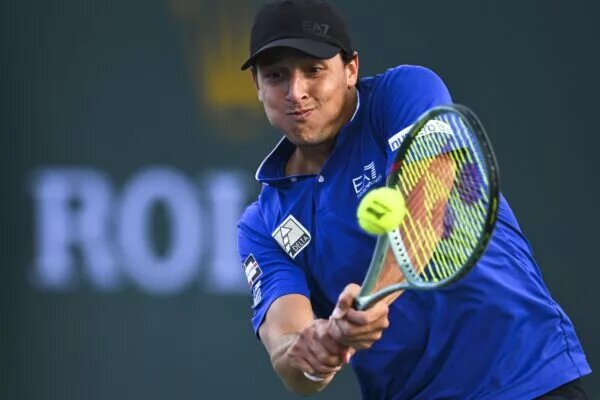

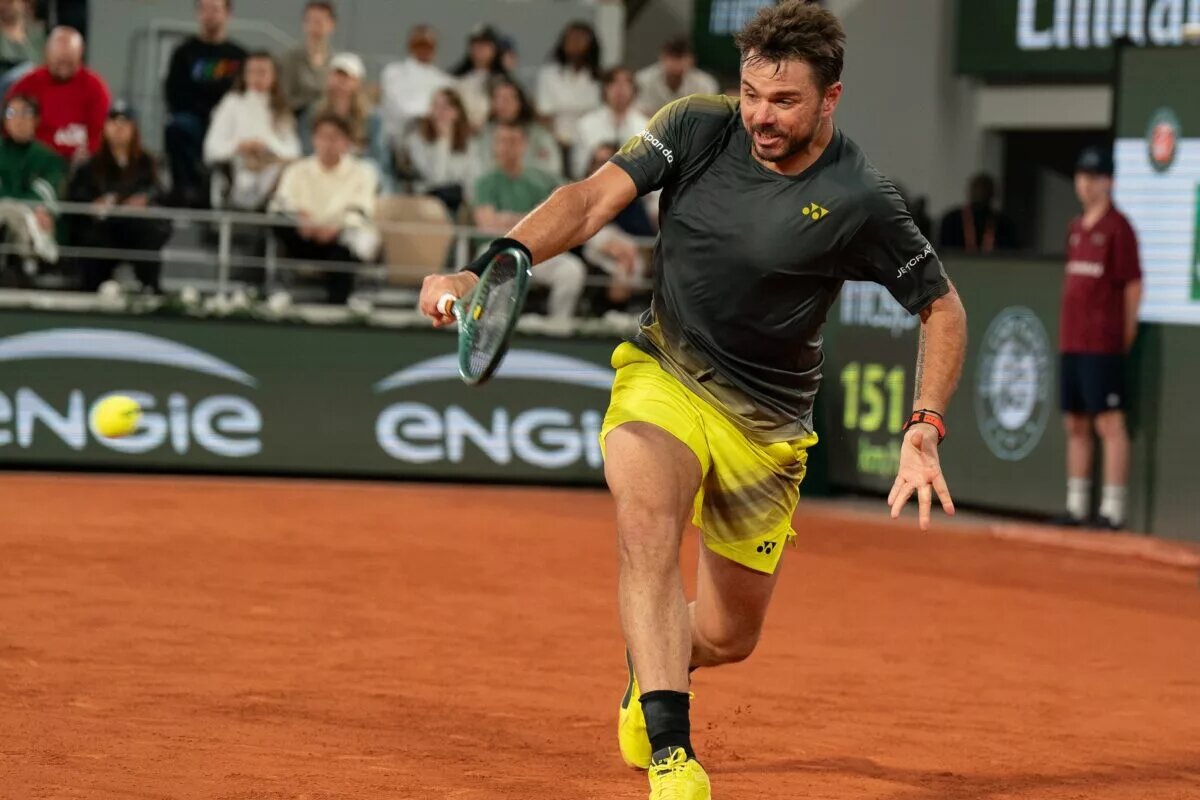

Stan Wawrinka lost to Roman Andres Burruchaga 6-4 4-6 6-3 on Tuesday at the Millennium Estoril Open, and with that two-hour, twenty-eight-minute battle, one of the great clay-court careers in modern tennis came to its final point. He saved three match points along the way, once lasering a trademark one-handed backhand down the line that briefly made the entire stadium believe in one more twist. There wasn’t one.
Burruchaga closed it out on the fourth opportunity, and Tournament Director Joao Zilhao walked onto the court afterward to present Wawrinka with a commemorative imprint marking his final appearance on the Estoril clay, and with it, the last clay-court match of his career. “I grew up on clay. I grew up practising on clay and watching clay-court tournaments, so clay was always special for me,” Wawrinka said afterward, and there was no need to embellish the sentiment further. The surface that shaped him as a junior in Switzerland is the same surface that just watched him leave the sport for good.
It seems only right, before he plays his very last matches this winter, to remember exactly how good Wawrinka was on this surface at his best–because at his best, on clay, Stan Wawrinka was one of the most dangerous and occasionally unplayable forces the men’s game has produced this century.
What Stan Wawrinka Actually Did on This Surface
Wawrinka finishes his relationship with clay-court tennis with a career record of 202 wins and 124 losses at tour level. But the number that matters is the one from Paris in June 2015, when Wawrinka walked into the Roland Garros final against a Novak Djokovic who was playing for the missing piece of the career Grand Slam, the last Major that had eluded him, and simply took the trophy away from him in four sets. It remains one of the most complete single-match performances the clay-court game has ever produced against an opponent of that stature. Djokovic was, by any measure, the best player alive that fortnight. Wawrinka hit through him anyway, backhand after backhand, until the outcome stopped being in doubt.
That was not a fluke built on one hot week. Wawrinka won the Monte Carlo Masters in 2014, one of only a handful of players outside the sport’s most dominant handful of champions to break through at that level during the peak Nadal-Djokovic years. He reached the Rome final. He beat the best clay-court players of his generation on their own terrain, repeatedly, using a game that had no business working as well as it did on a surface that traditionally punishes flat, first-strike hitting.
Wawrinka’s forehand and backhand were both struck with a violence that most clay-court specialists never needed to develop, because they were built around patience and construction. Wawrinka simply hit through the patience. His one-handed backhand, in particular, remains one of the most beautiful and destructive shots the sport has produced in the modern era. It was a stroke capable of ending points from defensive positions that would have forced any other player into a neutral, rally-extending slice.
The Player Who Made Power Work on Dirt
What made peak Wawrinka on clay so remarkable was the contradiction at the center of it. Clay is supposed to reward movement, defense, and patience above raw ball-striking. Wawrinka’s game was built on none of those things as a primary weapon. He hit the ball as hard and as flat as almost anyone of his generation, and rather than being neutralized by the surface the way conventional wisdom said he should be, he adapted his aggression into something that worked terrifyingly once he found his range.
On the days when the backhand was landing, and it landed often enough to win a Roland Garros title against the best player of that era, Wawrinka was arguably the most fearsome ball-striker on the surface, full stop. There was no defending it. There was no neutralizing it. There was only hoping it missed, and for stretches of his career, it very rarely did.
A Career Earned the Hard Way
None of this happened easily or early. Wawrinka spent years in Roger Federer’s shadow as a countryman, a talented but secondary figure in Swiss tennis until his thirties, when he suddenly became one of the most feared clay and hard-court competitors alive, winning three Grand Slam titles between the ages of 28 and 31. That’s an age at which most careers are already in decline. That the Roland Garros title arrived on clay, against Djokovic, at the peak of Wawrinka’s late-career powers, feels appropriate given how much of his identity as a player was forged on the surface long before the trophies started arriving.
Now, at 41, the clay-court chapter has formally closed. Estoril was new to him, a tournament he had never played in his career, chosen on purpose for his farewell season because it gave him one more Portuguese stage after his 2013 title in Oeiras. He leaves it having saved match points until there were none left to save, having reminded a crowd one final time what that backhand still looks like when it finds its target, and having been honored, appropriately, with a gift marking the exact moment his story on this surface ended.
Stan Wawrinka on clay, at his best, beat the best player in the world for a Grand Slam title using a game nobody thought could work on that surface. That memory does not fade because the career is ending. If anything, days like Tuesday in Estoril make it feel more remarkable, a reminder that some of the greatest days of that career were built on the surface he loved most, and that the sport is better for having watched him play on it for as long as it did.
Main Photo Credit: Susan Mullane-USA TODAY Sports