

Like nature, tennis abhors a vacuum. So, in the prolonged absence of Carlos Alcaraz from the European clay-court season, new young male stars have emerged, particularly at the Italian Open in Rome, to try to fill the huge gap created by the first serious injury of Alcaraz’s career.
Although it remains extremely unlikely that any of them can seriously challenge Jannik Sinner at the forthcoming French Open, especially after he completed the “Career Golden Masters” by winning the Italian Open, at least they are generating hope that men’s tennis will become more broadly competitive than it has been during the recent Sincaraz duopoly and the current Sinner monopoly.
New Stars Emerge at the Italian Open
The profound contrast between the ultra-competitiveness of women’s tennis and the relative lack of competitiveness in men’s tennis that has been evident for the last two seasons has only become more pronounced during the current European clay-court season, when the absence of Alcaraz has left the field free for Sinner to dominate completely. Nevertheless, despite Sinner’s Nadal-style annexation of the three clay-court Masters events in Monte Carlo (where he soundly defeated Alcaraz in the final), Madrid and Rome, a run that he hopes to continue in Paris, there have been positive signs that new stars are coming through to challenge the status quo.
There were numerous examples at the Italian Open, including Dino Prizmic defeating Novak Djokovic and Alexander Blockx building on his impressive 2025 and run to the semifinals in Madrid. However, there were three real standout stars at the Italian Open, who all enjoyed their best ever performance at an ATP Masters 1000 event.
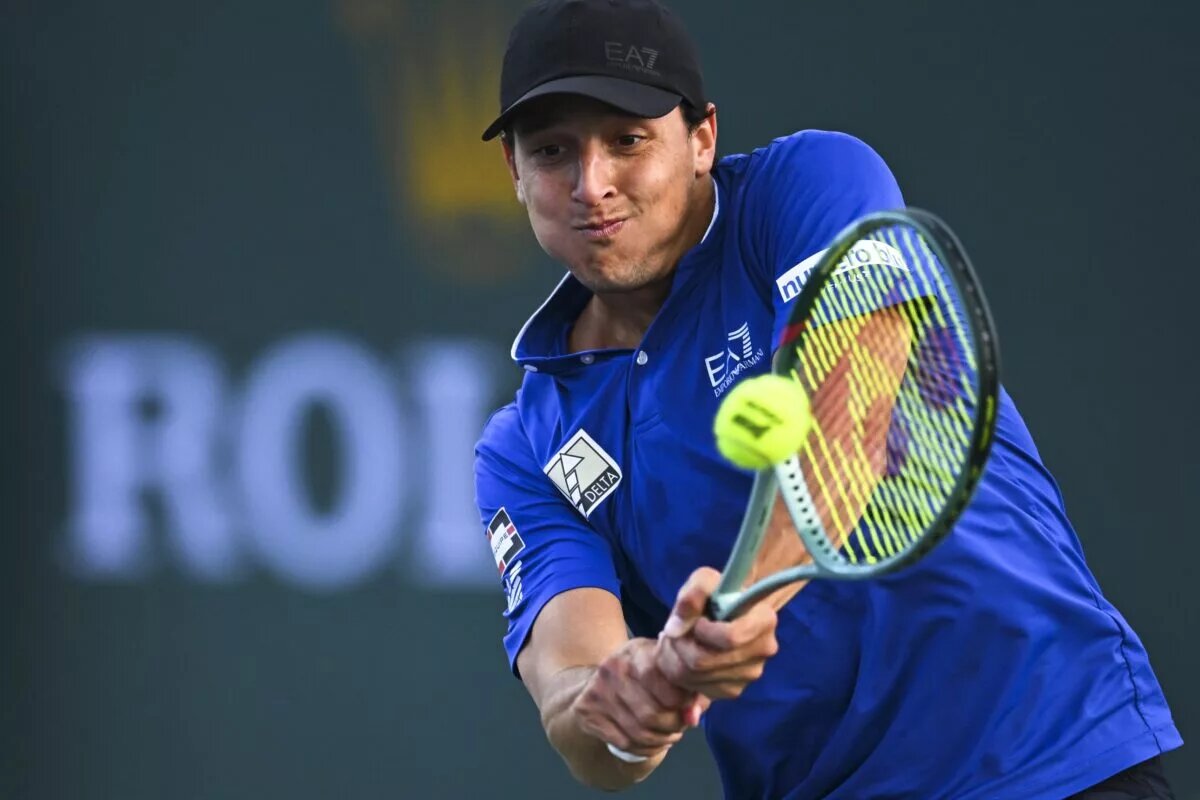
No. 1 – Luciano Darderi
Darderi is the latest Italian player to bloom during the current Tennissaince, which has catapulted the sport to previously unknown prominence within the country, especially during the ongoing travails of the Azzurri, or men’s national soccer team, which recently failed to qualify for a third World Cup in succession. And that is despite the fact that Darderi is Argentinian by birth. Nevertheless, he used the Italian citizenship he gained through ancestry to become the biggest Italian star in Rome other than Sinner.
The fact that Darderi made the semifinals of the Italian Open, where he eventually ran out of gas against the recently rejuvenated Casper Ruud, did not come as a complete surprise, given his excellent form on clay over the last 18 months. It is true that much of that success has come on the South American swing of the ATP Tour, including winning this year’s Chilean Open in Santiago.
However, unlike so many other South American clay-court specialists who do so well on their home continent, especially the fully Argentinian pairing of Francisco Cerundolo and Sebastian Baez, Darderi has finally been able to translate his South American clay-court form into success on the much higher-profile European clay-court circuit.
Perhaps Darderi’s greatest ability is his availability (as is often said in US sports), because at a time when so many young male players, Alcaraz included, are succumbing to injury, he seems to keep trundling on regardless. From the start of last season onwards, he has played considerably more events than any other ATP player and despite visibly flagging in the semifinal in Rome, he has already committed to playing this week in Hamburg and is still likely to be fully fit and firing come the start of Roland Garros.
No. 2 – Rafael Jodar
Being a Spanish tennis player called “Rafa” must be akin to being a Brazilian footballer called “Pele”, in that the pressure caused by sharing the name of the most famous compatriot in your chosen profession can be immense. So far, though, Rafael Jodar seems to be handling that pressure relatively easily, to the extent that other than the all-conquering Sinner he has probably been the biggest star and the best story of the European clay-court season on the men’s side of the sport.
Having excelled in his home tournament of Madrid, especially in his ultimately comprehensive defeat of Joao Fonseca, yet another of the teenage sensations trying to emulate Alcaraz and Sinner’s rise in recent years, Jodar had already confirmed that he has made the biggest rise up the ATP rankings of any player on the ATP Tour. Having been ranked outside the world’s top 600 at the start of 2025, he is now ranked World #29 and, like Darderi, might even be seeded for the French Open.
It was Darderi who ended Jodar’s impressive run to the quarterfinal in Rome, effectively doing to Jodar what Jodar had done to Fonseca in Madrid, “bagelling” him in the final set (winning it 6-0) just as Jodar had “breadsticked” the Brazilian in the final set in Madrid (winning that set 6-1).
In the long run, however, it is likely that Jodar will eventually rise above Darderi (who is now ranked No.16 in the world), not just because he is nearly five years younger but because he already looks to have more of an all-surface game than the Italian, who is very much a clay-court specialist.
No. 3 – Martin Landaluce
The Rome quarterfinal between Martin Landaluce, yet another young Spaniard (he is barely six months older than Jodar), and Daniil Medvedev might just have been the best three-set men’s match of the year so far. Medvedev ultimately won it 1-6, 6-4, 7-5. However, as the scoreline suggests, Landaluce dominated the first set and took the match deep into the third set, before following Darderi and Jodar and eventually succumbing to fatigue.
That is only to be expected with such young players. After the match, Medvedev was rightly full or praise for Landaluce, but also reminded everyone that even Jannik Sinner, the man who currently bestrides men’s tennis like a colossus, had taken a few years to build up not just his playing style but his physical resilience.
Landaluce, Jodar and Darderi will all have to complete a similar transformation if they are to challenge Sinner for the sport’s biggest titles, and obviously it will be impossible to effect such a transformation in the single week remaining before the start of this year’s French Open.
Two New Superpowers of Men’s Tennis
The fact that Sinner ended up winning the Italian Open so comfortably, after surviving a bout of sickness in his semifinal against Medvedev (which was possibly caused by the cumulative fatigue of relentless playing and winning), is a reminder that, in Alcaraz’s absence, he is the hottest of favourites for the French Open title, which would see him emulate Alcaraz and complete the Career Grand Slam.
Perhaps only Novak Djokovic, who so surprisingly defeated Sinner in the Australian Open semifinal at the start of the year, can stop him in Paris. None the less, the 2026 European clay-court season in the run-up to Roland Garros has already produced a number of potential future stars who might just be able to challenge both Sinner and Alcaraz in the future.
In addition, the last few months have confirmed, if it needed confirming, that Spain and Italy are the new superpowers of men’s tennis. For much of the 20th century and especially in the post-war period between 1950 and 1975, the USA and Australia were undoubtedly the biggest beasts in men’s tennis, as proven by the remarkable fact that between 1946 and 1959 they contested every single Davis Cup final.
In the 21st century, however, that mantle has undoubtedly passed to the new Mediterranean superpowers of Spain and Italy. And the emergence in recent months and particularly over the last fortnight of such new and promising stars as Jodar, Landaluce and Darderi is yet more proof of that.
Main Photo Credit: Jonathan Hui – Imagn Images