
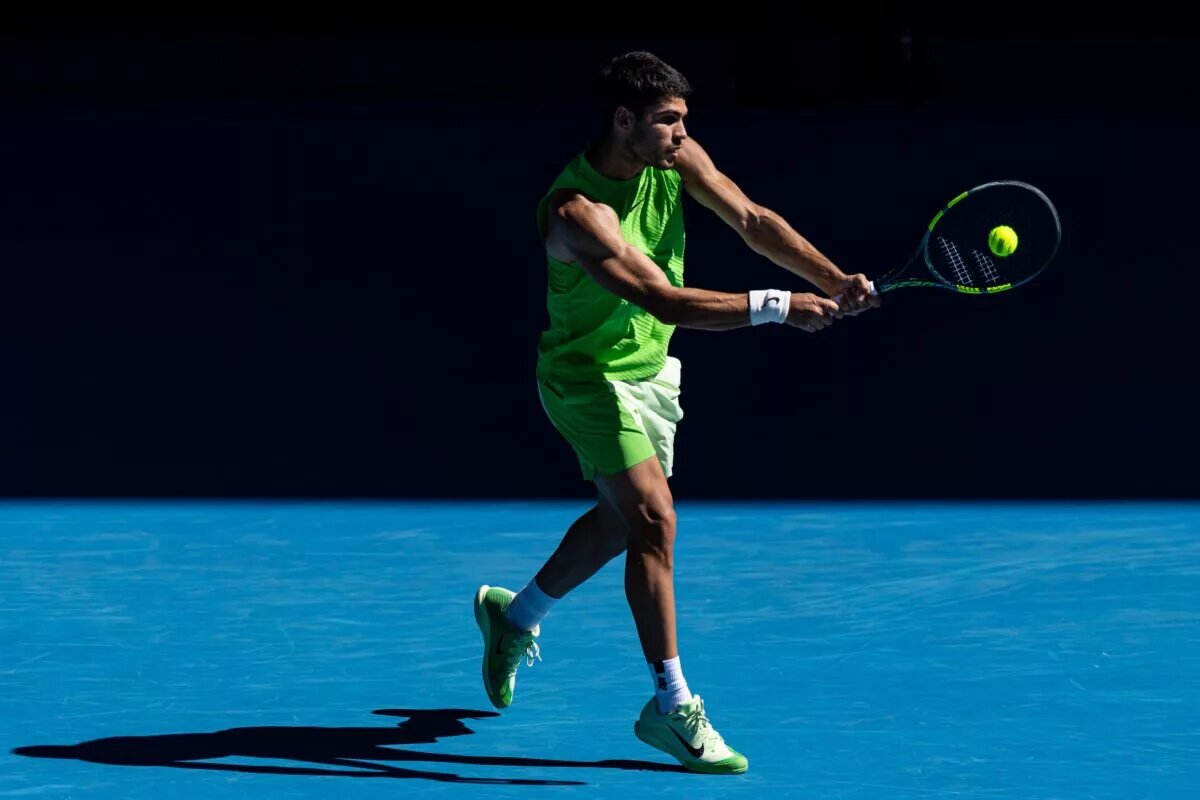

And so “The Schizophrenic Slam”, as the 2026 Australian Open might ultimately be remembered after a generally dull fortnight was followed by a fantastic final weekend, ended up becoming a genuinely historic Slam. And by completing the Career Grand Slam aged just 22, Carlos Alcaraz confirmed what virtually everyone (including this writer) thought when they first saw him on court: he is the best young male tennis player in history.
Alcaraz Career Slam At Age of 22
Everyone’s a Tennis Historian Now
As a tennis historian, it has been wonderful seeing everyone else who is interested in tennis also becoming (if only temporarily) a tennis historian, as the Men’s Singles final in Melbourne constituted what the French tennis writer Bastien Fachan called on X “arguably the highest-stakes men’s tennis match of all time”. That was an easy argument to make, given that Alcaraz was going for the youngest ever Career Grand Slam and his opponent, Novak Djokovic, was trying to win a 25th Major Singles title to break his tie with Margaret Court and stand alone as the sole holder of the most Major Singles titles.
In the end, after four extremely hard-fought sets (especially so after the Herculean efforts of both men in their semifinals), Alcaraz emerged as “The History Man”, or, more precisely, “The History Young Man”. Djokovic played superbly to win the first set of the final 6-2, breaking Alcaraz’s serve twice in the process, and it had seemed then that he might be about to achieve what had been thought impossible: beating Jannik Sinner and Carlos Alcaraz back-to-back, in a Grand Slam semifinal and final. However, Alcaraz recovered spectacularly, showing no signs of the cramp that had nearly crippled him in the last-four match against Alexander Zverev. And as Djokovic inevitably tired, he first ran away with the second and third sets, and then held his nerve to see out the fourth for victory.
Alcaraz’s Record Is An All-Time Tennis Record, Not Just For Open Era
From the point of view of a tennis historian, perhaps the most gratifying element of Alcaraz’s victory was that it obviously meant so much to Alcaraz himself. Earlier in the tournament, he had been asked whether he would rather win this year’s Australian Open than all the other three Majors in the rest of the year, and he had instantly replied that he would rather win in Melbourne to complete the Career Slam and become the youngest man ever to do so.
Perhaps the second most gratifying element is that over time most tennis fans have realised that Alcaraz has not just broken an Open Era record but an all-time record in tennis history, one that encompasses the entire history of the sport, from the end of the Victorian era to the present day.
When it was first being widely reported that Alcaraz would be able to complete the Career Slam in Melbourne this year, it was generally reported that the record that he was trying to beat was that of his illustrious compatriot Rafael Nadal, who had completed the Career Slam at the age of 24 at the US Open in 2010. Over time, however, as tennis fans and particularly tennis historians remembered that tennis did not start in 1968, it became clear that the real record to beat was that of Don Budge, the great American pre-WWII player who had completed the Career Slam at the French Championships (as it was then called) in 1938, when he was only 22.
Now, Alcaraz has beaten Budge, by just a few months, to become the youngest man ever to complete the Career Slam and his truly historic achievement can be placed in its full historic context.
What Next For Alcaraz?
Now that Alcaraz has beaten Budge’s near-century-old record of being the youngest man to complete the Career Slam, the logical next step for him is to try to emulate the American, and Australia’s Rod Laver, by becoming only the third man ever to complete the Grand Slam – i.e. the actual Grand Slam of winning all four Major tournaments in a single calendar year.
It was a feat that was famously beyond even The Big Three, including Djokovic in his annus mirabilis of 2021, when he won the first three Majors of the year and reached the final of the fourth, the US Open, before at last being beaten by Daniil Medvedev. However, Alcaraz, who is surely the ultimate product of The Big Three era, as the one player who somehow combines the greatest traits of Federer (the artistry), Nadal (the competitiveness) and Djokovic (the resilience), might just be able to achieve what they could not.
By winning in Melbourne and completing the Career Slam, he has, at least for the time being, distanced himself even from his greatest rival, Jannik Sinner, who had been the defending champion in Australia and indeed was going for a hat-trick of titles there until Djokovic channelled his inner Lazarus and defeated him in this year’s semifinal. Sinner will undoubtedly return, and probably stronger for the experience, as he showed at Wimbledon last year, when he beat Alcaraz to gain immediate revenge for losing their classic French Open final. Nevertheless, he is yet to win in Paris and until he does so, he cannot claim to be the complete, all-court and, crucially, all-surface player that Alcaraz is.
Can Djokovic, Zverev or Anyone Else Dethrone Him?
Of the other possible challengers to the crown, Djokovic is likely to remain in contention for Majors for at least another year, Alexander Zverev demonstrated in the Melbourne semifinal against Alcaraz that he is not as far away from him and Sinner as their ranking points would indicate, and there is still a chance that the phalanx of young (or rather, even younger) pretenders, such as Jack Draper, Jakub Mensik and Joao Fonseca, will finally get fully fit and stay fully fit long enough to compete for Majors.
For the foreseeable short-term future, though, it remains likely that Sinner alone will be able to consistently challenge, and even defeat, Alcaraz at the Majors (i.e. over five sets). Other than the brilliant Italian, it is very difficult to see anyone else right now really stepping up to take on the Young King. And that only increases his chances of completing, at some point, a Calendar Slam.
A Portrait of The Great Tennis Player As A Young Man
When the era of The Big Three finally began to draw to a close (and in time it might just prove to be the case that it finally ended this weekend in Melbourne), tennis and especially men’s tennis was rightly nervous about what lay ahead. However, what most tennis fans failed to realise was that such an extraordinary golden age, which was not just the greatest in tennis history but arguably the greatest in all of sporting history, would prove so enduringly inspirational that it would eventually beget even greater champions, who had learned from The Big Three and then added their own unique qualities.
That is precisely what Carlos Alcaraz has done. In learning from and then surpassing the historic achievements of such greats of tennis as Federer, Nadal and Djokovic, and Don Budge, he has proven that, despite his relatively short physical stature, he is a giant standing on the shoulder of other giants.
Main Photo Credit: Mike Frey-Imagn Images