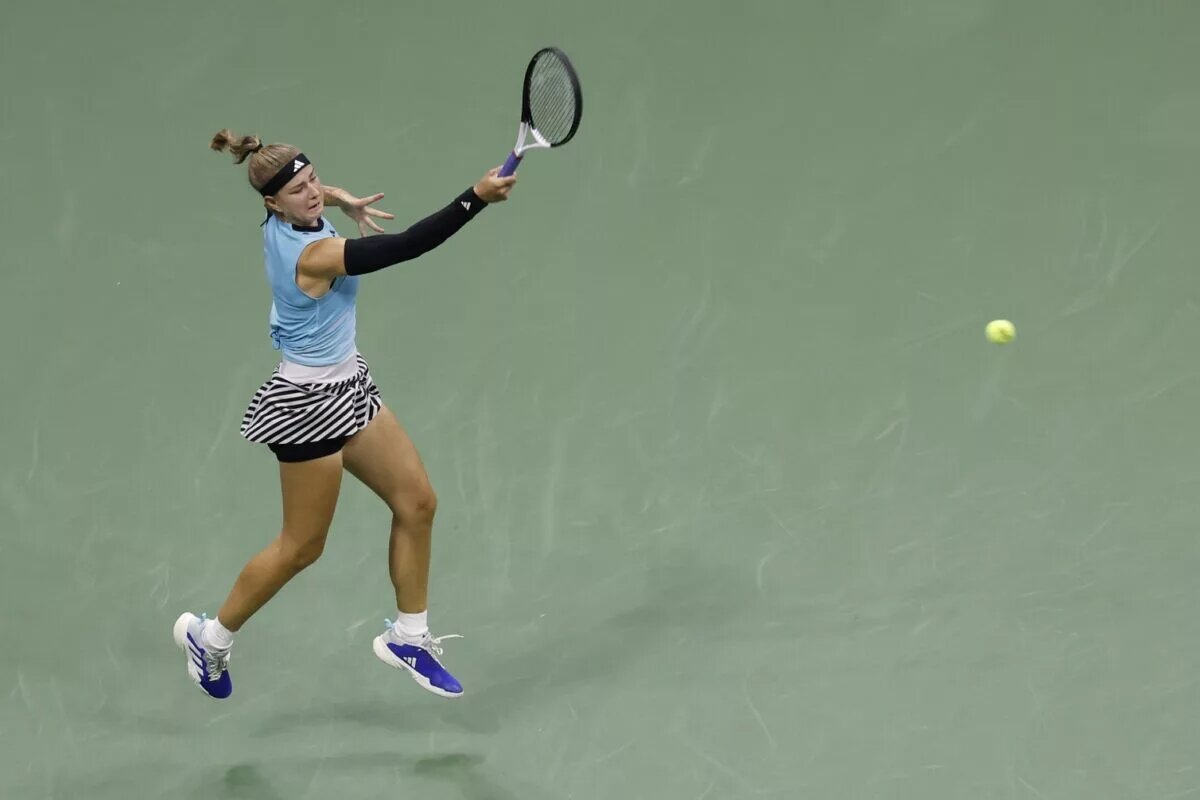

The all-Czech women’s singles final at Wimbledon 2026 saw a great comeback from Linda Noskova to win the title. Noskova served for a straight-sets victory but lost her serve, her way and had seemingly lost the match until she made a remarkable third-set comeback. Now, her opponent Karolína Muchová has to make an even harder comeback: to return from the disappointment of losing her second Major final and somehow win the Major title that her extraordinary tennis ability merits.
Will Karolina Muchová Ever Win A Major Title?
With the possible exception of Roger Federer, it is hard to think of a tennis player, male or female, other than Muchová who went into a Major final with seemingly the whole sport willing them on to win because of their uniquely attractive style of play. Ahead of the 2026 Wimbledon women’s final, Catherine Whitaker of The Tennis Podcast said that virtually the whole sport was “willing Muchová on”; former Wimbledon champion Pat Cash said on BBC Radio’s final preview programme that he had had a “tennis crush” on Muchová for years; and Andy Roddick echoed millions of tennis fans in announcing on his Served podcast that he “loves watching Muchová play”. However, despite that near-universal support for her before the final, Muchová was ultimately unable to win her first Major title.
Now, as she fast approaches her 30th birthday (she will turn 30 on 21 August, just two days before the start of the 2026 US Open), Muchová must hope that, after losing both the 2023 French Open final and the 2026 Wimbledon final, it will be third time lucky for her if she ever reaches another Grand Slam final. However, if she is to make the most of her undoubted natural talents, especially a fluidity of movement and genius for shot-making that at their best genuinely rival Federer’s ability in those departments, she must make at least three other vital adjustments.
1. Start Grand Slam Finals Better
In both her Major final defeats to date, Muchová has begun the match in fairly horrendous fashion. Against Iga Swiatek in the 2023 French Open final, she lost the first set 6-2 and was 3-0 down in the second set before she began a magnificent fightback that almost took her all the way to the title. She eventually won the second set 7-5 and even went a break up in the third set, before eventually losing it 6-4.
What was remarkable about the 2026 Wimbledon final was how similar it was to the 2023 French Open final; indeed, it was as if Muchová had learned little or nothing from the 2023 final about how damaging it is to start a Major final badly. In fact, initially she performed even worse in the 2026 Wimbledon final than she had in Paris, again losing the first set 6-2 and then going down 5-2 in the second set to allow Noskova to serve for the match. Muchová again fought back brilliantly to win the next five games in a row and clinch the second set 7-5, but Noskova’s nerves were undoubtedly a major contributor to that.
Effectively, in both the 2023 French Open final and the 2026 Wimbledon final Muchová dug herself into so deep a hole that she was ultimately unable to pull herself out of it. Although she fought back on both occasions to take the match to a third set, the supreme effort required to dig herself out of the hole and take the match to a deciding set eventually meant that she could not give of her best in those third sets.
Quite simply, if Muchová gets a chance to compete in a third Major final, and given her incredible run at the 2024 US Open she has a good chance of reaching the very next Major final in New York in September, she must ensure that she starts the final well and not dig herself into a hole that in the end proves too difficult to get out of.
-
Develop A Killer Instinct
Another worrying similarity for Muchová between her two Major final losses is that in spite of making a poor start in both finals and losing the first set easily, she fought back to put herself in a position to win the match only to falter right at the death. Against Swiatek in Paris in 2023, Muchová went a break up in the third set and against Noskova at Wimbledon in 2026 she won five games in a row to take the second set and seemed certain to break Noskova in the first game of the third set, only to falter, allowing Noskova to hold, and then promptly lost her own serve to give Noskova back a lead that she never relinquished.
In the 2023 French Open final, Swiatek was arguably at her imperious best against Muchová. That proved to be Swiatek’s third French Open triumph in total and the centre-piece of a hat-trick of titles between 2022 and 2024 that made her look a serious challenger to Chris Evert’s French Open women’s record of six titles. Consequently, it is entirely possible that whatever Muchová produced against Swiatek in that third set, she would have come through to win the match anyway.
Noskova at the weekend in Wimbledon was an entirely different proposition. Muchová’s much younger compatriot was in her first ever Major final and having failed to serve out for the match and indeed the championship at the end of the second set, she looked about as distraught as any Wimbledon finalist has ever looked. She covered her head with her towel, put her fingers in her ears (presumably to block out the crowd noise) and took an extended bathroom break to try and recover her equilibrium.
However, even when Noskova returned to serve for the first game of the third set she still looked mentally scrambled. It proved to be an incredibly long game in which Muchová had several breakpoints, but she just could not take any of them. If she had done so, to win a sixth game in a row and go a break up in the third set, she would surely have run away with the third set and comfortably beaten a broken Noskova.
Of course Muchová did not do that. Instead, she failed to pounce on a visibly stricken opponent, perhaps partly at least because she is such a good friend of Noskova and has even played doubles with her. But whatever the reason, she failed to display the killer instinct that all great champions possess. Instead, she allowed Noskova off the hook and Noskova took full advantage of her friend and doubles partner’s extreme generosity to break Muchová immediately and then serve out relatively comfortably for the rest of the match.
Once again, if Muchová should ever find herself in a third Major final with a chance to go in for the kill against an opponent who she has on the ropes, she must do so. It may go against her apparent personality type as a deeply sensitive introvert, but if she doesn’t she’ll surely taste defeat yet again.
-
Possibly Lose A Little Self-Control
The third possible improvement for Muchová to make if she is ever to fulfil her extraordinary potential and win a Major is perhaps the most difficult, because, just like developing a killer instinct, it seems to go against her whole personality type. Indeed, one of the reasons that Muchová is so universally admired is because, like Federer at his best, she seems so incredibly poised, self-contained and self-assured. Nevertheless, in both her Major finals to date and perhaps especially at Wimbledon at the weekend, she was perhaps just a little too self-contained and too self-controlled for her own good.
When Noskova’s game collapsed at the end of the second set, she let the whole world know it. She may have covered her head with a towel and put her fingers in her ears, but everyone could see the extreme stress that she was dealing with. And as has been said so often of so many great champions, from Agassi to Murray to Djokovic, perhaps it really is better to let it out than keep it in. By expressing and thereby releasing all the agony that she was experiencing at that point, Noskova was ultimately able to reset herself and her game, and recover her composure sufficiently to win.
By complete contrast, the only time that Muchová seemed to release what must have been her own sense of frustration at playing so poorly for most of the final was in the post-match on-court interview, when she began by making a joke (referring to her “ex-friend” Noskova) but soon broke down in tears as the enormity of the loss, and perhaps her own disappointment at playing so badly for so long, finally overcame her.
Next time, if there is a next time, Muchová might want to consider letting things out earlier during a final, especially if things are not going well for her. Her supreme sense of self-control and self-command, which is perfectly in keeping with her supreme control and command as a tennis player, may actually be a hindrance at moments of such high tension. If she is ever again losing a Major final so badly, or more precisely failing to perform at anywhere near her peak in a Major final, she might consider screaming, or smashing a ball or a racket, to give vent to those feelings and therefore make a reset easier to achieve.
Why The Tennis World Wants a Muchová Major Title So Much
In almost all major professional sport, there is an increasing sense that strength is over-riding skill—that a player’s physical attributes (height, speed, stamina) are ultimately more important than their technical abilities (especially their ability to strike or throw a ball of some kind). That is precisely why those professional sportspeople who seem to embody grace, style and flair, rather than sheer physical power, are so revered.
Roger Federer was such a sportsperson, so is Lionel Messi and so, too, is Karolina Muchová. She has all the technical attributes to win a Major, but now she must somehow develop the champion’s mindset to go with them: starting fast; killing off an opponent when they are there for the taking; and even being prepared to vent their frustration when things are not going well, before immediately resetting and going again.
Muchová has suffered terribly with physical injuries over the years, which is another reason why so many people in tennis wish her well, but it is possible that dealing with those physical ailments has meant that she has not concentrated so much on developing her mental fortitude. In 2026, the year in which she has trebled her career total of titles to three after wins in Doha and Bad Homberg, she has shown that she might finally be overcoming the physical problems that have dogged her for so long. But after the profound disappointment of losing the Wimbledon 2026 final, she must now show that she can add total mental toughness to her newfound physical resilience.
Main Photo Credit: Geoff Burke-USA TODAY Sports