
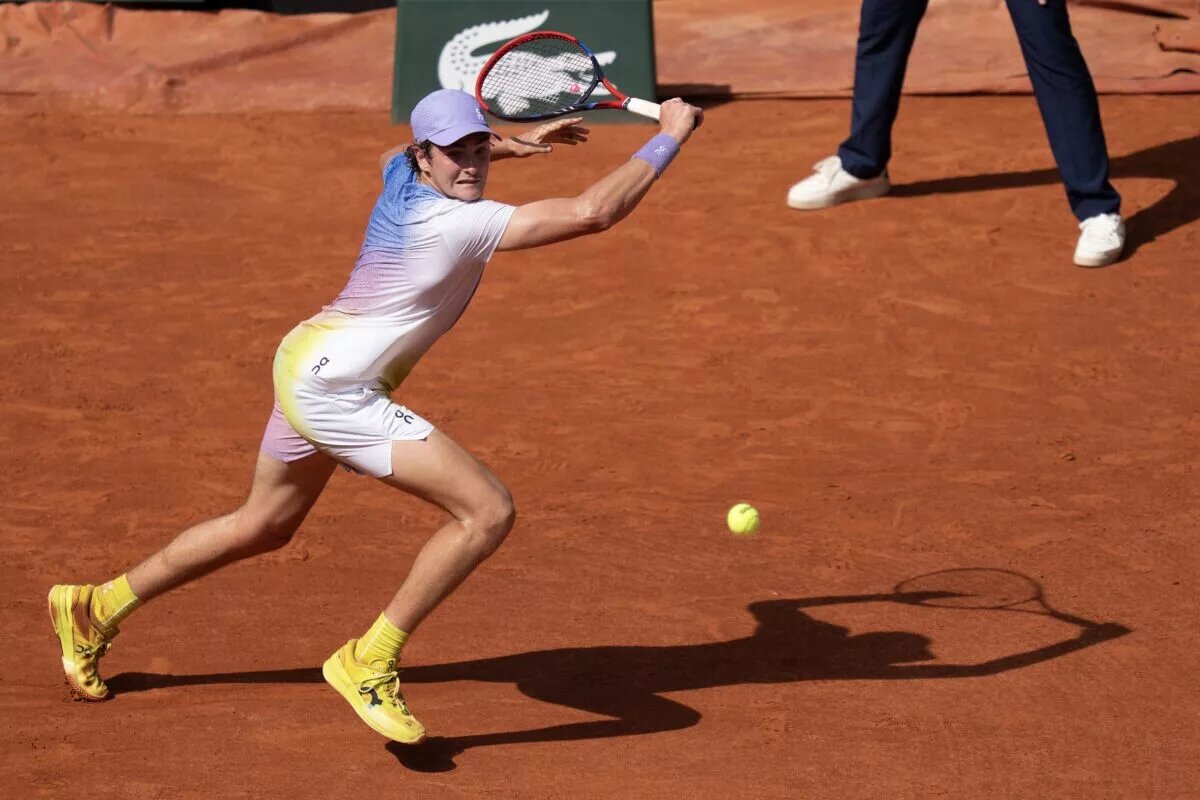

Tennis has always rewarded a full game, but it has never demanded symmetry. Plenty of players have reached the top with a wildly lopsided profile, dominant on one side of the ball and merely functional on the other. The question worth asking in 2026 is which half of that equation is easier to fix once a young player has already arrived near the top with the other half missing.
Joao Fonseca and Rafael Jodar, both nineteen, are the cleanest test case the sport currently has. One has an electric game built on a shaky return. The other built himself from a shaky serve into one of the tour’s most complete competitors in the space of a single season. The gap between how those two problems have played out says something real about which weakness a player can actually coach their way out of.
Can You Become Elite Without a Good Return?
Fonseca’s Return Problem
Fonseca’s serve, forehand, and raw ball-striking have never been in question. He beat Learner Tien for the Next Gen ATP Finals title in 2024, cracked the top fifty as a teenager, and has already taken sets and matches off both Sinner and Alcaraz. The concern sits entirely on the other side of the ball.
Over his career, Fonseca has won only 29% of his return points against top-ten opponents, a number that does not match that of a player talked about as a future Slam winner. In 2026 specifically, he has struggled in exactly the matches where a functioning return matters most: long, contested battles against players of similar quality. He exited the Madrid Open this year, losing to Jodar himself in a match that ran two hours and seven minutes, during which he won only 33% of the return points, against a player that’s not known as a good server, albeit a fellow in many other respects.
That pattern is the tell. A big serve and a big forehand can steal a set, sometimes two, against almost anyone in tennis. What they cannot reliably do is win a match once an opponent settles in and starts making Fonseca work from his own service games rather than simply riding the free points his own serve creates. Return game is fundamentally about anticipation, positioning, and hand-eye reaction under pressure, and those are qualities that are notoriously resistant to rapid coaching intervention in a way that serve mechanics are not.
You can rebuild a service motion in a tennis off-season. You cannot easily rebuild a player’s split-step timing or their read of an opponent’s toss, because those skills are built on thousands of competitive reps rather than a technical fix. Fonseca is nineteen and has time. But the honest read of his stalled 2026 season is that this specific weakness may prove far more stubborn than his fans currently assume.
Jodar’s Serve Problem, Solved
Jodar entered 2026 with almost exactly the inverse issue. Through his first eight tour-level matches of the season, including a 6-1, 6-2 defeat to Alejandro Tabilo at Indian Wells in under an hour, he won just 71.3% of his service games and 64% of his first-serve points, hardly impressive numbers in this era of tennis. What he already had, even then, was a return game that nobody else his age could match. He was winning 20% of his return games before Miami, a mark shared with Fonseca, Flavio Cobolli, and Learner Tien, respectable but unremarkable.
Then something clicked. Across fifteen matches spanning Miami, Marrakech, Barcelona, and Madrid, Jodar’s return numbers jumped to 35.6% of return games won, a 78% improvement, at one point putting him alongside Francisco Cerundolo, Daniil Medvedev, Carlos Alcaraz, and Sinner as one of the only five players on tour clearing 30% for the season. His serve improved alongside it rather than being left behind, climbing from sub-par to genuinely solid. The result is a player who now wins 76.1% of his matches in 2026 and sits at No. 29 in the world, having overtaken Fonseca, the player who arrived with vastly more hype.
What Jodar’s turnaround suggests is that a shaky serve, unlike a shaky return, is a more mechanically isolated problem. Toss placement, contact point, leg drive, and ball toss consistency are technical variables that a good coach can identify and drill directly, and the gains show up quickly because the skill does not depend on reading another player in real time. Jodar did not need to develop new instincts. He needed to fix a motion, and once he did, the weapon that was always going to matter most for his tennis career, the return, was already there waiting to be paired with it.
The Sinner Precedent
The clearest evidence that serve is the more fixable half of this equation sits with the World No. 1 himself. Sinner was never known as a heavy server early in his career, averaging around 6.3 aces per match in 2025 off a career mark of 6.5.
In 2026, working with his coaching team on an overhauled, more compact pinpoint service motion, he nearly doubled that output, striking around sixty aces across five matches at the Miami Open alone and averaging 11.1 aces per match during that stretch, while his first-serve percentage jumped more than 9% year over year. Crucially, none of that came at the cost of his return game, long considered among the best in the sport. Sinner became the first player since ATP records began in 1991 to lead the tour in both service games won and return games won in the same season, and he has since pushed both numbers even higher.
Sinner’s serve was always a limiting factor relative to his return early in his career. He fixed it without sacrificing the return game that made him elite in the first place. That is precisely the template Jodar has now followed at 19. It is also the template that remains unavailable to a player whose deficiency sits on the return side rather than the serve side, because there is no equivalent mechanical overhaul available for reading a serve better under pressure. You can rebuild a swing in an off-season gym. You cannot rebuild tennis instinct nearly as fast.
The Verdict
Can you become an elite tennis player without a good return? The evidence says no, not at the very top and not for long. A great serve wins you matches against players who cannot break you. It does not win you the ones where both players hold with ease, and the return games decide everything, which is exactly the kind of match that separates a good pro from a Slam champion.
Fonseca has the harder problem, and the deeper concern is that it may not be a coaching problem at all, but a competitive instinct that either sharpens with thousands of matches or never quite arrives. Jodar had the easier problem, fixed it in a matter of months, and is already reaping the reward. Sinner proved the same thing at the very top of the sport, turning a merely adequate serve into an elite one without giving up the return that made him great in the first place.
The lesson for anyone developing the next wave of tennis talent is fairly clear. If you are choosing which half of a young player’s game to leave underdeveloped for a season or two, choose the serve. It is the one that can still be rebuilt in time.
Main Photo Credit: Susan Mullane – Imagn Images