


Tennis is blessed. Not every sport has a succession of great champions who build on the achievements of previous titans to create their own legacy. Boxing, for one, has not produced a golden age to match that of the heavyweights in the 1970s or the middleweights in the 1980s, and may never do so again.
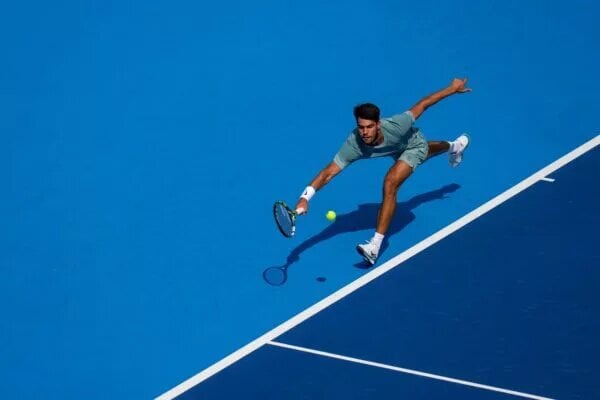
But as the 2025 Wimbledon final proved triumphantly, after the nearly 20-year era of The Big Three, men’s tennis now has two more truly great champions in Jannik Sinner and Carlos Alcaraz. Indeed, they are so great that in time “The New Two”, as they have been dubbed, might just come to be regarded as “The Huge Two”.
The Big Three Era is Finally Ending
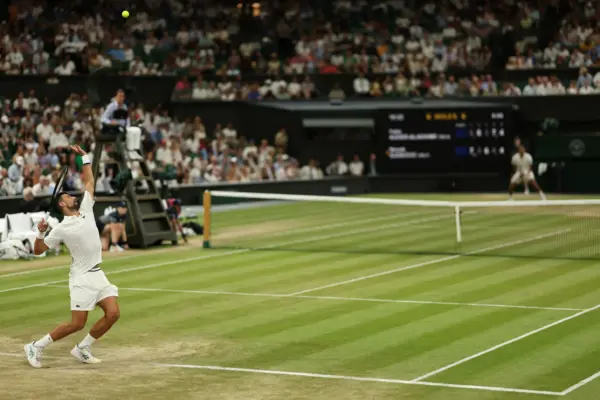
Wimbledon 2025 may be the Major at which the era of The Big Three finally gave way to the Age of Sinner and Alcaraz. The surest proof of that is that it was the first Wimbledon men’s final since 2002 not to feature one of The Big Three (Federer, Nadal, and Djokovic) or Andy Murray (who, for a brief period between 2012 and 2016, made The Big Three a Big Four).
In addition, the comprehensive defeat of Novak Djokovic, the last of The Big Three (or Four) who is still playing, by Jannik Sinner in the semifinal and his subsequent expression of doubt that he may no longer be able to compete for Majors against Sinner and Alcaraz, seemed to confirm the sense of one great generation of male players finally giving way to another.
Despite their outstanding start to their Major-winning careers, it still remains unlikely that Sinner and Alcaraz will join The Big Three in what might be called “The 20-Plus Club”: those rarest of champions who have won over 20 Major Singles titles, which also includes on the women’s side of the sport Margaret Court, Serena Williams and Steffi Graf. Even if they continued at their current rate of winning Majors (Alcaraz has won five and Sinner four), it would take at least another decade before they came close to the 20 mark, and injury or other unforeseen events can always derail them.
Nevertheless, even if Sinner and Alcaraz do not go on to match the astonishing numerical achievements of their immediate predecessors in men’s tennis, they can still establish a degree of dominance over the rest of men’s tennis that is comparable to that of The Big Three, or perhaps even greater.
Here are three ways in which Sinner and Alcaraz have already begun to establish a Big Three-like aura.
Separation From the Field
The Big Three were unique not just in tennis history but in the history of sport in creating a triopoly in tennis, to the extent that theirs was not just a rivalry but a Trivalry. Collectively, they elevated themselves above their competitors so much that for two decades, only six other men besides them won Major Singles titles: Murray (three); Wawrinka (three); and Gaudio, Safin, Del Potro, and Cilic (one each).
Obviously, Sinner and Alcaraz are yet to establish such decades-long domination of their sport. However, Sinner’s first Wimbledon triumph means that they have now won a truly magnificent seven successive Major Singles titles between them, stretching back to the Australian Open at the start of 2024. And now that Djokovic is on the wane, there is nobody else emerging who appears to have the range of skills, experience, and tenacity to match them.
There are obviously other contenders, such as Taylor Fritz (the other 2025 Wimbledon semifinalist), Jack Draper, and perhaps further along the line João Fonseca, who at only 18 is nearly six years younger than Sinner, who will be 24 next month. However, the fact remains that for the time being at least Djokovic looks by far the third best male tennis player in the world, especially at Slams, and Sinner, who has beaten him in the semifinals of the last two Majors, and Alcaraz, who had beaten him in the previous two Wimbledon finals, have now definitively surpassed him.
Their Completeness as Players (Especially at Such a Young Age)
The second main way in which Sinner and Alcaraz have proven themselves worthy heirs to The Big Three and even potential challengers in the future to their Grand Slam hauls is in their sheer completeness as players, especially at such a young age. (Alcaraz is just 22, 15 months younger than Sinner.) In that sense, they are the ultimate post-Big Three players, having learned from Federer, Nadal, and Djokovic that to win multiple Majors in the 21st century, you have to be a player without any obvious weakness on any surface.
Indeed, what is perhaps most remarkable about Sinner and Alcaraz is that they are both more complete players in their early 20s than any of The Big Three were at that age. At the start of their careers, Federer, Nadal and Djokovic were all significantly less fully developed as multi-surface players: Federer had yet to conquer the clay of Roland Garros; Nadal had yet to conquer the grass of Wimbledon; and Djokovic, largely because his gluten intolerance was yet to be diagnosed, had yet to show any of the complete domination that would become his trademark later on.
By contrast, Sinner and Alcaraz are not just all-court players (being equally comfortable at the baseline or the net) but all-surface players. Alcaraz has already achieved the Tennis Triple Crown of winning Majors on all three surfaces (hardcourt, clay, and grass), and Sinner came within a single point of doing so in Paris last month.
Their Resilience (Both Physical and Mental)
The third and perhaps most important way in which Sinner and Alcaraz have proven that they have inherited the mantle of The Big Three is by demonstrating the same extraordinary resilience, both physical and mental, as Federer, Nadal, and Djokovic did early in their careers.
It may be largely forgotten now, but when they were young, Federer, Nadal, and Djokovic all had to overcome enormous hurdles before they could maximise their talent. Federer had to process the death of Peter Carter, his early coach, in a car crash in 2002; from the very start of his career, Nadal had to learn to live with the physical problems that would continue to afflict him throughout his entire career; and Djokovic had to leave both his family and his war-torn country at a ridiculously early age to pursue a professional tennis career in Western Europe.
The obstacles that Sinner and Alcaraz have had to overcome are perhaps not as dramatic, indeed as career or life-threatening, as those faced by The Big Three, but they are still significant. In particular, Sinner has had to overcome the crushing disappointment of his loss to Alcaraz in the greatest ever French Open final last month, and the fact that he did so at the very first attempt is probably the ultimate testament to his mental fortitude.
Equally, Alcaraz has already demonstrated that he is the ultimate tennis escapologist by recovering from such a substantial deficit in Paris to retain his title there.
A Rivalry to Challenge the Greatest in Tennis History
The rivalry, or Trivalry, between The Big Three was an anomaly not just in tennis history but in sporting history. It is usually the case that a rivalry is precisely that, a direct head-to-head confrontation between just two opponents. And even if it remains the case that Sinner and Alcaraz might struggle to match the truly historic achievements of Federer, Nadal, and Djokovic, there is every possibility that they can establish themselves as the greatest rivalry in tennis history. Indeed, there is an argument that they already have.
The greatest direct rivalries in men’s tennis history, such as Borg v McEnroe, Becker v Edberg or Sampras v Agassi, were all either incredibly short-lived (Borg retired from tennis just as McEnroe was beginning to gain the upper hand in their rivalry) or largely confined to just one tournament or one surface (such as Becker v Edberg at Wimbledon).
By contrast, as both the 2025 French Open final and the 2025 Wimbledon final have gloriously demonstrated, Sinner v Alcaraz is already a truly epic rivalry that has been played out on multiple surfaces at multiple Majors, and it has every chance of continuing in that vein in the future. And at the end of it all, Sinner and Alcaraz might just have earned a historical monicker of their own, such as “The Huge Two”, to match that of “The Big Three”.
Main Photo Credit: Susan Mullane – Imagn Images