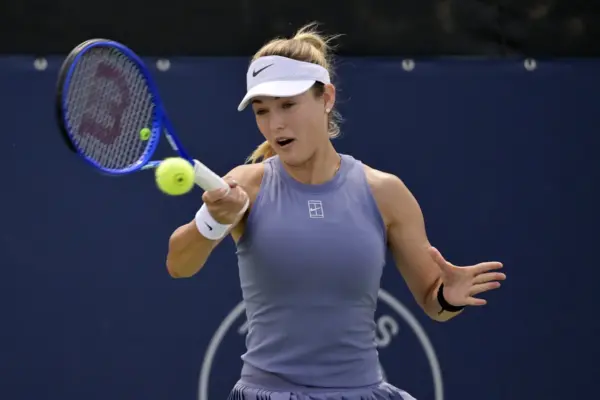



At just 22 years old, Lois Boisson has emerged as the unexpected darling of the 2025 French Open, captivating tennis fans with her improbable run to the semifinals.
Ranked No. 361 in the world and entering Roland Garros as a wild card, Boisson’s journey from obscurity to the cusp of Grand Slam glory is a testament to resilience, talent, and the magic of home-soil inspiration. Her recent straight-sets victory over sixth-ranked Mirra Andreeva (7-6(6) 6-3) has cemented her status as a historic underdog, and with a semifinal clash against World No. 2 Coco Gauff looming, Boisson stands on the brink of rewriting French tennis history.
A Modest Beginning and a Battle with Adversity
Born on May 16, 2003, in Dijon, France, Lois Boisson’s early career was steady but unremarkable. She transitioned professionally in 2021, making her WTA Tour debut in doubles at the Lyon Open alongside Juline Fayard. That same year, she attempted to qualify for the French Open but fell short, a sign of the challenges ahead.
Boisson’s first singles title came in 2022 on the ITF Circuit in Dijon, her hometown, followed by another in Le Havre in 2023. Her breakout moment came in March 2024, when she won three ITF titles in a single month, showcasing her potential on clay. However, her career was nearly derailed by a devastating injury.
Just a week before the 2024 French Open, Boisson tore the anterior cruciate ligament (ACL) in her left knee, forcing her to miss the tournament and sidelining her for nine months. The injury was a crushing blow, as she had been set to make her Roland Garros debut, and her ranking plummeted outside the top 500.
Undeterred, Boisson returned to competition in early 2025, her resolve hardened. Her comeback was marked by a newfound aggression and tactical versatility, with a game built on heavy topspin forehands, a slicing backhand, and remarkable court coverage. Despite her low ranking, her special ranking of No. 152 (before her injury) and a wild card entry into the 2025 French Open gave her a second chance to shine on the sport’s biggest stage.
A Historic Run at Roland Garros
Boisson’s 2025 French Open campaign has been nothing short of extraordinary. Entering as a wild card, she stunned the tennis world by defeating No. 24 seed Elise Mertens in the first round (6-4 4-6 6-3), marking her first Grand Slam main-draw win. She followed this with victories over Anhelina Kalinina and compatriot Elsa Jacquemot, displaying grit despite managing lingering knee pain.
The defining moment came in the fourth round, where Boisson faced world No. 3 Jessica Pegula on Court Philippe-Chatrier. Down a set and facing a seasoned Grand Slam finalist, Boisson staged a thrilling comeback, winning 3-6 6-4 6-4 in a 2-hour, 40-minute battle. The victory, fueled by a raucous home crowd chanting “Loïs, Loïs!” and singing La Marseillaise, made her the first Frenchwoman to reach the Roland Garros quarterfinals since Caroline Garcia and Kristina Mladenovic in 2017. She became the lowest-ranked player to reach a Grand Slam quarterfinal since Kaia Kanepi (No. 418) at the 2017 US Open.
Boisson’s dream run continued in the quarterfinals against 18-year-old prodigy Mirra Andreeva, ranked No. 6. Under the closed roof of Chatrier, with 15,000 fans roaring her name, Boisson delivered a composed 7-6(6) 6-3 upset, becoming the first wild card to reach the French Open semifinals and the lowest-ranked women’s Grand Slam semifinalist in 40 years. She is also the first woman to reach the semifinals in her Grand Slam main-draw debut since Monica Seles and Jennifer Capriati in 1989.
What a Final or Title Would Mean
The stakes are monumental as Boisson prepares to face Coco Gauff in the semifinals. A victory would propel her into the French Open final, making her the first Frenchwoman to reach the women’s singles final since Mary Pierce’s title win in 2000. It would also draw comparisons to Emma Raducanu’s improbable 2021 US Open triumph, as Boisson is poised for a ranking jump from No. 361 to at least No. 65, with a final berth potentially pushing her into the Top 50.
Reaching the final would be a life-changing achievement. Financially, her run has already quadrupled her career earnings, with a guaranteed £580,000 (approximately $780,000) for reaching the semifinals, compared to her previous career total of £109,000. A final appearance would net her €1,275,000 (approximately $1.46 million), providing the resources to compete in higher-level tournaments without financial strain.
Her ranking surge would also grant direct entry into WTA events, reducing reliance on wild cards and allowing her to build a sustainable career. Beyond the numbers, Boisson’s story of overcoming a career-threatening ACL injury would inspire countless young athletes, proving that perseverance can triumph over setbacks.
A French Open final or title would ignite a renaissance in French tennis, which has longed for a homegrown champion. The last Frenchwoman to win Roland Garros was Mary Pierce 25 years ago, and Boisson’s run has already rekindled national pride. Her success could inspire a new generation of French players, much like Amélie Mauresmo’s 2006 Wimbledon title.
Boisson’s fairy tale run challenges the sport’s hierarchy, proving that talent and determination can emerge from anywhere, even outside the top 300. Her victories over two Top 10 players (Pegula and Andreeva) in a single tournament echo Serena Williams’ feat in 1997, highlighting her potential to disrupt the WTA Tour. A final or title would draw parallels to historic underdog stories like Raducanu’s and Goran Ivanišević’s 2001 Wimbledon win, reinforcing tennis’s capacity for unpredictability and magic. It would also spotlight the importance of wildcard opportunities, validating the French Tennis Federation’s faith in her potential.
The Road Ahead
Boisson’s semifinal against Coco Gauff, a former French Open finalist and the 2024 US Open champion, will be her toughest test yet. Gauff’s athleticism and defensive prowess will challenge Boisson’s aggressive spin-heavy game, but the Frenchwoman’s ability to dictate play and feed off the Chatrier crowd could make it a classic
Win or lose, Lois Boisson has already etched her name into tennis history. Her journey from a career-threatening injury to the French Open semifinals embodies the spirit of Roland Garros: passion, resilience, and the courage to dream big. If she reaches the final or claims the title, she won’t just be a champion—she’ll be a symbol of hope for underdogs everywhere, and a new star for France to rally behind. As the tennis world watches, one thing is clear: Loïs Boisson is no longer an afterthought. She’s a sensation, and her story is far from over.
Main Photo Credit: Susan Mullane-Imagn Images