
As LSU quickly approaches its third week of Spring camp, some players have separated themselves from the pack. We used on-field performance and the measured words of Lane Kiffin to present the most impactful LSU Spring practice developments to this point.
With so much change in one off-season, this team has not evolved to the point where one can accurately assess its ceiling. However, there are a few players and approaches that have already given glimpses of how the team will be different. Time will tell if the differences yield better results than last year’s.
LSU Spring Practice Developments
Freshman Phenoms up Front
One of LSU’s first and most obvious Spring practice developments has been the play of the young defensive tackles. We haven’t shied away from pointing out the potential of LSU’s 2026 defensive line class, and it hasn’t disappointed.
It wasn’t a shock when the top-rated defensive lineman in the country, Richard Anderson, took reps with the first team defense. But fellow true freshman Deuce Geralds has made a statement by earning more first-team reps than any other tackle. This would be impressive under any circumstances. It’s even more notable considering LSU returns a starting defensive tackle and former five-star Dominick McKinley.
The depth chart isn’t settled at the position, as McKinley and Auburn transfer Malik Blocton have also repped with the ones at times. An injury kept Clemson transfer Stephiylan Green out of action until the second week of practice. Each of the previously mentioned players will likely play a role in 2026, but the nation’s top overall recruit, Lamar Brown, will add even more competition with his arrival this summer. This room has gotten younger and appears to be deeper than it was in 2025.
LSU Hits Again at Safety
Not much went right for Brian Kelly last year, but he hit on arguably the best safety transfer available in AJ Haulcy. It’s quite possible that the new regime has done the same a year later. Early returns on Boise State’s Ty Benefield have been overwhelmingly positive.
Benefield is approaching his senior season and is an imposing presence at 6’-3” and 208 pounds. He’s extremely aggressive against the run, as evidenced by his 107 tackles in 2025. Kiffin has singled out Benefield, left tackle Jordan Seaton, and tight end Trey’Dez Green as “ultra elite” players. In short, Kiffin explained that they possess mental approaches to the game that match their superb physical talent.
Benefield’s arrival has allowed the staff to move returning safety Dashawn Spears to the star, a specialized nickelback position, while leaving Tamarcus Cooley in the other safety spot. Blake Baker’s defense should be more versatile in coverage with Spears in the star role as opposed to Harold Perkins. Cooley has no time to relax, as Ohio State transfer Faheem Delane is battling for a safety spot. True freshman Aiden Hall is battling with redshirt freshman CJ Jimcoilly to be the primary backup at star.
Different Strokes
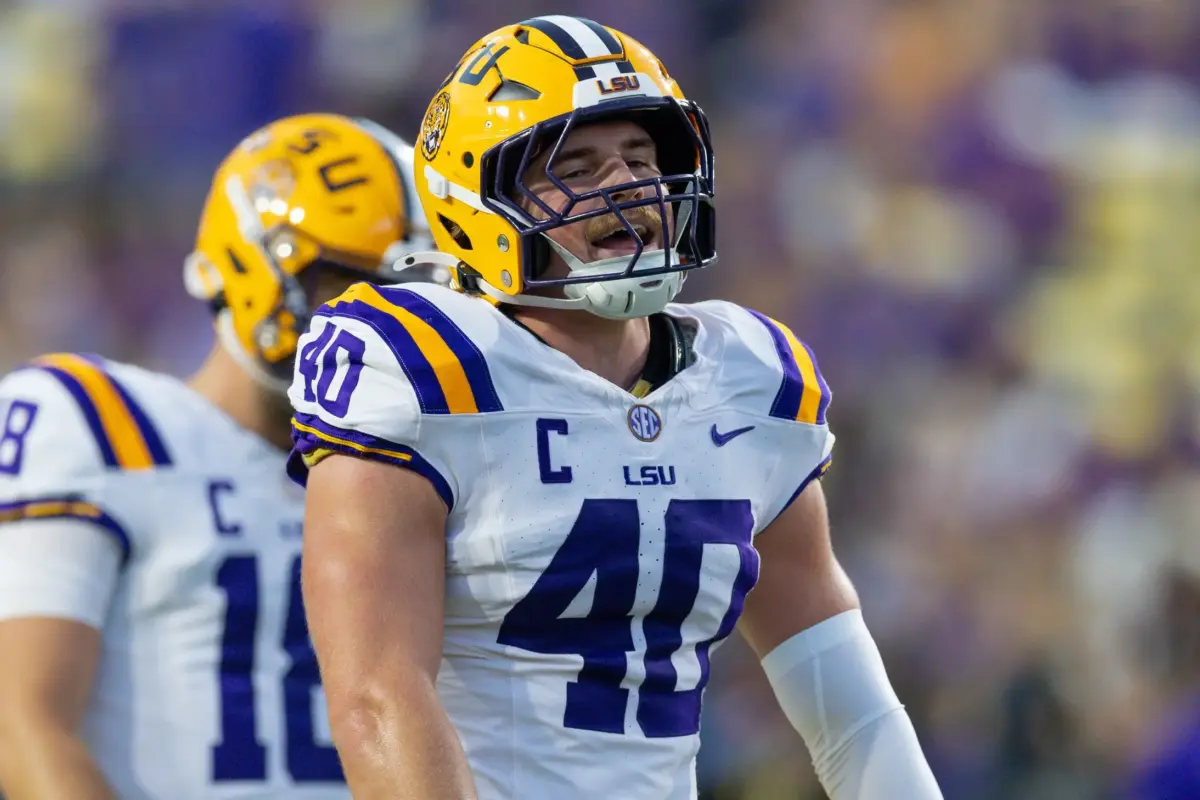
Several players have spoken about the differences in the approach from the current coaching staff compared to the last regime. Linebacker and team leader Whit Weeks pointed out that the current staff doesn’t do anything randomly or without purpose.
“Everything we do has a purpose from what time we eat in the morning, to lunch, everything we do within this program has a specific purpose,” Weeks stated.
Other players, like projected starting running back Harlem Berry, have commented on the value of each practice drill and high level of coaching on the field. It’s clear that the new staff is on one accord and is emphasizing the importance and urgency of getting the most out of each practice.
Another important LSU Spring practice development is the tempo of the offense. Plays are coming in faster; players are getting lined up, and the up-tempo offense has been quickly implemented. Those who follow the college game closely are aware of the pressure tempo places on defenses, pushing defenses to their physical brink while limiting substitutions. However, sometimes an unintended consequence of fast offenses is putting your own defense back on the field quickly. So, it’s even more important for LSU to develop depth defensively.
Main Image: Stephen Lew-Imagn Images