

Every off-season, the conversation in Tuscaloosa drifts to the same place. The quarterback position.
It’s predictable, relevant, and loud. Arm Strength clips circulate the internet, recruiting rankings get reposted, and late-game plays from the season before are analyzed in fine detail.
But if Alabama plans to reassert itself as the standard of all college football, it won’t be because of a quarterback competition decided in the late offseason. It will be decided in the trenches.
The offensive line doesn’t dominate offseason headlines or be the talk of the town, but it is the most important position group on Alabama’s roster entering the season. Not because it generates buzz, but because it determines control.
The Foundation of Alabama’s Next Run
The Standard Up Front
For many years, Alabama’s philosophy was painfully simple, especially for its opponents. Dominate the line of scrimmage, dictate the tempo of the game, and let elite skill players make plays when the opportunity presents itself. Whether the offense leaned power-heavy or evolved into a spread attack, the foundation never shifted. Games were won up front.
When schemes changed, the standard did not. That’s why recent cracks have felt so noticeable.
Over the past few seasons, there have been stretches when protection wavered in high-leverage moments. Third-and-short situations felt less automatic than they once did. Pre-snap penalties stalled drives that should have continued. As a program that has built its dynasty on physical dominance, these inconsistencies stand out.
At Alabama, small weaknesses get magnified.
Replacing NFL-caliber linemen is nothing new for the Crimson Tide, as the program has sent wave after wave to the league. Part of the culture and standard in Tuscaloosa is reloading.
However, the current state of college football throws a wrench in that cycle. With the transfer portal accelerating roster turnover and NIL reshaping recruiting dynamics, depth is harder to come by. It no longer means 3-4 years of investment and commitment to a process within a program, but chemistry and continuity in an environment that doesn’t sit still.
The question now isn’t whether Alabama has talent sitting in the offensive line room. It always does. The question is whether that room can come together and reestablish authority.
Control or Volatility
When Alabama controls the line of scrimmage, everything downstream changes. Confidence builds across the roster. The quarterback has time to play cleaner and more efficiently when pressure isn’t immediate. The run game regains rhythm and sets the tone of the game instead of grinding for marginal gains. Play-calling expands with the coordinator’s trust in the pocket.
The alternative is far more uncomfortable.
If protection proves to be inconsistent or communication breaks down across complex SEC fronts, the offense tightens up, and success becomes sporadic. Drives depend on improvisation rather than structure, and suddenly, games that once felt controlled feel volatile.
In today’s SEC, volatility is dangerous.
Defensive fronts across the conference are deeper, faster, and more versatile than ever. Edge rushers can win one-on-one, while interior linemen collapse the pocket within seconds. Simulated pressures and disguised fronts test communication on every snap.
Offensive line success is not just about size or recruiting rankings. It’s about five players seeing the same picture and reacting as one unit.
That kind of synchronization doesn’t appear in September by accident.
It’s built in spring practice when the stands are empty, and the cameras are off. It’s reinforced in summer workouts when temperatures climb, and fatigue sets in. Film room meetings sharpen protection frame by frame.
Where It Will Be Decided
This season’s line faces added complications that few eras have seen.
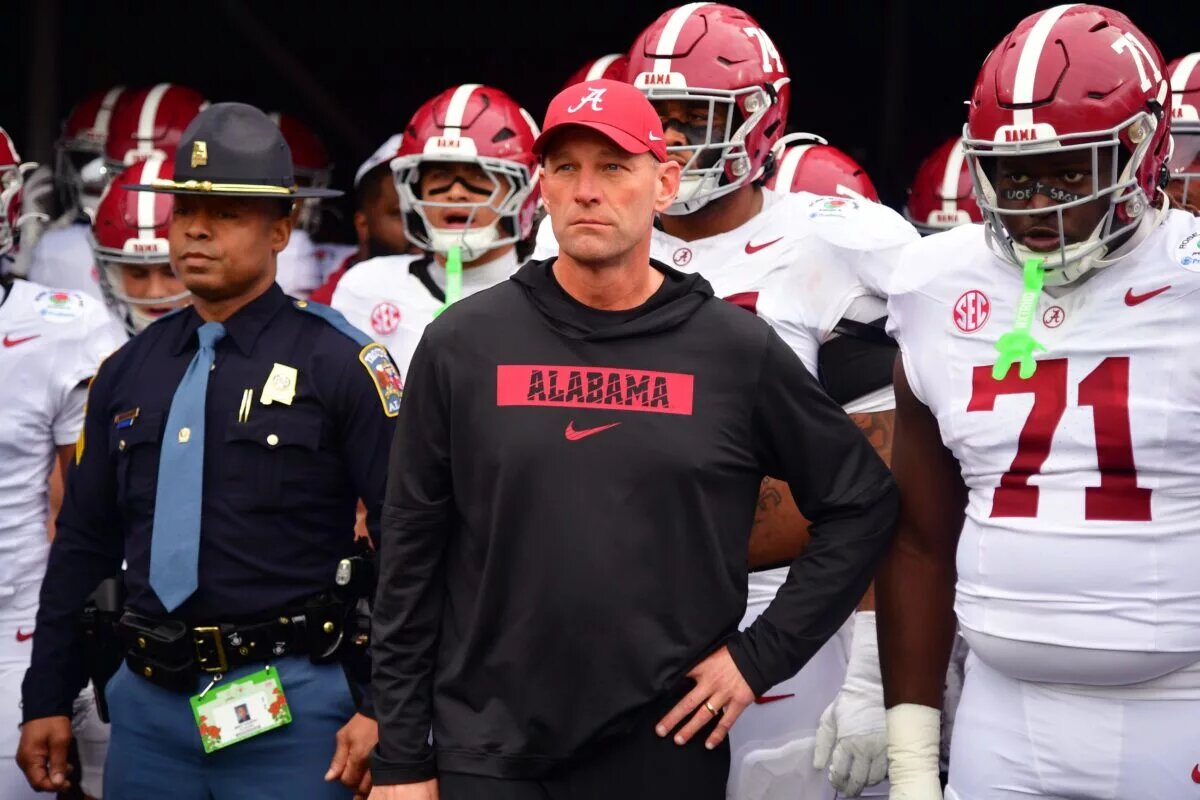
Alabama enters 2026 with a new offensive line coach, Adrian Klemm, who was officially hired this offseason to direct the unit after the program parted ways with Chris Kapilovic. Klemm brings experience from multiple Power Five stops and NFL staff work as he takes over the task of rebuilding a dominant offensive line under head coach Kalen DeBoer.
The transition comes at a critical time with multiple players moving on to the NFL or entering the transfer portal. Alabama returns only one familiar starter on the offensive line, Michael Carroll. This means four of the five starters when the fall arrives will be portal additions or someone new to a full-time role.
Ty Haywood and Kaden Strayhorn (Michigan), Racin Delgatty (Cal Poly), Nick Brooks (Texas), Javin James (Mississippi State), and Ethan Fields (Ole Miss) make up the list of transfer portal additions to the Tide’s offensive line. Bryson Cooley, Chris Booker, Jared Doughty, and Bear Fretwell come from their respective high schools to join the Crimson Tide next season. Both groups will look to play a large part in the success of coach Klemm’s first season and Alabama football as a whole.
Skill players will command headlines throughout the preseason. They’ll trend on social media and highlight prediction segments; that’s just the nature of today’s coverage in college football.
The offensive line won’t.
Yet the tone of this season and perhaps the trajectory of Alabama’s next era will be shaped by a group that rarely touches the ball. If this unit becomes a strength, Alabama regains the ability to dictate terms rather than react. It can impose its will in hostile environments while closing games with certainty instead of tension.
Historically, when Alabama controls the line of scrimmage, the rest of college football adjusts.
Quarterback debates will continue as they always do. But the real story, the one that determines whether Alabama competes or controls, begins on the line of scrimmage, where games are decided the old-fashioned way.
Main Image: Gary A. Vasquez-Imagn Images