

Joey McGuire achieved something in 2025 that no other Texas Tech head coach has done in 70 seasons prior. He won an outright conference title for the Red Raiders with another dominating performance over BYU. The season ended with a deflating Orange Bowl loss. However, this program is positioned in a place it has never been before. With alignment among the coaches, athletic director, and the boosters, the Red Raiders are positioned to be a nationally relevant program for the foreseeable future. But could Texas Tech have made this jump 18 years ago? If Texas Tech beat Oklahoma back in the 2008 season, would the Red Raiders have turned into a perennial contender for Big 12 championships?
Setting The Stage
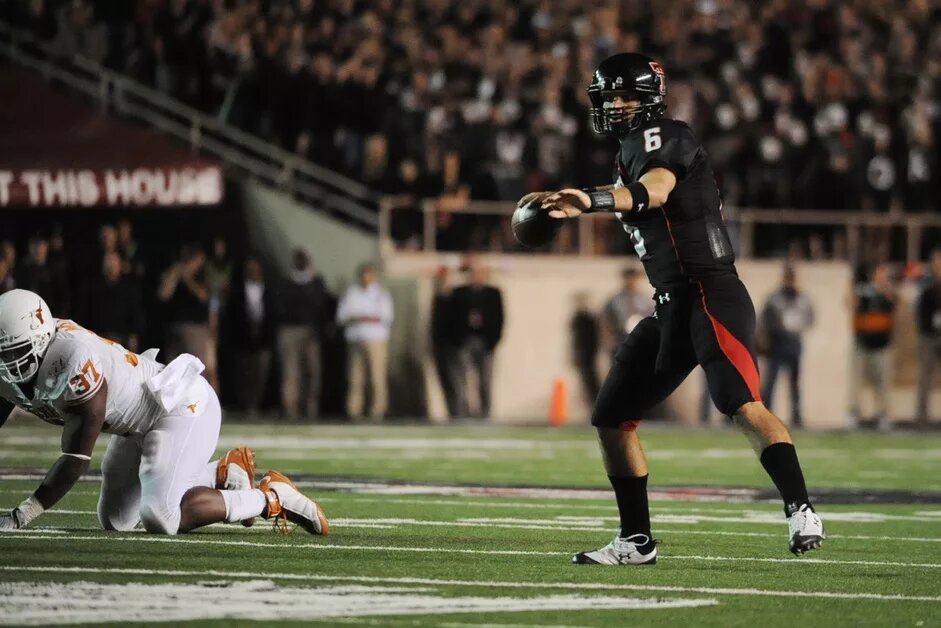
The Mike Leach-led Red Raiders were amid the greatest season in program history. The offense finished third nationally in scoring in 2008, averaging 43.8 points per game. It was powered by quarterback Graham Harrell and the first-ever two-time Biletnikoff-winning wide receiver Michael Crabtree. Entering the last week of October, Texas Tech was 7-0. However, they were embarking on a schedule that would include four consecutive teams ranked in the top 25. They dispatched 19-ranked Kansas by a score of 63-21 before a game that lives in college football history. The top-ranked Texas Longhorns came to Lubbock. We will let the great Brent Musburger refresh your memory on how that game ended. The Red Raiders climbed to number two in the polls. But number eight, Oklahoma State, was coming to Lubbock that next week.
A letdown had to be in store, correct? No chance as the Red Raiders rolled 56-20. A 10-0 Red Raider squad would face a four-win Baylor team to close out the season. If Texas Tech beat Oklahoma the week before, they would secure the Big 12 South Division title and play in its first Big 12 championship game. The winner of the Big 12 South was going to be a heavy favorite against Missouri. The Tigers lost to Texas 56-31, Kansas 40-37, and Oklahoma State 28-23. Texas Tech had a 3-0 record against those teams while Oklahoma went 2-1 (with their only loss being to Texas, more on this later).
Ugly Night In Norman
Texas Tech had traditionally lacked the ability to compete at the top of the Big 12. But coming into that 2008 meeting, the Red Raiders had won two of their last three against the Sooners. However, it had been since 1996 that Texas Tech beat Oklahoma in Norman (five straight losses). This was going to be different, though. This was the best team that ever donned the Scarlet and the Black in Lubbock. Except it wasn’t. With 6:28 remaining in the first half, it was Oklahoma 28-Texas Tech 0.
It was never competitive, with the final score being 65-21. With the loss, it created a three-way tie in the Big 12 South. There was no head-to-head tiebreaker that could be used. It finally got down to using the BSC rankings. The computers were going to determine the fate of the Big 12. At season’s end, the computers ranked Oklahoma 2, Texas 5, and Texas Tech 8.
Loss To The Sooners Cost About $20 million
The Sooners dismantled Missouri by 41 points to claim the Big 12 championship. It also clinched them a birth in the BCS national championship game against the Florida Gators. Additionally, since Texas ranked higher than Texas Tech, Texas played in the Fiesta Bowl (a BCS bowl at the time) while Tech played in the non-BCS bowl of the Cotton Bowl. Here is why that loss to the Sooners gutted the Red Raiders chance to elevate financially.
Precise data couldn’t be found for the 2009 bowl season, but we are going to utilize 2012 bowl season data for illustrative purposes. For teams participating in a BCS bowl game, each school was paid approximately $22 million. The teams that participated in the Cotton Bowl that year received approximately $3.2 million. Looking at almost a $20 million gap through the NIL lenses of 2026, that’s the difference between retaining/building a national championship roster and an average G6 school.
Texas Tech Beat Oklahoma; What Changes?
In this hypothetical world, even with a one-point victory over the Sooners, Texas Tech would have played for the Big 12 championship with a pristine 12-0 record. We will also safely assume they handle a Mizzou team. Those Tigers couldn’t beat the toughest teams on the Red Raiders schedule. So, Texas Tech rolled by a convincing score of 49-21. Now, as the only 13-0 team in the Power 5 (Utah also went 13-0 that season), Texas Tech would have claimed the number one ranking in college football.
That is an honor that has eluded the Red Raiders to the present day. Now, the college football world would have had to talk about a non-traditional blue blood playing for a national championship. The Red Raiders would have received a substantially larger check. Which could have been reinvested into…facilities, yes, that’s all the money was ever used for at that time *wink wink*. But we do need to be honest about how that national championship game would have gone. Florida had NFL guys all over that field. Eventually, 19 players from that team would be drafted. Of those 19, six were first-rounders and one of the greatest college football quarterbacks the game has ever seen. There is reason to believe the Gators would have chomped the Red Raiders apart by the score of 52-20.
Adam James Didn’t Go Away In This World
Maybe the Texas Tech athletic director at the time, Gerald Myers, would have given Leach an extension if Texas Tech beat Oklahoma. Afterall, Leach would have brought back a Big 12 championship, a 13-0 regular season, and a national championship birth. So, let’s assume the relationship between Myers and Leach wasn’t on rocky ground. It likely doesn’t change the course of how the end of the 2009 season ended.
The 2009 season was a predictable regression as the program was never built on elite high school recruiting. The highest ever class Leach signed was ranked 28th nationally (2006). His 10 high school classes averaged a national ranking of 46th. The Red Raiders went 8-4 in the 2009 regular season. This included going only 1-3 against ranked opponents. Additionally, nothing from the alternate 2008 season would have likely changed the messy dismissal of Leach at the end of 2009.
Even if Leach wasn’t fired for cause and had signed an extension, that extra $20 million could have been used for a buyout. If anything, donor involvement would have been at an all-time high coming off the ’08 season, so money wouldn’t have been an issue to dismiss him. In terms of finding a new head coach, Texas Tech was competing with notable programs. Florida State was replacing Bobby Bowden, Notre Dame fired Charlie Weis, USC saw Pete Carroll leave for the NFL, and Tennessee was dealing with the one-and-done Lane Kiffin experience.
In The End Nothing Much Would Have Changed
It’s hard to envision a world, even in this alternate universe we created, where Texas Tech could have landed Brian Kelly, Jimbo Fisher, Kiffin, or even Derek Dooley at the time. If Texas Tech beat Oklahoma in 2008, it would have been a moment in time that the Red Raider fan base would have been able to hold onto for the next 13-14 seasons of national irrelevance.
Maybe Kliff Kingsbury’s leash is shorter if the ceiling had built higher before he arrived. So, he gets fired after four seasons instead of six. It still would have been nine seasons since the magical ’08 run. The program would still have been viewed the same way it was prior to that season. Ultimately, it probably worked out better for Red Raider fans that they drew the short end of the straw 18 seasons ago. Otherwise, the alignment and trajectory the program is on now likely never comes together.
Main Image: Brendan Maloney-USA TODAY Sports