
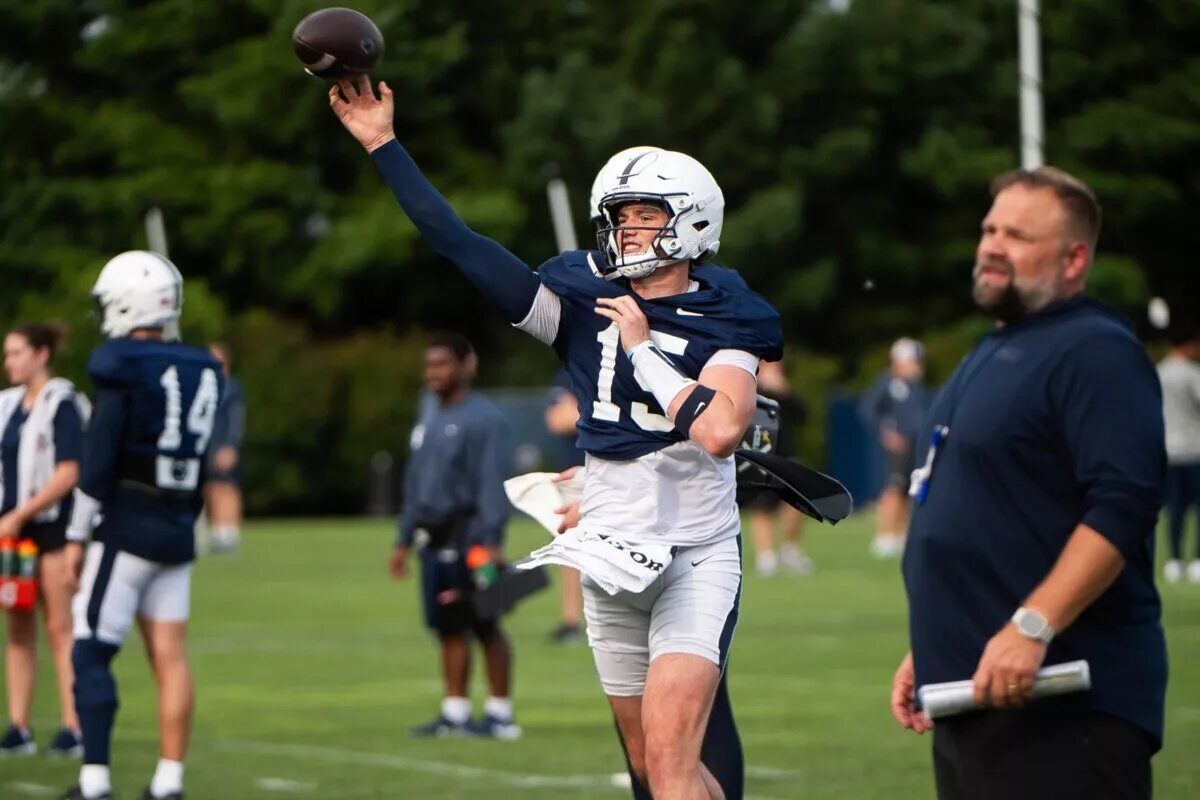
Penn State opens 2025 with championship expectations and a roster deep enough to contend. But the path is filled with potential traps, from early-season complacency to physical road battles and late-season attrition. Head coach James Franklin has assembled his deepest staff and most veteran team in a decade, and the pressure is on to make a serious playoff push. The White Out against Oregon may serve as the season’s focal point, but Penn State’s ability to dominate early, adjust midseason, and stay healthy late will determine its fate.
Early Season Urgency Must Build Competitive Readiness
Penn State opens the season with three games against Nevada, FIU, and Villanova. While the Nittany Lions will be heavy favorites in each, the challenge is not about winning. It is about preparing a playoff-caliber roster for the first Power Four test of the season when Oregon arrives in Beaver Stadium on Sept. 27. How do you prepare for that level of speed and physicality when the first four weeks include no Power Four opponents and a mid-month bye? That is the central concern for Franklin and his staff. Every practice rep, walkthrough, and rotation must carry weight. The early schedule offers no shortcuts to game-speed reality.
Franklin emphasized that rankings and projections hold no value in August. “We want to spend our time working on the things that are going to allow us to do the things we want to do this year,” he said at Penn State media day. He also credited Chuck Losey’s strength staff for a productive offseason. “The testing numbers have backed it up. As you guys know, we have 12 years of data to compare and contrast in terms of strength numbers, in terms of speed. So that data has been impressive.”
Still, some veterans are being eased back after postseason surgeries. The staff will need to balance load management with sharpening the two-deep. The bye week must function as a final round of live prep, not as recovery time. Oregon will come in tested. Penn State must create its edge through focused internal competition and clean execution before the lights go on in Week 5.
Emotional Letdown Looms at UCLA
If the White Out is the emotional peak of September, then Oct. 4 at UCLA may be the season’s biggest psychological trap. The Nittany Lions beat the Bruins last year at home but face a much stronger roster this time, led by quarterback Nico Iamaleava. The transfer from Tennessee brings poise, arm strength, and a championship mindset.
The Rose Bowl will offer a different kind of environment. It is less hostile than the Big Ten’s rowdiest venues, but full of energy for a program hungry to make a statement. The risk for Penn State is mental. Coming off a potentially draining Oregon game, the team must recalibrate and travel cross-country with a business-like mindset. Franklin noted that the long 2024 season required offseason surgeries and managed workloads in camp. Avoiding injury setbacks while traveling west is part of the challenge. The coaching staff will rely on NFL-style logistics and player leadership to maintain rhythm and intensity.
This is the first of three true trap environments in 2025. How Penn State responds will say a lot about its mental toughness.
Kinnick Still Demands Respect
Kinnick Stadium, home to the Iowa Hawkeyes, remains one of the most difficult places to play in college football. On Oct. 18, Penn State enters a battle that will be defined by field position, discipline, and defensive pressure.
Iowa defensive coordinator Phil Parker has consistently built top-tier units that frustrate high-powered offenses. His defenses rarely miss assignments and force quarterbacks to beat them with precision. Even Drew Allar, who started against Iowa in 2023, found limited space in the passing game despite Penn State’s 31–0 win. That day, Allar completed just 25 of 37 passes for 166 yards, showing how Parker’s coverages can restrict explosive plays even in lopsided losses.
Franklin has long respected Parker’s approach. At media day, he noted that one of the reasons Penn State took a chance on transfer wide receiver Devonte Ross was his production against Iowa’s defense. “To be able to watch him make plays against an Iowa defense gave us a lot of confidence,” Franklin said.
The Hawkeyes lost several pieces to the NFL, but they remain fundamentally strong. Their linebackers are disciplined. Their safeties disguise coverages. Their front creates turnovers. For Penn State offensive coordinator Andy Kotelnicki, this game requires patience and balance. He must avoid forcing throws into windows that Parker’s unit is designed to bait.
Penn State’s improved offensive line and deeper tight end room may be the key to winning here. The Lions will also rely on a rotation of backs and controlled tempo to neutralize Iowa’s rhythm. Surviving Kinnick is never pretty. But walking out with a win could define the season’s second half.
Knowles Must Out-Scheme Hartline and Patricia
If Penn State hopes to win the Big Ten, it must solve Ohio State. The Nov. 1 matchup in Columbus presents not just a talent challenge, but a chess match between elite minds. While much of the attention falls on Ohio State offensive coordinator Brian Hartline and assistant Matt Patricia, Penn State has its answer in defensive coordinator Jim Knowles. Hired from the Buckeyes, Knowles brings familiarity and innovation.
Penn State’s defense is adapting. Franklin acknowledged that while they’ll still use the attack front and man coverage from the Manny Diaz era, Knowles is implementing more coverage diversity and linebacker reads. “There are some tweaks and that coverage diversity will be important,” Franklin said. Expect Knowles to disguise looks, mix man and zone, and trust his corners. He also made it clear: “Terry Smith has built an awesome culture in that room. Those guys are playmakers, so I’m going to set things up for them to make plays.”
Ohio State may have speed, but Penn State’s experience and flexibility on defense could be the difference if Knowles wins the battle of minds.
Staying Healthy for a Physical Finish
Penn State’s final four games include Indiana, Michigan State, Nebraska, and Rutgers. The stretch features two trap games at home and two rivalry-style tests on the road. With Indiana and Nebraska bringing physical play styles into Happy Valley, the Lions will need full strength in the trenches to survive.
Franklin emphasized the importance of depth behind the starters. “Who the three running back is going to be is going to be critical,” he said. “Who the fifth and sixth D-tackle and fifth and sixth D-end is going to be is going to play a huge part in our season.” That rotational depth will be essential as Penn State navigates a physical November. Even special teams could swing a late-season game. Coach Justin Lustig called the return unit “a deep position that’s going to show a lot of improvement.” That includes veterans like Trebor Peña and breakout candidates like Koby Howard.
If Penn State stays healthy, rotates smartly, and wins the physical battles, it will enter the postseason in playoff position.
Main Image: Dan Rainville / USA TODAY NETWORK via Imagn Images