
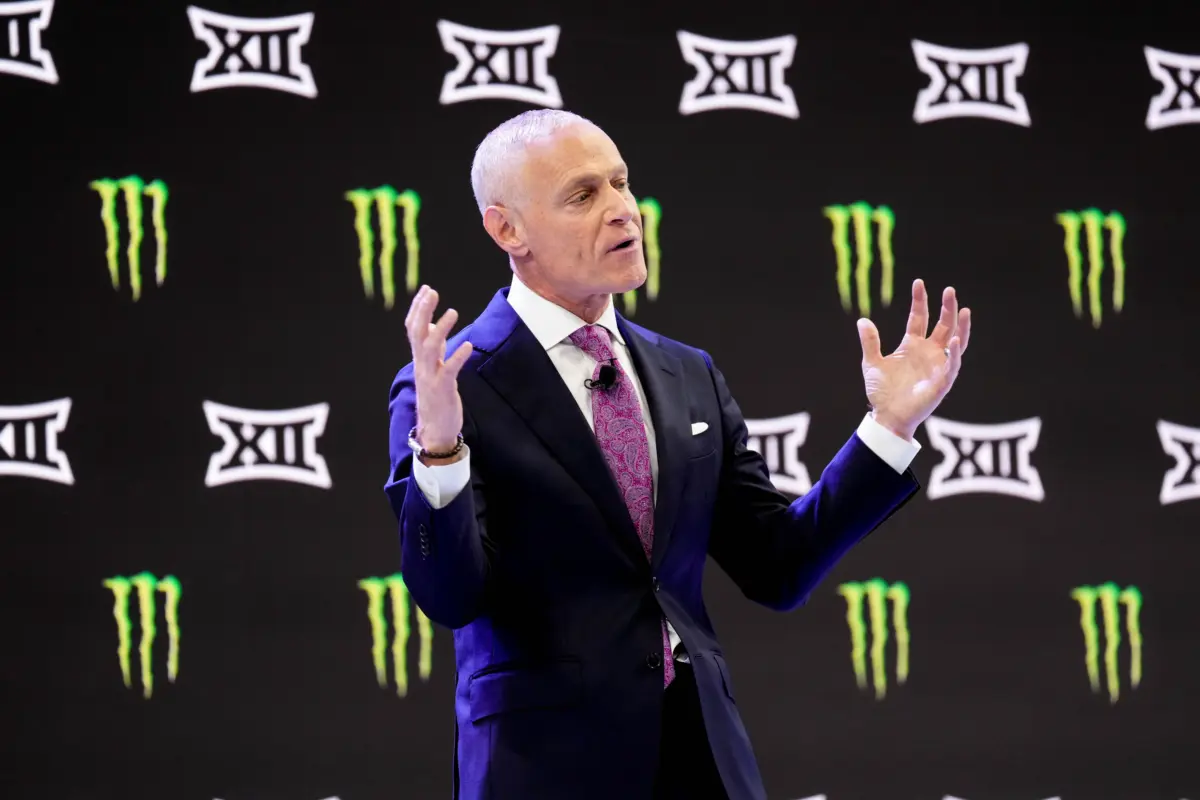

Welcome to the Monster Energy Big 12. “Unleash the beast.” That is the tagline for the energy drink that just inked a $20 million annual deal for the naming rights of Big 12 football, men’s basketball, and women’s basketball. Commissioner Brett Yormark announced the deal during the conference’s Big 12 Media Days. He views the deal as a way to expand the Big 12’s global reach and cultivate new, culturally relevant audiences.
Here are the key details of the new partnership:
- Financial Structure: The multiyear deal is valued at approximately $20 million annually, providing roughly $1 million per year to each member school. Remember, despite being the “Big 12,” they currently have 16 teams.
- Branding & Naming Rights: The conference will officially brand its regular seasons as “Monster Energy Big 12 Football” and “Monster Energy Big 12 Basketball” (covering both men’s and women’s programs).
- Uniforms & Facility Assets: Teams will wear co-branded Big 12/Monster jersey patches, and co-branded logos will be displayed prominently on football fields and basketball courts.
- Logistics: Monster Energy is absorbing all installation costs for the new branding, ensuring the $1 million annual distribution to each school remains intact and undiluted.
- Global Marketing: The agreement includes a formal commitment from Monster Energy to actively market the Big 12 brand worldwide.
The Sickos Committee captured the essence of the deal this week at Big 12 Media Days.
Living my life as the Big 12 intended pic.twitter.com/X3pf7ordLw
— Sickos Committee (@SickosCommittee) July 8, 2026
Monster Energy Big 12: Yormark’s Folly?
College football is a beast. The calculus is constantly changing. NIL and the Transfer Portal are how rosters and dynasties are built; see the emergence of Indiana and Texas Tech in 2026. It is no longer about who is a blue blood, but rather whose bank account can fund a winner.
Yormark understands that all too well. Adapt, iterate, or perish. The Big 12 was a literal and figurative dumpster fire when Yormark took over in August of 2022. Texas and Oklahoma were headed to the SEC. The rats were looking to leave a sinking ship. Yormark held fast, added four of the best teams in the American (Cincinnati, Houston, UCF, and independent BYU) in 2023, and the four corner schools (Arizona, Arizona State, Colorado, and Utah) of the then-defunct Pac-12 to stabilize the conference.
Yormark’s mantra from Day 1 has been that the conference is “Open for Business.” His partnerships with AllState, PayPal, and others have paid dividends. Yormark shared at Big 12 Media Days this week that the conference has seen a massive 182% increase in sponsorship revenue over the past year. Yormark projects a record-high gross revenue of approximately $710 million for the current year.
Despite his many wins, many in the media and on social media took victory laps on Wednesday, poking holes in the Monster Energy deal and wondering whether the deal was more folly than the juice to reenergize the Big 12.
Yormark’s Folly?
“What is Yormark thinking? Monster Energy fleeced the Big 12.” That was a sentiment among those outside the Big 12 office when the deal was announced. A lot of the ire came from those within the B1G and SEC circles. We even had an ACC coach, SMU head coach Rhett Lashlee, respond on X with the sentiment from one reaction from an SEC account: “Neither would the ACC.”
Social media and the message boards are never the place to get your expert analysis (or legal advice) on the current state of college football. But it is useful to get a pulse on the sentiments driving the conversation around the sport. Yormark and the Big 12 have been in the crosshairs for most of the Spring and summer, amid the news and information surrounding the melodrama between Brendan Sorsby and Texas Tech. At the crux of backlash around the Monster Energy Big 12 was the selling price. Yormark’s folly in the deal with Monster Energy wasn’t in selling the naming rights to the conference; it was in the price tag.
20 million dollars sounds like a lot of money. Two years ago, that was the alleged going rate for Ohio State’s national championship roster. But $20 million doesn’t buy you what it once did, and it’s just not inflation. When you look at the $20 million and divide it among the 48 teams (16 schools and their corresponding football, men’s basketball, and women’s basketball teams), the amount per team is really small. It averages about $250,000 per team. That is not even the going rate for a four-star high school recruit. So, why did Yormark make the deal?
Yormark’s Playing Chess, Not Checkers
Look at Yormark’s realignment deal. He added teams from across the country that fit with what he was trying to build. He knew he would not be able to entice a sitting B1G or SEC team to join the Big 12. It was also unlikely that he was going to pry an ACC team away, at least for the long term.
So, instead, he took the best of the G5 and the burning mess that was the Pac-12 and built a strong conference that positioned itself to deal with the new age of college football. BYU has not CRUMBLed; instead, it has elevated its game and sees itself on the cusp of a CFB Playoff appearance. Arizona State has been to the playoffs and has one of the hottest coaches in the game. Houston has the coach, the quarterbacks, and the NIL dollars to see if they can make as much noise on the field as that team in West Texas.
We don’t understand all the when or how of the Monster Energy Big 12 coming together, but time will tell if Yormark’s folly will pay dividends to his schools.
Main Photo: Raymond Carlin III-Imagn Images