
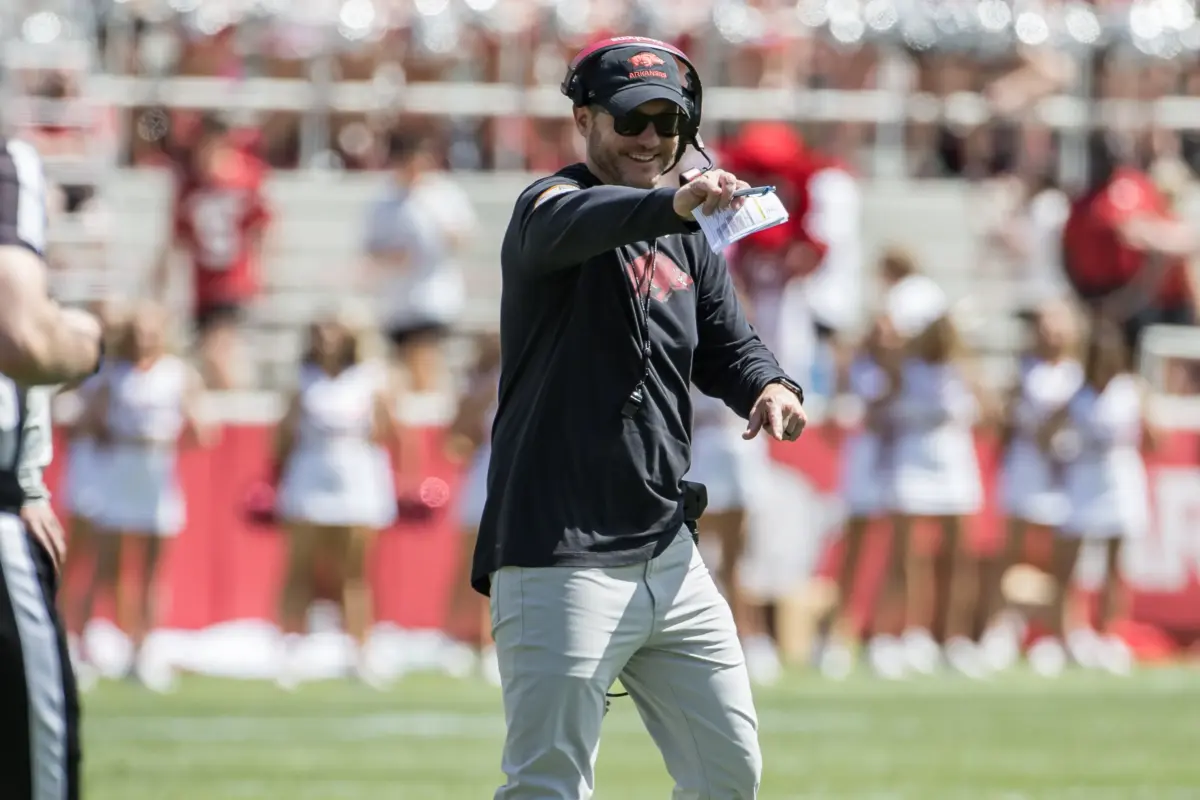

Looking inside the Silverfield blueprint. When Arkansas hired Ryan Silverfield away from Memphis, it was not just hiring a play-caller or a recruiter. It was hiring a builder. That matters for a program that has cycled through ideas, coordinators, and identities without ever really settling on what Razorback football is supposed to look like in the modern SEC. Silverfield arrives with a clear sense of how he wants to construct a roster, organize a staff, and run the program day to day. The question is whether that blueprint, proven in the American, can hold up under the pressure and physicality of the SEC.
The Silverfield Blueprint
The Résumé
At Memphis, Silverfield went 50–25 as head coach, won multiple bowl games, and helped keep the Tigers nationally relevant in an era when many Group of Five programs were treading water. He did it by leaning on continuity, experienced coordinators, and an approach that blended old-school line-of-scrimmage emphasis with a willingness to adapt offensively to his quarterbacks and skill talent. That résumé is part of what attracted Arkansas—and part of why expectations exist right away, even with a battered roster.
A Staff That Tells You the Plan
You can tell a lot about a head coach by the staff he chooses. Silverfield’s first Arkansas staff looks like a direct extension of his philosophy rather than a collection of random big-name hires.
Offensively, he brought Tim Cramsey with him from Memphis, where Cramsey coordinated an attack that routinely ranked among the nation’s the scorers. That hire says Silverfield wants familiarity and shared language on that side of the ball. He is not interested in burning a year teaching everyone a brand-new system when he already has a play-caller who knows exactly how he thinks. It is a “move fast without being reckless” choice.
On defense, the Razorbacks turned to Ron Roberts, a veteran coordinator with stops at Baylor, Florida, Auburn, and Louisiana. Roberts is known for an aggressive, multiple approach, one that thrives on disguised pressure, mixed fronts, and defensive backs who can handle man coverage. Pairing him with co-coordinator and secondary coach Deron Wilson, plus assistants like Kynjee’ Cotton in the run game and Marcus Johnson with the offensive line, gives Arkansas a staff that blends new voices with some continuity. It also reflects Silverfield’s belief that you cannot fake toughness. You have to coach it, demand it, and scheme for it every week.
This is not a staff built to hang on simply. It is a staff built to attack.
Competition Over Comfort
One of the most revealing early messages from Silverfield has been his insistence that there is “no depth chart” in spring. On the surface, that sounds like standard coaching talk, a way of keeping everyone motivated. In Arkansas’ case, it carries more weight because very few positions have earned the right to be locked in. After a two-win season and a wave of roster turnover, penciling in returning starters for the sake of stability would send the wrong signal.
Silverfield is instead leaning into competition. Every spot is contested. Every player is under evaluation. That fits with what he has said publicly about roster building in the NIL and portal era—he expects coaches to know their players, to keep developing them, and to be honest about where they stand. If a transfer is better, he will play. If a homegrown player earns the job, he will not be blocked by a portal arrival. The blueprint is about building a program where performance, not politics, determines the lineup.
That approach will be tested quickly. It is easy to talk about open competition; it is harder to sit as an upperclassman or a name the fan base recognizes. But if Silverfield follows through, he will send a message that should resonate in the locker room: do your job, and you will see the field.
Building Something That Lasts
Ultimately, Silverfield is trying to do more than survive the 2026 schedule. He is trying to reset how Arkansas operates. The blueprint is clear enough: physical at the line of scrimmage, flexible and quarterback-friendly on offense, aggressive and detail-driven on defense, and relentless in competition.
For that to matter, it has to show up in real games. The Razorbacks do not need to win 9 or 10 games this year to validate the hire. They do need to look more organized, more stubborn, and more consistent, especially against teams in their weight class. If Arkansas looks like a tougher out, if the coaching decisions make sense, and if the roster starts to reflect a real developmental pipeline rather than a patchwork, fans will see the outline of a program being built, not just a team trying to survive.
In a league that rewards clarity and punishes confusion, having a blueprint is not optional. It is the only chance Arkansas has to move from “scrambling” to “building.” Year one will show how committed Silverfield really is to the long-term picture—and how quickly that picture can start to come into focus.
Main Photo: Brett Rojo-Imagn Images