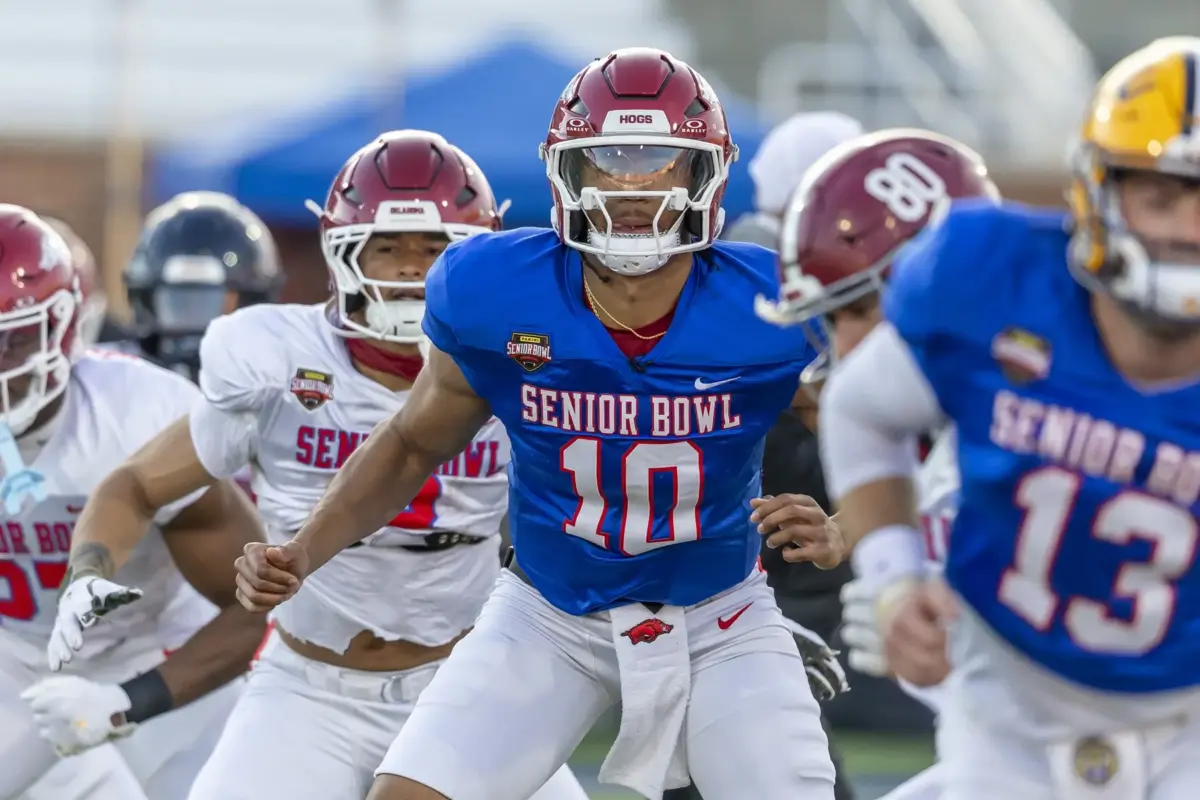

College sports have changed, and they have changed faster than Arkansas did. The transfer portal is in constant motion, NIL has turned promises into contracts, and rosters are now one-year bets instead of five-year plans. In that environment, the 2026 NFL Draft dropped a hard truth. That is, Fayetteville, Arkansas, has no excuse anymore.
Arkansas Has No Excuse Anymore
Even in chaos, even after a broken season, Arkansas still sent a real group of players to the league. Running back Mike Washington, Jr. went in the fourth round to the Raiders at 122. Quarterback Taylen Green went in the sixth to the Browns. Cornerback Julian Neal went 99th overall to the Seahawks in the third. Defensive tackle Cam Ball signed an undrafted free agent contract with the Colts. Linebacker Xavian Sorey, Jr. signed an undrafted free agent contract with the Raiders. . Names being called at the next level of the sport just showed Arkansas what is possible here. The only fair question now is what Ryan Silverfield is going to do with that information.
The Draft Class That Exposes The Excuses
For years, Arkansas has leaned on context. Tough league. Even tougher schedule. Nearly impossible rebuild. This draft undercuts a lot of that. Washington did not arrive as a four-year homegrown star. He showed up through the portal, got one SEC season, and still went high enough that Las Vegas traded up for him. That says Arkansas can still take a talented, unsettled back and turn him into a fourth-round pick in a position market that is colder than ever.
Green walked the same path as the quarterback. One year in the program. Flaws on tape. A losing season around him. He still did enough to get a shot in Cleveland’s room, where they are already invested at the position. That tells future quarterbacks something, but it also tells the current staff something else. That is, you do not need the perfect situation to raise a player’s stock. All you need is a plan that actually fits who he is.
Neal’s story might be the most telling. Seattle has a type at corner, length, physicality, and confidence, and they saw enough of it in an Arkansas defensive back to spend a top-100 pick. Sorey and Ball are backing that up from the second level, and the interior shows this is not a one-off. In a sport where everyone claims they “can’t get dudes,” Arkansas quietly put pros at running back, quarterback, corner, linebacker, and defensive line into the draft pipeline in the same window. That does not erase the losses, but it absolutely demolishes the idea that forces outside their control doom the Razorbacks.
A Challenge To Silverfield, Not A Victory Lap
This draft cannot be treated as a happy accident. It has to be treated like an audit. Silverfield’s real work starts with questions, not celebration. Why did Washington’s skill set finally cash in here? What did the staff do differently with his usage, training, and role compared to stops before Fayetteville? How did Green, in one year, show enough traits and toughness to convince an NFL team he was worth developing? What, exactly, turned Neal from a transfer into a third-rounder, and how did Sorey and Ball keep themselves on radars through all the losing?
If those answers live only in vague language about “culture” and being “all in,” nothing will change. The new world of college athletics does not reward vagueness. It rewards programs that can look at a draft board and draw a straight line from process to outcome. That means building position-specific blueprints, not just for slogans but for recruiting, for practice, for scheme, for how players are used and showcased in the fall. Running backs should know exactly how Washington’s path will be used as a model. Quarterbacks should know what Green did and what will be demanded of them. Defenders should see the Neal, Sorey, and Ball tape and understand the standard.
Make the Most of It
This is the challenge in front of Arkansas now. The draft just proved that the ceiling is higher than the win–loss column suggests. The sport around the Razorbacks is not slowing down. Roster churn will continue. NIL battles will get uglier. Another playoff expansion will pull more attention toward the programs that adjust fastest. Arkansas can either accept that and build a new identity on top of the proof these five players just provided, or drift back into the comfort of excuses and nostalgia.
Silverfield did not create the hole Arkansas climbed into, but he is now responsible for whether the program climbs out. The 2026 draft lit up the path. It showed that, even in the middle of a mess, Fayetteville can still be a place where serious players raise their value and reach the league. If that does not become the rule rather than the exception, the conclusion will be simple. The problem was never the sport, the state, or the logo. It was what Arkansas chose to do with the chances it had. It is simple: Arkansas has no excuse anymore.
Main Image: Vasha Hunt-Imagn Images