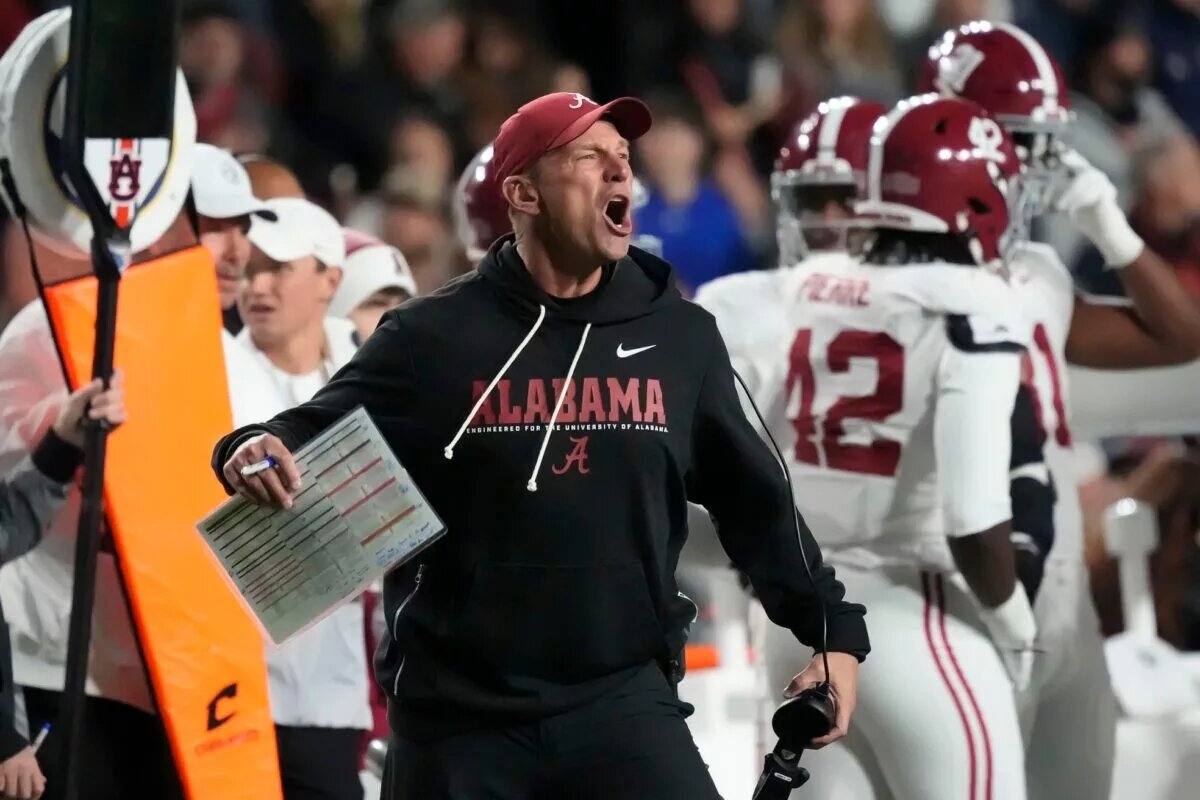

Alabama enters the SEC Championship with a clear understanding of the challenge in front of it. Georgia arrives with one of the nation’s most efficient defenses and a balanced offense built around precision, spacing, and the ability to squeeze mistakes out of opponents. Alabama has improved steadily under second-year coach Kalen DeBoer, who emphasized this week that Georgia “continues to get better as the season goes along.” The matchup in Atlanta will demand a disciplined plan on both sides of the ball. It will also require Alabama to stay true to its identity, manage situations, and play clean football.
How Alabama’s Offense Can Challenge Georgia’s Defense
Georgia’s defense remains defined by its balance and refusal to give up easy yards. The Bulldogs limit explosive plays with tight interior fits, disciplined leverage rules, and pattern-match coverage. To move the ball, Alabama must create conflict across multiple levels of the field. The offense has evolved behind Ty Simpson’s improved rhythm and Alabama’s increased use of shifts, motions, and formational variety.
Creating Horizontal Stress and Vertical Opportunities
Alabama needs to stress Georgia horizontally early to force adjustments to tempo and spacing. The Bulldogs defend downhill well, so the Tide must use quick-game concepts, orbit and jet motion, and perimeter screens to widen windows. When Alabama successfully creates lateral stress, it opens the door for vertical shots that match Simpson’s strengths. Georgia’s corners—Daylen Everette and Ellis Robinson—play with patience, but they can be influenced by layered route combinations and spacing adjustments. Alabama should pair its intermediate passing game with well-timed play-action to pull safeties and create middle-field voids.
Run-Game Structure and Personnel Adjustments
The run game must remain stable even with personnel challenges. With Kevin Riley ruled out and Jam Miller unlikely to play, the Tide will rely on Daniel Hill and Richard Young to carry the load. Georgia’s front closes interior gaps quickly, so Alabama must pair inside-zone with split-flow, counters, and pin-pull variations that force linebackers to declare their fits. Even modest gains matter because they maintain rhythm and keep Alabama ahead of schedule.
Protecting Ty Simpson and Managing Pressure
Protection remains the central variable. DeBoer addressed the challenge directly, saying, “You got to do what you do best. You have your identity. You hang your hat on that.” Alabama must keep the pressure predictable. Sprint-outs, moving pockets, and quick timing routes can reduce Georgia’s ability to collapse the pocket. When Alabama controls the pace of the play, Simpson becomes more comfortable and more dangerous. His legs add a layer that Georgia has not consistently faced this season. Designed quarterback runs should be used selectively to punish man coverage and occupy Georgia’s linebackers.
Perimeter Matchups and Alabama’s Path to Control
Key matchups on the perimeter could tilt the game. Isaiah Horton must win physical battles on the outside against Everette, while Ryan Williams has opportunities in the slot when Georgia shifts to pattern-match coverage. Williams’ acceleration stresses nickel defenders, and Alabama can scheme him into choice routes and crossers that force Georgia to communicate in space. If Alabama wins those one-on-ones, the offense can stay on schedule and keep Georgia from dictating structure.
How Alabama’s Defense Can Slow Georgia’s Offense
Georgia’s offense thrives on clarity and controlled aggression. The Bulldogs use varied formations to create matchups and force defenses into revealing coverage. They operate with rhythm, and they punish hesitation. Alabama must disrupt timing. The Tide defense has improved in its ability to rotate late and disguise pressure, which will be essential against Georgia’s passing game.
Stopping the Run and Controlling the Interior
The first priority is altering the throwing windows. Georgia quarterback Gunner Stockton operates with rhythm, decisiveness, and a willingness to attack the middle of the field. Alabama must close those lanes with physical reroutes and disciplined zone drops. The Tide can disrupt Georgia’s timing by mixing coverage shells and tightening underneath leverage. When Alabama forces Stockton to reset or hold the ball, the defensive front gains opportunities to win.
Stopping the run remains non-negotiable. Georgia stays patient with inside-zone, duo, and gap-scheme variations that set up Stockton’s play-action and RPO elements. Alabama must limit early-down gains to prevent Georgia from accessing its full menu of shot plays and perimeter concepts. DeBoer referenced the nature of that challenge by saying, “Georgia is a complete football team.” That balance means Alabama cannot overcommit to one phase. The front seven must maintain gap integrity, set strong edges, and finish tackles without allowing cutback lanes.
Pressure Angles, Disruption, and Space Tackling
Pressure needs to come from varied angles rather than simple edge rushes. Georgia’s protection is experienced and handles standard four-man fronts well. Alabama can disrupt structure by using simulated pressures and delayed blitzes to test Georgia’s communication. The goal is not reckless pursuit but controlled disruption that forces longer second and third-down situations. When Georgia becomes one-dimensional, Alabama’s athleticism up front becomes a sharper advantage.
Tackling in space may become the defining element of the game. Georgia creates yards after contact with disciplined receivers and physical backs. Alabama’s secondary must rally quickly and prevent eight-yard gains from turning into explosive plays. If Alabama keeps Georgia behind schedule, the Tide can tilt the field and control momentum.
Executing Identity and Controlling Situational Football
Alabama must execute a plan rooted in structure. The offense needs complementary rhythm and controlled aggression, while the defense must occupy space and alter timing. If the Tide wins situational downs, protects the football, and maintains leverage, they can dictate the style of the game.
The path is narrow but defined. Alabama has risen throughout the season by adhering to its identity. Doing so again gives the Tide its best chance to take control of the matchup and compete for another SEC title.
Main Image: Gary Cosby Jr.-Tuscaloosa News