We are going to introduce a revolutionary thought for college football. Stay with us here at Last Word. If a team has more high-level players than the team they face, they are likely to win many football games. I know that can damage the minds of many non-Blue Blood programs, but that is the reality. Specifically, having a roster filled with blue-chip recruits is a reliable indicator of who the top programs are in the country. Although the Big 12 likes to promote itself as having more parity than anyone else, it does have a significant blue-chip problem.
The Big 12’s Blue-Chip Crisis
What Is A Blue-Chip Recruit?
We are gonna borrow some corporate jargon here and do a good level set. A blue-chip recruit is a high school football player who is considered a five or four-star recruit. These are the players on an annual basis considered the best potential college football players in the country. So yes, the Jeremiah Smiths and Ryan Williams of the world grab all the headlines. But there are only roughly 30-45 of those players a year. Meanwhile, there are around 300-330 four-star recruits that make up the meat of all of the blue-chip recruits in a recruiting class. All of these highly-sought players earn their rankings by evaluations from multiple national recruiting services.
Before everyone gets up in arms about the incredible development of a 1/2/3 star recruit that has come through their program, let’s take time to acknowledge what recruiting is. It is an inexact science to try and predict what these players will be at the next level after high school and possibly in the NFL. And while it can have swings and misses on individuals (both good and bad), these recruiting rankings are a good guiding light when viewed on the aggregate.
What Is The Blue-Chip Ratio?
Bud Elliot of CBS Sports created the blue-chip ratio back in 2013. That revolutionary idea we rolled out in the introduction. Bud has quantified it in a way that has been 100% accurate since its creation. The ratio states that a team must have signed more blue-chip recruits than non-blue-chip over the four previous recruiting cycles. If a team has over 50% recruits on its roster from those recruiting cycles, they have enough baseline talent to win a national championship. Every single national championship winner has met this threshold in the modern era.
It is worth noting that Bud does not factor transfers into his equation. We would argue that Bud is correct in keeping transfers out for a few reasons. One, consistent high school recruiting is the fundamental building block elite teams do annually. Two, teams have adjusted their NIL strategy to retain blue-chip talent on their roster. They aren’t breaking the bank trying to bring in players via the transfer portal. Three, as Bud states in his article from this year’s list, the window to attempt to build an elite team through the portal is possibly closing (in large part due to the point about money shifting). In 2025, 18 teams clear the blue-chip ratio requirements: Notre Dame, three from the ACC, five from the Big 10, and nine from the SEC.
Big 12’s Blue-Chip Problem
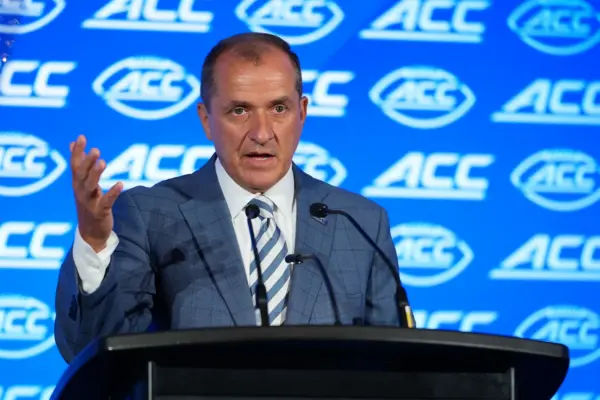
Talent acquisition is the most important factor in winning a national championship in college football. For the Big 12 to have zero teams on this list is a massive problem. Big 12 commissioner Brett Yormark has done a ton to stabilize the conference and should be applauded for it. Yormark, though, cannot recruit. The coaches need to elevate their pitches if the Big 12 wants to bring home a national championship.
Of course, Bud’s ratio should eventually not hold up simply based on the law of averages. The recipe to do so would be a team with a roster in the 40th percentile of blue chip players and have an elite quarterback. This almost happened in 2014 with Oregon and Marcus Mariota. TCU made a national championship game appearance just three seasons ago. But to win a national championship in an expanding playoff world has only gotten harder.
Big 12 teams will have to beat three or four of the teams of those 18 previously listed in order to win a national championship. March Madness Cinderellas typically don’t get past the Sweet 16 (if Cinderella even appears at the dance). George Mason found its way to the Final Four in 2006, and Butler came one half-court prayer away from winning it in 2010. But that is only two instances in 40 years of the bracket being played out ever since it expanded to at least 64 teams in 1985. Based on those results, the Big 12 only has a 5% chance of ever getting a team into the national championship again. And then there is this quote from Bud:
“You could put together an all-star team of the top two Big 12 teams and it wouldn’t even be a title favorite. 17 teams had more players drafted than the top Big 12 team did.”
Photo Credit: Tim Heitman-USA TODAY Sports
Can It Be Fixed?
Just like JP from Angels In the Outfield said, “It could happen.” Arizona State came this close to beating Texas last year in the playoff and giving Kenny Dillingham a signature victory in just his second season. Making splashes in the playoffs is nice and all. But how can the Big 12 start competing for national titles consistently? Bud suggested one possible solution as he stated, “Texas Tech could get there in three or four cycles if it continues to spend like crazy.” Yes, Joey McGuire and company have made national headlines for their transfer portal class. McGuire talked about the offseason additions and the rising expectations during Big 12 Media Days. The Red Raiders have been seeing a surge in the high school recruiting ranks since McGuire arrived.
But focus on the part where it says “Texas Tech could get there in three or four cycles.” That means, at the very earliest, the Big 12 will not have a bona fide national champion contending roster until 2028 at the earliest. How can Texas Tech/any Big 12 team sustain that type of momentum? Resources are certainly a factor, and not every Big 12 school has the resources to compete with teams that routinely have rosters with more blue-chip recruits than not. But there are plenty that can.
Just Win Baby
The single most important thing the Big 12 can do to help shift the tide nationally for these players to flock to its programs is to win. More specifically, win their non-conference games (especially against other P4 programs) and make runs in the playoffs. Coaches have to sell proof of concept to recruits. The quickest way to do so is on the field. Specifically in 2025, the Big 12 could pick up wins against Nebraska, Georgia Tech, Auburn, UCLA, North Carolina, SMU, Iowa, Missouri, Mississippi State, Stanford, and Pitt.
For a real shift in the message to occur, the Big 12 needs to post at least a 9-2 record in those games. They will need to repeat that type of effort for the next season as well to demonstrate it wasn’t a fluke. It is quite a mountain to climb, no question. But the Big 12 has had a history of staring extinction in the face and surviving. There is no reason they can’t do it now in the new landscape of college football.
A native Texan, Andrew was baptized early on in the waters of college football. But when he witnessed Vince Young scampering into the end zone to defeat the USC Trojans in 2006, it was from his seat in the Rose Bowl he knew nothing could compete. He is a former college baseball player, proud Texas Tech graduate, and Air Force veteran. Andrew and his wife live in Maryland with their 4 kids and black lab. When not covering the Big 12, he can be frequently found tending to BBQ on his smoker on the weekends.