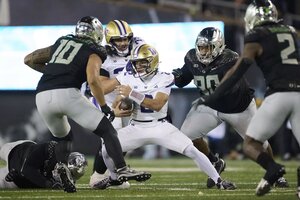

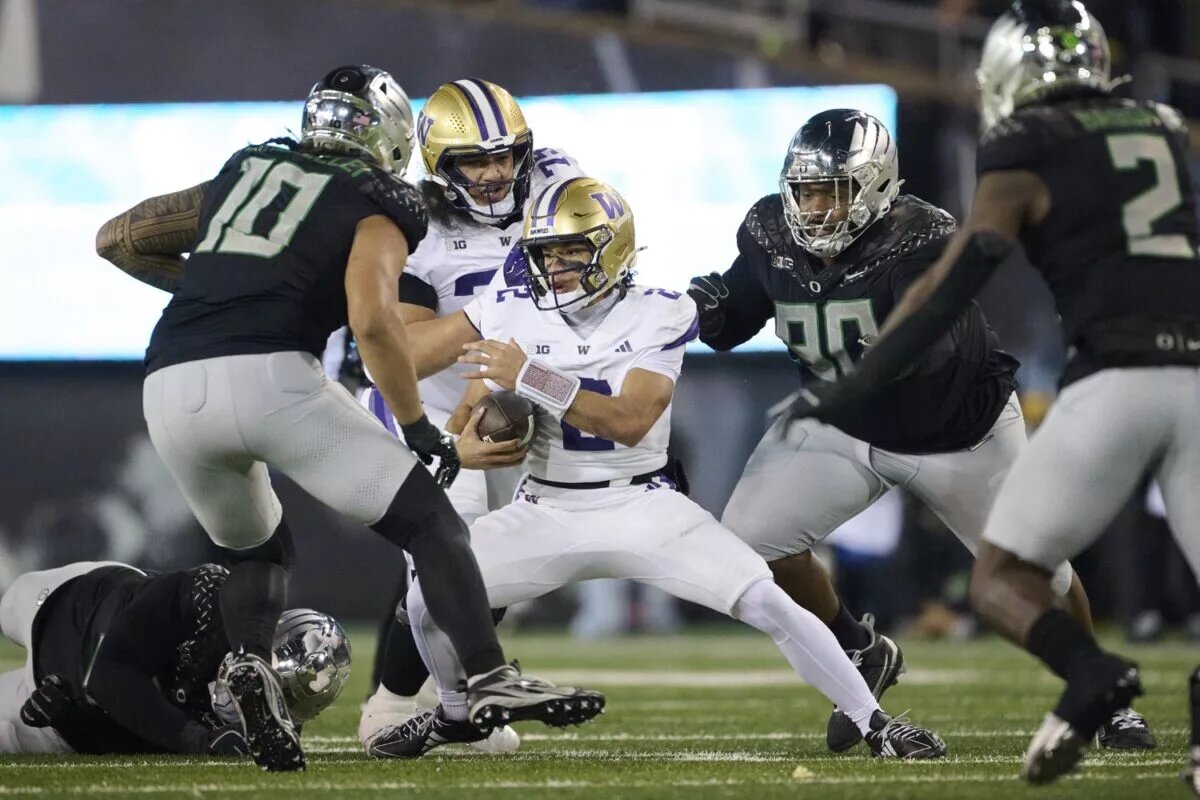

The difference in talent along the line of scrimmage on Saturday night was the separator. Oregon’s defense had its way with the Washington offensive line, creating havoc in the backfield all evening. The Ducks’ havoc rate was a remarkable 26% against the Huskies, as they tallied 10 sacks, 16 tackles for loss, and forced a fumble. Their sacks totaled -49 yards, and their tackles for loss totaled -65 yards. This performance paved the way for Oregon’s 49-21 victory over Washington.
A rivalry loss at Oregon is not an easy pill to swallow for Washington fans. But Demond Williams Jr. was handed the keys to the Husky offense in this regular-season finale. We saw flashes of what the future of this Washington football team looks like with Williams under center.
Flash of the Future for Washington in Loss at Oregon
Early Game Red Zone
Two of Washington’s first three possessions reached the red zone, but neither of which resulted in touchdowns. Red zone struggles have been a common theme this season for the Huskies, and they appeared early on in this one. Washington’s first red zone appearance was on the heels of a nine-play, 65-yard opening drive that reached the Oregon eight-yard line. But a three-yard loss on first down stifled the possession, and the offense had to settle for three points.
Two drives later, the Washington defense created a turnover. Thaddeus Dixon forced a fumble on Noah Whittington to give the Huskies the football at the Oregon 23-yard line. With optimal field position, the offense had a great look at the end zone. But after two negative plays, it had to settle for another field goal on fourth down. These two red zone appearances were not the difference in the game, but two examples of a reoccurring issue for Washington in game 12 this season.
Ducks’ Quick Separation
Grady Gross‘ second red zone field goal cut the Husky deficit to just one point. But Oregon began its next possession with premiere field position after the kickoff. Twice in the first half, Washington’s kickoff team executed a pooch kickoff. Gross has forced just 18 touchbacks this season. The lack of touchbacks has had the special teams unit looking for other ways to limit returns. They went to the pooch kick twice and as a result, Oregon’s field position early on was advantageous. With a one-point lead, the Ducks began its ensuing drive at the 46-yard line. It took just four plays to reach the end zone. Jordan James finished off that drive that lasted just 1:23 with a one-yard touchdown.
On Washington’s very next possession, Jonah Coleman took the handoff from Williams and immediately fumbled. It was difficult to tell if it was an issue on the exchange between the true freshman quarterback and the veteran running back, but Oregon jumped on it. The Ducks took just two plays to go 19 yards and extend its lead to eight.
Oregon regained possession after forcing a three-and-out on Washington’s next drive. This time, it took just three plays to go 45 yards and score its third straight touchdown. In the span of just 2:16 of game time, the score expanded from 7-6 to 28-6. From that point on, the game was out of reach for Washington.
Promising Response
There was a point in the second quarter where the Washington offense began to look like it was at a stall. Back-to-back drives ended quickly. One was a one-play fumble, and the second was a three-and-out. This was the window where Oregon extended its lead, and it began to feel like the game was out of hand. But the response from Washington following these two negative drives was an 11-play, 75-yard touchdown drive. Williams completed four passes for more than 11 yards, including a 23-yard connection with Giles Jackson. The Huskies reached the goal line with the assistance of a spectacular grab by the 6′-4″ Denzel Boston. At full extension, he snagged a bullet pass from Williams and tapped his left toe at the one-yard line. Coleman punched it in for his 10th touchdown of the season, and a two-point conversion cut the deficit to just two scores.
Ultimately, the Oregon defense was just too much for Washington’s offense. The stat line put up by the defense was substantial. Late in the game, the Huskies were out of juice. But the response that Williams and the offense put together after two disastrous drives in a hostile environment were promising signs of the confidence that this offense has.
First Start for Demond Williams Jr.
The moment was not too big for the true freshman. On the first play from scrimmage, Williams fired a 34-yard, high-arching, back-shoulder pass to Jeremiah Hunter. The Cal transfer wide receiver hauled it in on the sideline to immediately spark the offense. Williams began the game 5/5 with 54 yards. In his first start, Williams finished with 17 completions on 20 attempts with 201 passing yards and one passing touchdown coming late in the game.
The difference that Williams brings to the offense is very easy to see. Entering this game, Oregon was a team that had produced a lot of quarterback pressure. That continued on Saturday night from the Ducks. But with Williams under center, he’s able to turn some of those pressures from negative plays to zero-gain plays, or even positive plays. Williams scrambled 22 times against Oregon. If you remove the sack yards Williams had 66 rush yards.
Hunter finished the game as Washington’s second-leading wide receiver. He tallied four catches and 64 yards, as one of Williams’ favorite targets of the evening. When Hunter transferred to Washington this past offseason, much of his reps early on during the Spring were with the second team. That was in an effort to assist with the adjustment to the new offense, but it resulted in a lot of extra reps with Williams early on. It’s clear the two developed a chemistry, and the stat line reflected that on Saturday. Jackson led the team in receiving with six catches for 69 yards and the late-game touchdown reception.