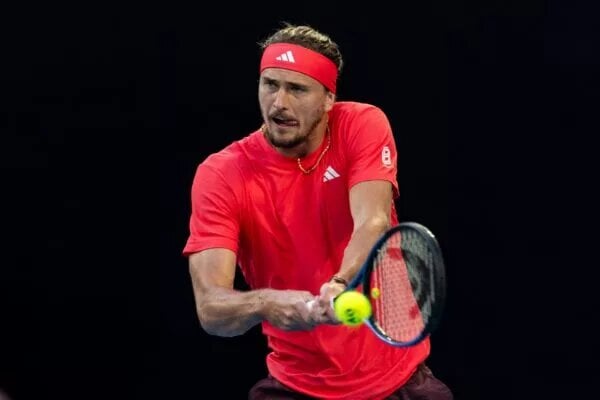


To sum up Alexander Zverev’s 2024 season, it’s enough to say that he finished ahead of a player who won two Grand Slams—Carlos Alcaraz. It was no fluke, as the German displayed incredible consistency: he reached the last 16 in all nine ATP Masters 1000 events, made the final at the French Open, won two titles (Rome and Paris), and compiled an impressive 69–21 record. Everything pointed to 2025 being his year, and his early wins—culminating in a run to the Australian Open final—seemed to confirm that.
However, it took just one loss to derail everything. That loss came against Jannik Sinner in the Melbourne final, where Zverev was beaten in straight sets. Once again, his long-awaited first Major slipped through his fingers. From that point on, he began to struggle significantly and was never able to produce tennis worthy of the world No. 2.
Missed Chances and Missteps
After the Australian Open, he made the questionable decision to play the South American clay-court swing, where he suffered disappointing losses to Argentinians Francisco Cerúndolo and Francisco Comesaña. He was also upset in the first round of Acapulco by American youngster Learner Tien.
What truly raised alarms was the fact that all of that happened after Jannik Sinner received a three-month suspension, opening a clear path for Zverev to aim for the No. 1 spot—a career-defining opportunity. Ironically, that very pressure may have contributed to a string of poor performances. Later on, he failed to reach the quarterfinals in the following Masters 1000 events he entered: Indian Wells, Miami, Monte Carlo, and Madrid.
Yes, he did win the title in his hometown of Munich, gaining both 500 ranking points and a temporary boost in confidence. But even there, he never really looked like a player who was back on track.
Zverev’s Attitude in Question
Worst of all, he doesn’t seem willing to acknowledge what he’s going through. For example, when asked in Rome about his slump, he lashed out at a journalist, accusing him of “asking stupid questions.” In Rome, he reached the quarterfinals but lost to Lorenzo Musetti in straight sets, despite serving for the first set at 6–5, 40–0. Did he take responsibility? Of course not. He blamed the balls, saying: “They were a real disaster. For someone like me, who seeks quick points with aggressive shots, it’s not easy.” He also failed to credit his opponent: “Musetti did his job, as he always does on clay—defends well and waits for the opponent’s errors.”
Zverev’s Future and the French Open
Heading into Roland Garros, Zverev is still considered one of the contenders—behind Sinner and Alcaraz, of course—but it wouldn’t be surprising to see him exit early, given his current form.
What should he do? First of all, be honest with himself. He needs to develop a sense of self-criticism, rather than constantly looking for someone else to blame. His game is certainly effective, but his tendency to play passively in key moments has cost him dearly. It’s no coincidence that he’s never taken that final step to reach the very top.
Time is still on his side—he’s only 28—but if he wants to make real progress, a change in mindset is needed.
Main Photo: Robert Deutsch-Imagn Images