
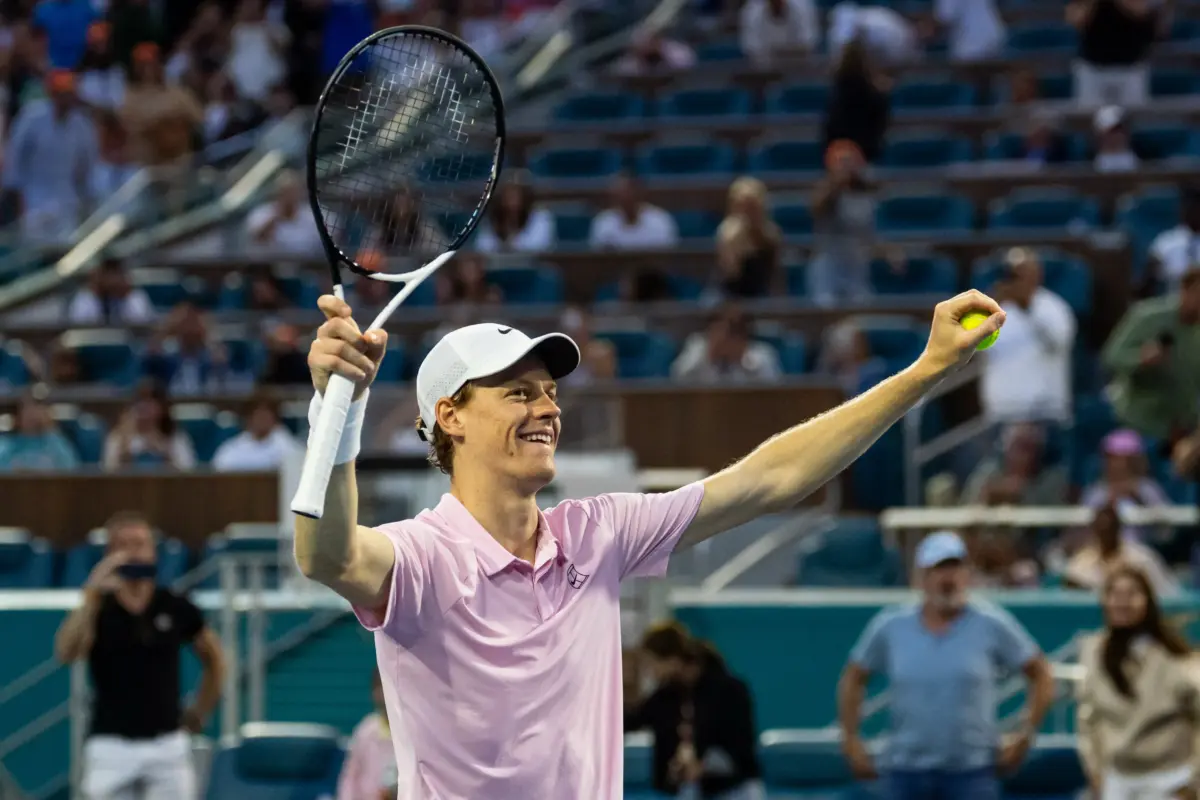

Jannik Sinner’s 2026 record through Wimbledon stands at 44 wins and three losses across 47 matches, a win rate of 93.6%. He has claimed six titles: Indian Wells, Miami, Monte Carlo, Madrid, Rome, and Wimbledon. He has reached six finals and won every single one of them.
Specifically in ATP Masters 1000 events, his record stands at 29 wins and 0 losses, a perfect campaign at the tour’s second-highest tier. He completed the Sunshine Double, winning Indian Wells and Miami back-to-back without dropping a single set, becoming the first man ever to do so. He then strung together three consecutive Masters 1000 titles. In Rome, he completed the career Golden Masters, becoming only the second man in tennis history to win all nine Masters 1000 events.
Getting tired yet? It’s been a lot, so the question worth asking, honestly, is whether Sinner’s 2026 belongs in that historic company, or whether it is simply an excellent season inflated by the recency of watching it unfold.
Is Sinner’s 2026 Season on Pace to Break Records?
How the Numbers Stack Up Against History
The benchmark for a truly iconic season in the Open Era is narrow and demanding. John McEnroe went 82 -3 in 1984, a win rate of 96.5%. Novak Djokovic’s 2011 season produced a 70-6 record and a winning percentage in the mid-90s. McEnroe himself called it the greatest in the sport’s history, built on a 41-match winning streak and a combined 10-1 record against Roger Federer and Rafael Nadal, the other two best players alive at the time. Djokovic’s 2015 season, his own individual peak by winning percentage, saw him go 82-6, a rate of 93.2%.
Sinner’s 93.6% sits comfortably inside that historical tier, ahead of Djokovic’s iconic 2015 campaign on pure winning percentage and within range of the numbers that defined 2011. His Masters 1000 dominance this year has no real historical precedent. Nobody has completed a Sunshine Double as cleanly as he did. The depth of his 2026, specifically the manner in which he has won, not merely the frequency, is arguably unmatched at that particular level of the sport.
What separates an iconic season from a merely excellent one, historically, has always come down to the majors. McEnroe’s spectacular 1984 win rate carries an asterisk precisely because he lost the French Open final to Ivan Lendl after leading two sets to love. Djokovic’s 2011 run ended at the French Open semifinals, a loss to Federer that similarly denied him a calendar-year sweep. The pattern across the sport’s most decorated seasons is consistent: even the very best years carry one significant crack, usually at Roland Garros, and what defines the difference between iconic and merely great is how large that crack is allowed to become.
The Crack in Sinner’s Own Season
Sinner’s crack arrived at Roland Garros this year, and it was not a narrow near-miss. He arrived in Paris on a career-best winning run, the outright favorite to complete the career Grand Slam, a distinction held by only six men in the Open Era. Against Juan Manuel Cerundolo in the second round, he led by two sets and 5-1 in the third, one game away from victory. Then his body gave out.
Cramping severely, he failed to serve out the contest twice, lost 18 of the final 20 games, and suffered one of the biggest upsets Roland Garros has ever produced. Where McEnroe’s 1984 crack was a five-set final defeat to a genuine rival, and Djokovic’s 2011 crack was a straight loss to Federer at the peak of his powers, Sinner’s crack was a physical collapse against an unseeded opponent in the second round of the only major that still stood between him and history.
That matters enormously in judging where this season ultimately lands. A season can still be iconic with one loss in it. Djokovic’s did. McEnroe’s did. But those losses came against elite opposition on the biggest stage available. Sinner’s loss removed him from Roland Garros before the second week had even begun, on a day when his level of tennis was good enough to win comfortably, but his body was not.
The Verdict
The season Sinner has produced at Wimbledon is, statistically, one of the finest single years in men’s tennis this century. The perfect Masters record, the Sunshine Double, the Golden Masters, the Wimbledon defense: any one of those achievements would define a good season on its own. Together, they describe a player performing at a level that genuinely belongs in the same conversation as 2011 Djokovic and 1984 McEnroe on pure output.
What keeps this season from being labeled iconic, at least for now, is the manner of the Roland Garros loss. Iconic seasons in tennis have always required either a clean sweep of the majors or a defeat that came against a worthy rival on the sport’s biggest stages. Sinner’s 2026 has neither.
With the US Open still to come, he has one more chance this year to close that gap and finish a season that, statistically, may already be historic in every category except the one that has always mattered most in deciding what gets remembered forever.
Main Photo Credit: Mike Frey – Imagn Images