
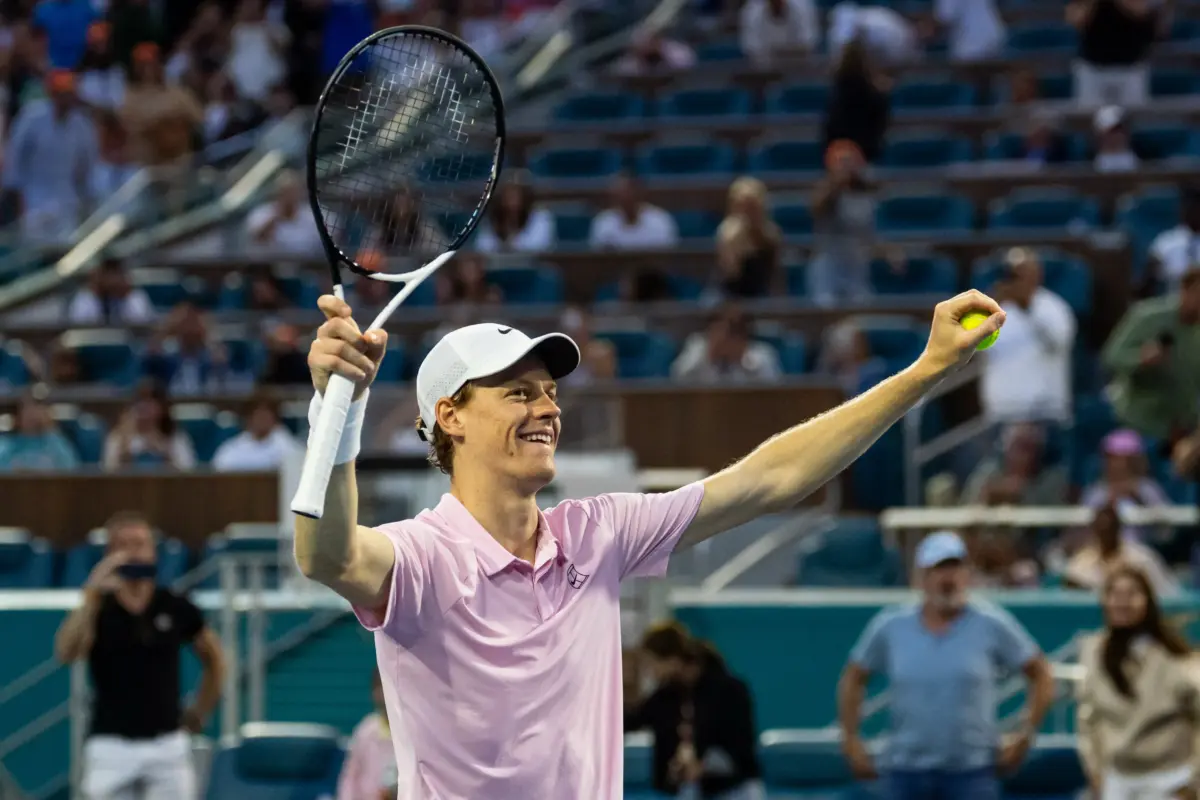

Jannik Sinner arrives at the French Open carrying the longest winning streak of his career and one of the most remarkable unbeaten runs the sport has seen in decades. With 29 consecutive match wins heading into Paris, the conversation around most consecutive wins in Open Era men’s tennis has shifted from an abstract historical discussion to something that feels genuinely, tangibly possible.
The numbers are extraordinary and the road ahead is complicated, but for the first time in a long time, the record books look nervous.
Where Jannik Sinner Stands
How He Got Here
Sinner’s current streak dates back to his opening match at Indian Wells in March. Since then he has not lost a match, winning all three clay-court Masters 1000 events in Monte-Carlo, Madrid and Rome to complete the Career Golden Masters, and becoming the first player in history to win six consecutive Masters 1000 titles. Along the way he broke records that had stood for over a decade, including surpassing Novak Djokovic’s previous record of 31 consecutive Masters 1000 victories, a run that had stood since 2011.
Since 1990 Djokovic leads with 43, followed by Roger Federer with 41, Thomas Muster with 35, Rafael Nadal with 32, Pete Sampras with 29, and Andy Murray with 28. Sinner, at 29, has now moved into sole fifth place on that list with every win he adds. The modern era record, in other words, is already within a realistic number of matches.
Catching Djokovic: The Attainable Target
Djokovic’s 43-match streak in 2011 began at the Davis Cup in December 2010 and ended when Roger Federer beat him in the French Open semi-finals in June 2011. That run, widely considered the defining stretch of tennis in the modern era, has stood untouched for 15 years. Sinner is now 14 wins away from it.
The path is straightforward on paper. The French Open draws are seven wins. If Sinner wins the title in Paris, which given Alcaraz’s confirmed absence through a right wrist injury makes him the undisputed favourite, his streak reaches 36. A warm-up tournament on grass, either Halle or the Queen’s Club event, typically runs five matches for a champion.
Win that and the streak hits 41. Win Wimbledon, another seven matches, and Sinner reaches 48, surpassing Djokovic’s mark of 43 somewhere in the middle of the fortnight at SW19. That is the clean version of the scenario and it represents a real possibility, not a fantasy.
With Alcaraz confirmed out of the French Open due to a right wrist injury, and his participation at Wimbledon also uncertain, the draw at both events loses its most dangerous variable. The player who has beaten Sinner most recently and most consistently is simply absent. That is the domino whose fall makes the Djokovic record not just plausible but likely, if Sinner stays healthy and maintains anywhere near his current level.
Chasing Borg: The Mountain at the End of the Road
Bjorn Borg’s all-time record of most consecutive wins in Open Era men’s tennis is 49 consecutive match victories, set in 1978. The streak began in the Davis Cup in March of that year and ended in the final of the US Open, where Borg was beaten by Jimmy Connors. It is a number that has survived 48 years, outlasting the careers of Lendl, McEnroe, Sampras, Agassi, Federer, Nadal and Djokovic. Nobody has come close.
For Sinner to break it, the math requires patience. French Open, seven wins: streak at 36. A pre-Wimbledon grass tournament, five wins: streak at 41. Wimbledon, seven wins: streak at 48. That gets him past Djokovic but one short of Borg at 49.
To break the all-time record outright, he would need to win his first match at either the Canadian Open in Montreal or the Cincinnati Masters in August. Win one match in Montreal and the streak hits 49 to equal Borg. Win the second and the record is his.
That is the scenario in full. It requires winning the French Open, a pre-Wimbledon warm-up event, and Wimbledon itself back to back, three consecutive titles on two different surfaces, against the best players in the world, and then winning an opening-round match at a hardcourt Masters event. Framed that way, it is genuinely difficult. Framed another way, it is a player who just won six consecutive Masters 1000 titles across hard and clay courts, and it is only asking him to keep doing what he has been doing.
The Verdict
Sinner breaking Djokovic’s record for most consecutive wins in the modern era feels less like a question of whether and more like a question of when, specifically whether it happens at Wimbledon or requires one additional tournament. The combination of his current form, the absence of Alcaraz from the French Open draw, and the uncertainty around Alcaraz’s fitness for Wimbledon creates a window that may not open this wide again.
The Borg record is harder to call.
It requires sustained perfection across three different tournaments on two different surfaces over three months, and the margin for error is zero by definition. A bad day, a tweaked ankle, one inspired opponent at the right moment, and the streak ends. Borg holds first with 49 consecutive wins which tells you how singular his dominance was and how difficult replicating it remains.
But if you had said six months ago that Sinner would arrive at the French Open having won six consecutive Masters 1000 titles and owning the record for most consecutive wins at that level, the same scepticism would have applied.
Right now, the most consecutive wins record in all of Open Era men’s tennis is not a relic from a bygone age. It is a live conversation, and Sinner is the reason why.
Main Photo Credit: Mike Frey – Imagn Images