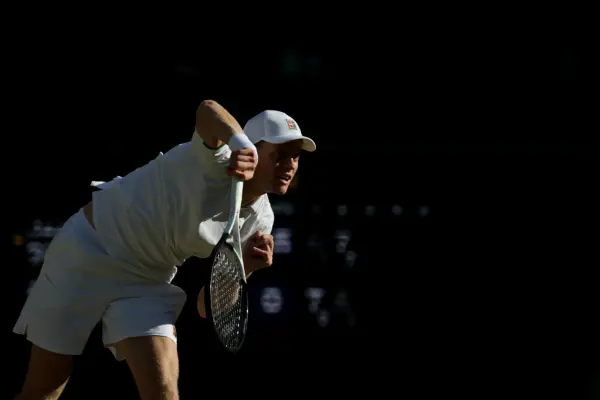



After losing a Madrid Open final 6-1 6-2 in under an hour, most players would offer an apology and quietly disappear into the locker room. Alexander Zverev sat down at the press conference and drew a map of men’s tennis in which he placed himself among the four best players on the planet. The tennis internet has not fully recovered since.
The quote, delivered after his ninth consecutive loss to Jannik Sinner, was direct enough. “I think there’s a big gap between Sinner and everybody else right now–it’s quite simple. Then there’s another gap between Alcaraz, myself, maybe Novak Djokovic, and the rest. So I think there are two gaps at the moment.” He doubled down days later when asked about it in Rome, telling the Italian Open’s official YouTube channel: “I’ve been losing to one man, but everybody has been losing to him.”
The reaction was swift. Former doubles World #1Rennae Stubbs was among the most vocal critics. “The delusion. The delusion,” she said, questioning how a player without a Grand Slam title could place himself in the same category as Alcaraz, who completed the career Grand Slam by his early twenties. Former World #1 Andy Roddick was more measured but still pushed back, saying he sees “a grouping of two and then the rest”–meaning Sinner and Alcaraz together at the top, not Sinner alone.
So was Zverev being delusional, or is there something to the claim when you actually look at the numbers?
The Case For Alexander Zverev’s Top 4 Status
Start with the ATP ranking, which is not an opinion. Zverev is the World #3. That is an objective fact reflecting results accumulated over 52 weeks, and it already puts him inside the top four before any argument begins.
Look at his 2026 Masters 1000 season and the picture gets more interesting. Zverev became just the fourth man to reach the semifinals at each of the first four Masters 1000 events of a season since the series began in 1990, joining Roger Federer in 2006 and Rafael Nadal in 2010 and 2011. That is not a modest achievement. Those are names that belong in any serious conversation about the history of the sport. Despite Sinner’s dominance in the Masters 1000 series, the player with the best results in 2026 in that category outside of Sinner himself has actually been Zverev, who reached the semi-finals of three Masters tournaments and the final in Madrid.
He also has a legitimate claim to be the closest rival to Sinner in terms of sheer consistency. Not in terms of beating him–he has not managed that in nine attempts–but in terms of getting to the final rounds week after week and consistently outperforming the rest of the field. That matters.
The ranking of Alcaraz, for all his undeniable talent, is currently sitting below Zverev’s. With Carlos Alcaraz absent from Roland Garros due to a right wrist injury, Zverev is the #2 seed in Paris. That is the concrete, points-based reality of where these players stand in 2026.
Where the Claim Falls Apart
The problem with Zverev’s framing is not that he placed himself in the top four. The problem is the specific groupings he drew, and the context in which he chose to draw it.
He was speaking minutes after one of the most one-sided finals in recent Masters 1000 history. Sinner dismantled him 6-1 6-2 in under an hour. The timing made the comments land with max awkwardness, and that was entirely self-inflicted.
More importantly, the data does not support placing Alcaraz and Zverev in the same competitive bracket. Alcaraz has won all four Grand Slam titles. Zverev has won zero. That gap is enormous. When Stubbs and others reacted strongly, this was the core of their objection, not pettiness or dismissal of Zverev’s genuine quality. A player can reach every Masters semi-final and still occupy a different category from someone who has already rewritten the Grand Slam record books at an age most players are just finding their footing on tour.
The head-to-head record reinforces this. Sinner leads Zverev 9-4 in their head-to-head series, and the Italian has won their past eight meetings in a row, a streak going back to Cincinnati in 2024. That is a clear, sustained pattern of dominance. Even more tellingly, Zverev has been beaten by Sinner in all four Masters 1000 events this season, which gives a concrete and recent data point about the distance between them.
The Djokovic inclusion also requires scrutiny. Djokovic reached the final of the Australian Open in 2026, which speaks to continued relevance at 38 years old, but his ranking at World #4 reflects a player in gradual decline from his peak. Including him as part of a de facto elite tier while Alcaraz is presumably also in that tier creates a grouping that is more about Zverev wanting company at the top than any rigorous assessment of current form.
And then there is Rome. After his bold public statements, Zverev squandered four match points against Luciano Darderi in a fourth-round defeat at the Italian Open, falling in three sets to a player ranked considerably below him. He cited possible illness and fatigue as contributing factors, which may be true, but it was a timely reminder that the gap between him and the rest of the field is not as wide as he implied.
What Roddick Got Right
Roddick’s framing was the most accurate reading of where the tour currently stands. He told his podcast that he sees two players at the top–Sinner and Alcaraz–with everyone else behind them. That structure reflects what the titles, the ranking points and the head-to-head records have been telling us for roughly two years.
Zverev at his best is genuinely elite. He has been the best player in the world outside of Sinner and Alcaraz for long stretches. He is a legitimate title contender at Roland Garros and has the serve and the baseline game to trouble anyone on a given day. None of that is in dispute. The issue is specifically the claim that he occupies the same tier as Alcaraz, and that the gap between himself and the rest of the tour is comparable to the one between the field and Sinner. The numbers disagree.
Delusional or Just Honest?
Interestingly, Roddick offered a more nuanced take on Zverev’s self-awareness than the loudest critics. He said Zverev, in private conversation, is remarkably candid about his career, acknowledging that his legacy will ultimately be defined by whether he can win the final two matches of a Grand Slam. That is not the self-portrait of a man without perspective.
What looked like delusion in the immediate aftermath of Madrid may have been closer to a player making the strongest possible case for his own relevance, in a tournament structure where perception and confidence matter. Zverev has spent much of his career being written off or treated as a permanent bridesmaid. The overcorrection, when it comes, might occasionally overshoot the mark.
The Alexander Zverev top four claim is not entirely wrong, and it is not entirely right. He is the third-ranked player in the world, he has produced the most consistent Masters 1000 campaign of anyone not named Jannik Sinner, and he is a genuine Roland Garros contender. All of that is real. But placing himself in the same competitive bracket as Alcaraz, immediately after being smashed in a final, was a swing he needed to miss.
Great players believe in themselves, often past the point that looks rational from the outside. The line between conviction and delusion is usually only visible in hindsight. For Alexander Zverev, Roland Garros is coming. That is where the argument will either be settled or dropped.
Main Photo Credit: Susan Mullane-USA TODAY Sports