

Second serve fail ATP players in two ways. It can miss entirely, a double fault, handing the point away before any rally even starts. Or it can land safely but sit up for the returner to attack, in which case it needs to at least be dangerous enough that the returner can’t do anything with it, measured by how often it goes unreturned altogether. The ideal second serve is therefore one with a low double fault rate and a high unreturned rate: it rarely misses, and even when it lands short of an ace, it’s heavy or well placed enough that the returner frequently can’t do anything productive with it.
Data from Tennis Abstract, covering the last 52 weeks, lays out exactly where every member of the ATP top 10 sits on those two measures. The gap between the best and worst is much larger than most people watching these players week to week would probably assume.
Which ATP top 10 players have the best second serves?
Here Is Where Everyone Actually Sits
Daniil Medvedev is in a category of his own, and not a flattering one. His second serve goes unreturned around 17% of the time, roughly in the middle of the pack, but he pairs that with a double fault rate above 15%, comfortably the worst of any top 10 player and a wide margin clear of the next closest name. Separate tracked data backs this up directly: over a recent 6-month stretch, Medvedev won just 41.07% of his second-serve points, a number that would be alarming for a player ranked outside the top 50, let alone a former world No. 1.
Felix Auger-Aliassime sits at the other end of the unreturned-rate scale in the wrong direction. His second serve goes unreturned only around 15.5% of the time, the lowest rate of anyone in the top 10, meaning returners handle it more comfortably than anyone else’s. He then compounds that by carrying a double fault rate above 10.9%, second worst in the group behind only Medvedev.
What makes this particularly costly for him is the contrast with his first serve, which ranks among the best in the sport by most measures. A player with a top serve and a bottom two second serve creates an enormous gap in what happens depending on which ball lands, which goes a long way toward explaining why his matches can swing from untouchable to vulnerable within the same service game.
Novak Djokovic, Alex de Minaur, and Flavio Cobolli occupy a tightly bunched, unremarkable middle tier: unreturned rates in the roughly 15.5% to 17% range, double fault rates clustered near 7% to 9%. None of these are weapons. None of them are liabilities either.
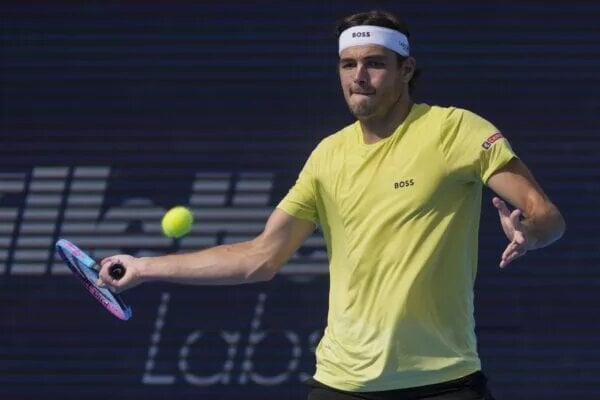
Carlos Alcaraz, Taylor Fritz, and Alexander Zverev sit a tier higher on the unreturned-rate scale, all landing between roughly 18.7% and 19.3%, with double fault rates ranging from a lean 7.1% for Fritz up to 8.9% for Zverev. This is a meaningfully more dangerous zone than the Djokovic-De Minaur-Cobolli cluster, representing second serves that do real work rather than merely surviving.
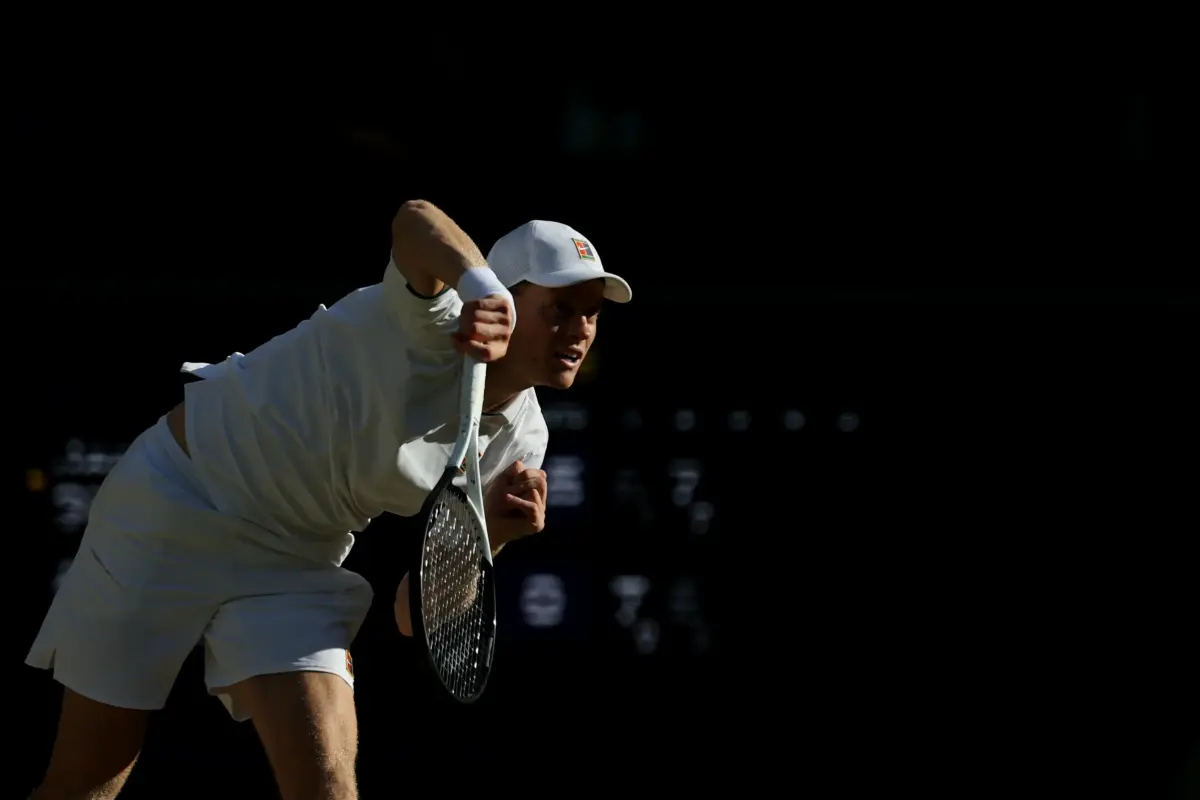
Jannik Sinner is the most efficient player in the ATP top 10. His unreturned rate, around 19.4%, is essentially tied for the best mark among players who aren’t taking on serious double fault risk to get there, and his double fault rate, just above 6%, is comfortably the lowest of anyone in the top 10.
That is the profile of a serve doing maximum damage for minimum risk, and it lines up with reporting that Sinner deliberately reworked his service motion over the past year specifically to extract more from both deliveries. The result: he became the first man since ATP record-keeping began in 1991 to lead the tour in both service games won and return games won in the same season.
Ben Shelton stands alone at the extreme end of unreturned rate, sitting around 22%, roughly three full percentage points clear of anyone else in the top 10. His double fault rate, just under 10%, is not the tour’s best, but it’s a small price for a return that no other player in this group comes close to matching.
What the Numbers Actually Explain
These figures put real data behind something that shows up constantly in results but rarely gets discussed directly. Shelton’s serve looking untouchable on grass in 2026, where he’s held above 90% of the time across his matches this season, is not just a function of his first serve. A big server whose second delivery turns passive the moment the first one misses gives returners a reliable opening once every couple of games. Shelton doesn’t give them that opening, because his second serve does nearly as much damage as his first.
Medvedev’s numbers explain the flip side of that same coin. A grinder’s entire game is built around surviving long enough to make an opponent break first. That approach requires a second serve that at minimum doesn’t hand away free points, and Medvedev’s currently does, at a rate no other top 10 player comes close to matching. It is the clearest statistical explanation available for why his hold percentage remains modest relative to his ranking despite perfectly good underlying numbers elsewhere, including a first-serve win rate north of 75% and an ace rate that has actually improved over the past year.
And Auger-Aliassime’s gap between his first and second serve numbers is the most specific, fixable-sounding problem on the entire list. It’s a technical problem, and unlike Medvedev’s, whose second-serve issues appear tied to broader patterns in his game that have proven durable and hard to shift, Auger-Aliassime’s second serve looks like the single clearest lever available to actually close the gap between his ranking and his ceiling.
Main photo credit: Geoff Burke-Imagn Images