
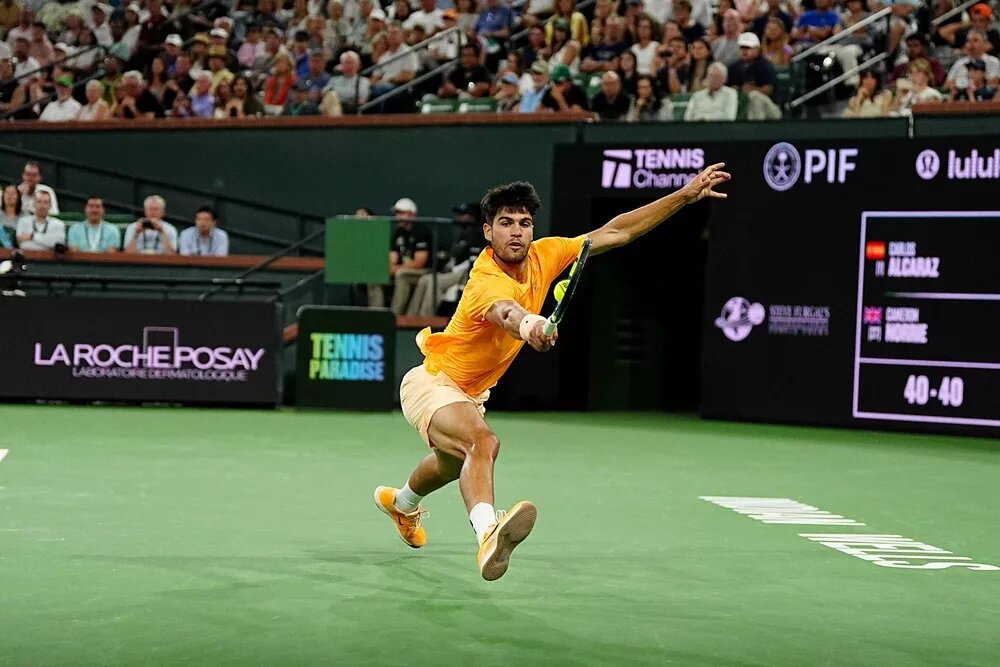

When Carlos Alcaraz arrived at the Laureus Sports Awards wearing a brace on his right wrist, most people were still hoping it was a precaution. On April 24th, he confirmed what many had feared, announcing he would miss both the Italian Open in Rome and Roland Garros while awaiting further evaluation on the injury’s progress. For a player who had won back-to-back French Open titles and recently became the youngest man in history to complete the career Grand Slam, the absence is not merely inconvenient. It is a stoppage to his momentum that the sport’s most compelling player kind of can afford but what will it cost him? That’s the tricky part. To understand, it helps to look at the men who came before him and what the wrist took from them.
A Fragile Design Under Extreme Load
The wrist is not built for what modern tennis demands of it. When a racket strikes a ball, the wrist absorbs all the force generated by the rest of the body, with the ulnar side being the most vulnerable because it has fewer bones than the thumb side. It leaves the free-floating ligaments beneath the pinkie particularly susceptible to damage. Elite servers are now generating rotational velocities that specialists describe as approaching the limits of human physiology, and the wrist sits at the end of that chain, absorbing whatever the shoulder, trunk, and arm have produced.
Research published in the Sports Medicine Journal found that wrist injuries now account for a greater proportion of 21st-century tennis injuries than in previous eras, in some cases outstripping more traditionally injured areas like the lower back and shoulder. The grips and stroke mechanics of the modern game, with their extreme angles and heavy topspin production, have made the wrist a site of chronic stress. The semi-western and western forehand grips, now ubiquitous at the top of the Tours, are specifically associated with injuries to the ulnar side of the wrist, including the dislocations and degeneration of the extensor carpi ulnaris tendon. Alcaraz’s game is built on precisely that kind of forehand.
The most commonly injured structure is the triangular fibrocartilage complex, the TFCC, which functions something like the wrist’s equivalent of a knee meniscus. It helps stabilize the small carpal bones and the ulna, aiding grip and forearm rotation, and can be injured through overuse or through the specific demands of grip type. Depending on severity, treatment can range from anti-inflammatory medication and rest all the way to surgery, and full recovery can take up to four months when an operation is involved. The complication that makes wrist injuries particularly treacherous is that the structure of the joint means returning too quickly rarely stays quiet. It tends to make itself known again.
The Shadow of Precedent
No career in tennis illustrates this more painfully than that of Juan Martin del Potro. After winning the 2009 US Open in one of the most extraordinary upsets the sport had seen, del Potro’s wrist became the defining story of his career, eventually eclipsing everything else. He underwent four wrist surgeries in total: one on his right wrist in 2010, followed by three on his left wrist between 2014 and 2015. Those years did not just cost him tournaments. They cost him his ranking, dropping him outside the top thousand at one point, and they cost him something less quantifiable: the chance to see what he might have become in an era without the Big Three’s stranglehold. After returning, he was forced to rebuild his game around protecting his wrist, significantly reducing the pace of his two-handed backhand and adopting a one-handed slice he openly admitted was not his natural game. He adapted brilliantly. He also never won another major.
Rafael Nadal offers a different kind of warning. In May 2016, Nadal withdrew from the French Open due to a left wrist injury caused by extensor carpi ulnaris tendinitis and a possible subsheath tear, an injury that had been robbing him of the ability to hit his signature topspin forehand without significant pain. He had shown no outward signs of distress in his first two matches, which made the announcement all the more shocking for those who witnessed it. Nadal also skipped Wimbledon that year, struggled through the remainder of the hard court season, and finished without a title on that surface for the year. It was not the end of his story, of course, but it was a reminder that even the most physically resilient players are not immune to what the wrist can do when it is pushed past a recoverable point.
What makes these cases relevant to Alcaraz’s situation is not that his career is in jeopardy. It almost certainly is not. But the wrist does not forgive shortcuts in recovery, and the temptation to return early, to chase a Wimbledon or a US Open title before the joint has fully settled, is one that has caught out more than one player who believed they were ready before they were. The history of the tour is full of players who rushed back and then had to leave again.
A Reason to Feel Optimistic
Alcaraz is 22 years old. He has already won seven Grand Slam titles, completed the career Grand Slam faster than any man in history, and demonstrated a physical resilience and mental clarity that his contemporaries can only admire. His own statement was measured and pointed forward: “This is a difficult time for me, but I am sure we will come out of it stronger.” Alcaraz understands that sport runs long and that time spent recovering properly is not time lost. Wimbledon is not far away. And when Alcaraz returns, the clay, the hard courts, and the grass will all be there waiting.
Main Photo Credit: Taya Gray/The Desert Sun / USA TODAY NETWORK via Imagn Images