
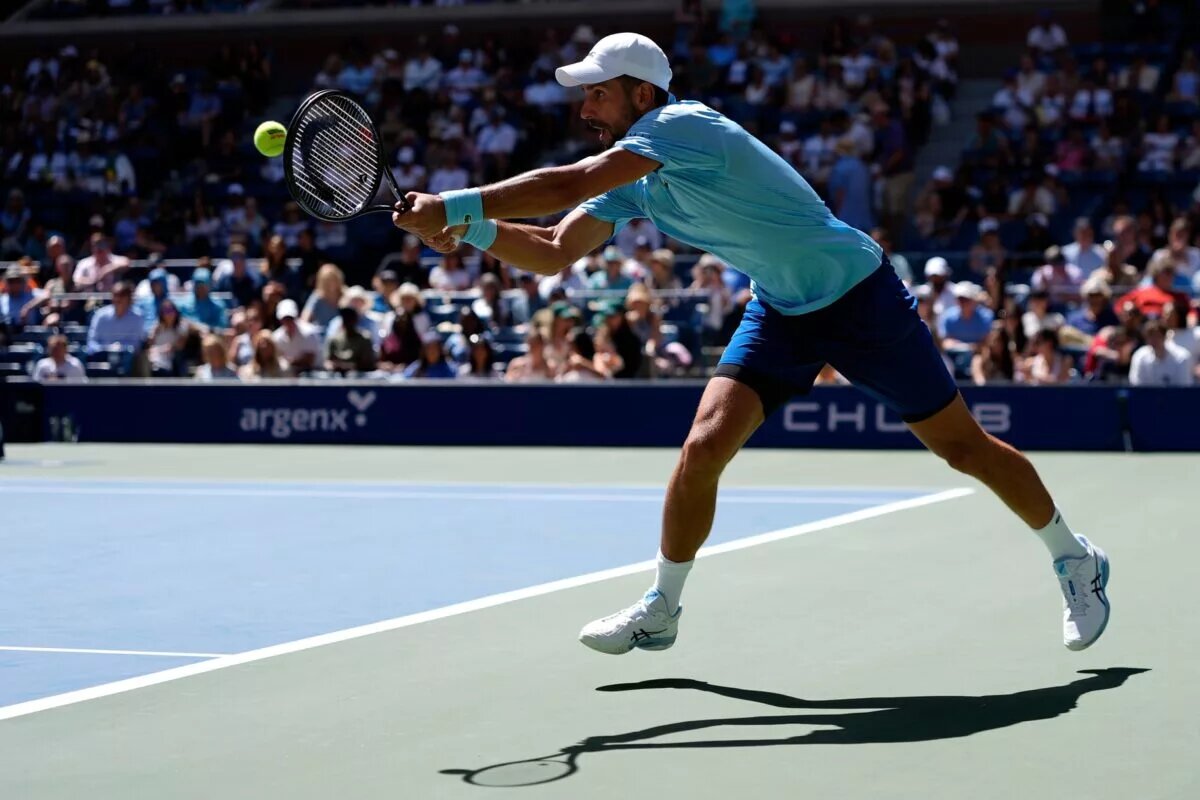

The men’s draw at the 2026 Australian Open had produced high-quality tennis throughout the fortnight, but relatively few epics heading into the semifinals. The four quarterfinals were largely clean, straightforward contests, with one major exception: Lorenzo Musetti’s heartbreaking injury, which prematurely ended his match against Novak Djokovic despite Musetti holding a two-set lead.
Heading into the semifinals under brutal temperatures, the four highest-ranked players in the world were set to square off. Most fans, however, expected a familiar rivalry to emerge once again in the final — Carlos Alcaraz vs. Jannik Sinner. What transpired instead was a day that feels destined to become the subject of tennis documentaries for years to come.
Carlos Alcaraz’s Mental Fortitude to Overcome Cramping (and Alexander Zverev)
In punishing conditions, Carlos Alcaraz was attempting to finally reach an Australian Open final. The 22-year-old Spaniard had lost four times previously in Melbourne — more than at any other Grand Slam — despite having already won multiple titles at every other major.
For Alexander Zverev, long burdened with the label of “the best player never to win a Grand Slam,” this semifinal felt like his clearest opportunity yet. At 28, he was trying to reach another Australian Open final and finally convert one of his three prior Grand Slam final appearances into a title.
Zverev had not been playing flawless tennis leading into the semifinal, but his power and ability to dictate rallies ensured Alcaraz would be tested. What unfolded, however, became less about Alcaraz versus Zverev and more about each player battling himself.
Alcaraz’s first two sets were defined by composure under pressure. He broke to take the opening set, while vomiting from a stomach ailment, then broke back when Zverev served for the second. Winning the ensuing tiebreak gave Alcaraz a two-set lead, and Zverev’s chances appeared to be fading rapidly.
Zverev’s Revived Hopes Dashed by Alcaraz’s Calm Fight
Those hopes were revived only when Alcaraz began suffering from leg cramps in the third set. Given a second life, Zverev nearly squandered it immediately. Even with limited mobility, Alcaraz was firing winners from a static stance, repeatedly threatening to end the match despite diminished serve power and reduced spin. At one point, he stood just three points from victory.
Zverev eventually steadied himself enough to claim the third set and force a fourth, pushing the match toward a decisive fifth. Visibly angry and flustered — particularly as Alcaraz received treatment that he may have not been entitled to under the rules of the game — Zverev began playing down to an injured opponent. Alcaraz’s physical limitations clearly seeped into Zverev’s mind.
Alcaraz’s Refusal To Retire
Alcaraz refused to retire. He played through the pain, trusting that persistence would bring reward. Zverev never quite solved the puzzle of finishing off a compromised opponent, as both players probed for weaknesses but ultimately didn’t find many. Strong serving carried him through a fourth-set tiebreak in which there were no breaks, and he secured an early break in the fifth — only to hand it back while serving for the match. A show of mental weakness from Zverev that has defined his career.
From that moment, Zverev’s collapse felt inevitable. A player with all the physical tools required for greatness once again fell short mentally, while Alcaraz leaned on the decisive edge he has shown throughout his career. Their rivalry remains close on paper, but on this night, the difference in belief was unmistakable.
No one knows the physical condition Alcaraz will bring into the final, but mentally he arrives undefeated. Zverev, meanwhile, is left wondering what more he must do to win a Grand Slam, particularly if his path requires defeating any combination of the current “top three”: Alcaraz, Sinner, and Novak Djokovic.
Zverev’s greatest opponent was himself. Alcaraz’s calm tenacity produced a match that will be replayed during rain delays, late-night tennis television, and off-season retrospectives for decades. This was not about pristine shotmaking; it was about grit, endurance, and human struggle. The crowd never lost faith in Alcaraz — and he never lost faith in himself. Post-match, Alcaraz said:
“Believing. Believing all the time. I always say that you have to believe in yourself no matter what struggles you’re going through. You gotta still believe in yourself all the time. I was struggling in the middle of the third set. Physically it was one of the most demanding matches I’ve ever played in my short career. But I’ve been in these kind of matches before so I knew what I had to do.”
Novak Djokovic Turns Back the Clock When It Matters Most
Fans were already emotionally drained after watching Alcaraz transform from a near-routine winner into a player in deep physical distress, only to surge back in the fifth. What followed was Jannik Sinner versus Novak Djokovic.
Sinner, a two-time Australian Open champion, entered brimming with confidence against the 38-year-old Djokovic. Their head-to-head stood level at 5–5, but Djokovic had not beaten Sinner since 2023 and had reached the semifinals aided by retirements in the previous rounds. Jakub Mensik was unable to take the court, while Musetti had been playing some of the best tennis of his career before injury struck — a match Djokovic himself admitted he was losing.
With rumors of a foot blister hindering his movement and widespread belief that Djokovic’s prime had passed, much of the “smart money” was on a Sinner victory. But this was the Australian Open — the tournament where Djokovic has repeatedly found the fountain of youth. Ten of his 24 Grand Slam titles have come on Rod Laver Arena.
Djokovic played far from flawless tennis, yet delivered one of the most mentally resilient performances of his career. Over a five-set epic played deep into the night, he repeatedly clawed his way out of trouble, refusing to surrender his serve. He saved 16 of 18 break points and absorbed wave after wave of pressure before prevailing in five sets.
Djokovic’s Self Belief
Sinner did not play poorly, nor did he lack effort. This night simply belonged to Djokovic — another chapter added to a career already overflowing with memories, and one more etched permanently into Rod Laver Arena history.
Djokovic, like Alcaraz, cited self-belief as the difference maker. ”
“Well, I never stopped doubting. I’ve never stopped believing in myself.”
“There’s a lot of people that doubt me and I see there’s a lot of experts all of a sudden that wanted to retire me or have retired me many times the last couple of years. But I want to thank them all because they gave me strength. They gave me motivation to prove them wrong, which I have tonight. And for me, it’s not a surprise to be honest. I know what I’m capable of.”
That momentum will carry Djokovic confidently into the final against Alcaraz, setting the stage for a clash worthy of the chaos that preceded it. The two semifinals, played back to back, were the equivalent of watching two of the great boxing prizefights, if they had taken place on a single night. Two great champions, Alcaraz and Djokovic, were battered, but ultimately prevailed against adversity.
Has There Been a Better Day in Melbourne — or Anywhere Else?
Nearly ten hours of action at the Australian Open on Friday can credibly lay claim to being the greatest non-final day in the history of the sport. Other contenders exist, but few — if any — featured the world’s top four players pushed to such physical and mental extremes on the same day.
The 2018 Wimbledon semifinals saw Djokovic defeat Rafael Nadal 10–8 in the fifth set, while Kevin Anderson outlasted John Isner 26–24 in a fifth set that stretched across two days — the longest match in Wimbledon history.
Fans of “Fedal” will remember the 2009 Australian Open semifinals, when Rafael Nadal produced a five-set forehand masterpiece against Fernando Verdasco, while Roger Federer defeated Andy Roddick in four sets.
The 2011 US Open semifinals delivered Big Four drama as Djokovic came back from two sets down to defeat Federer, while Nadal overcame Andy Murray in four competitive sets.
That format repeated itself at the next Slam: the 2012 Australian Open semifinals saw Djokovic defeat Murray 7–5 in the fifth, while Nadal beat Federer in four. The 2021 French Open semifinals produced another historic pairing, with Djokovic upsetting Nadal on clay and Stefanos Tsitsipas edging Alexander Zverev.
All of those days were memorable. Yet in the modern television era, what unfolded in Melbourne felt different — an instant classic defined by endurance, tension, and poise under pressure. For drama alone, it stands as a compelling case for the greatest single day of men’s tennis ever played, by players who compromise the modern ‘big 3″, Sinner, Alcaraz, and an ageless Djokovic.
Main Photo Credit: Robert Deutsch-Imagn Images